

The Nature of True Opinion (Doxa): A Philosophical Inquiry
Summary: In the grand tapestry of philosophical thought, opinion (doxa) occupies a fascinating and often contentious space, distinct from both sheer ignorance and definitive knowledge (episteme). While a true opinion may align perfectly with truth, its fundamental characteristic lies in its lack of robust justification and stable grounding. This article delves into the classical understanding of doxa, exploring its relationship to truth, the role of our senses in its formation, and the perennial philosophical quest to elevate mere belief to the realm of demonstrable knowledge.
The Elusive Landscape of Doxa: What We Think We Know
From the bustling marketplace to the quiet contemplation of a scholar, we are constantly forming and exchanging opinions. But what precisely is an opinion, philosophically speaking? The ancient Greeks, particularly Plato, distinguished sharply between doxa (opinion or belief) and episteme (knowledge). This distinction is not merely semantic; it underpins much of Western philosophy's enduring quest for truth.
An opinion, at its core, is a judgment or belief held by an individual. It can be about anything – the nature of justice, the best route to the city, or the beauty of a sunset. The critical question, however, is not what we believe, but how we believe it, and on what grounds. Can an opinion be true? Absolutely. Can a true opinion be considered knowledge? Here, the philosophical journey truly begins.
Plato's Hierarchy: From Shadow to Substance
In the Great Books of the Western World, particularly within Plato's dialogues like the Meno and the Republic, we encounter a profound exploration of doxa. Plato posited a hierarchy of cognitive states:
- Ignorance (Agnosia): A complete lack of understanding or belief, often unaware of its own deficiency.
- Opinion (Doxa): A belief that may or may not be true, but lacks a firm rational foundation or justification. It's often based on persuasion, habit, or immediate experience.
- Knowledge (Episteme): A true belief that is also justified, understood, and stable. It is tied down by reason and can withstand scrutiny.
Plato famously illustrates this with the example of knowing the way to Larissa in the Meno. Someone with true opinion can guide you there just as effectively as someone with knowledge. Both arrive at the truth of the correct path. However, the person with true opinion might have simply heard it from someone, or guessed correctly, while the person with knowledge understands why that path is correct – they know the landmarks, the terrain, the underlying reasons. The true opinion, Plato argues, "is not likely to remain long, but will soon be run away with." It lacks the "tie of the cause."
The Problem of Justification: Why True Opinion Isn't Enough
The crux of the distinction between opinion and knowledge lies in justification. A true opinion, while aligning with truth, is often held without sufficient reason or understanding of why it is true.
Consider these differences:
- Opinion:
- Can be true or false.
- Often based on sense experience, hearsay, or intuition.
- Prone to change; it can be swayed by new information or persuasion.
- Lacks an account (logos) or rational explanation.
- Its truth is often accidental or unexamined.
- Knowledge:
- Must be true.
- Requires robust justification, evidence, and logical reasoning.
- Stable and enduring; it is "tied down" by understanding.
- Possesses an account (logos) – one can explain why it is true.
- Its truth is understood and demonstrated.
The pursuit of truth is not merely about holding correct beliefs, but about understanding why those beliefs are correct. This is the philosophical imperative that drives us beyond mere opinion.
The Role of Sense and Experience in Forming Opinion
Our senses are the primary gateways through which we interact with the world, and thus they play a crucial role in the formation of our opinions. What we see, hear, touch, taste, and smell informs our immediate judgments about reality.
- Empirical Basis: Many of our opinions are empirical, born from direct observation. "The sky is blue" is an opinion derived from sense data.
- Subjectivity: While the sky appears blue, the interpretation and the certainty of that belief can vary. Our individual experiences and perspectives shape our opinions.
- Limited Scope: Sense experience alone, however, is often insufficient to establish knowledge. The sun appears to revolve around the Earth, an opinion held for millennia based on direct observation, yet astronomical knowledge reveals a different truth.
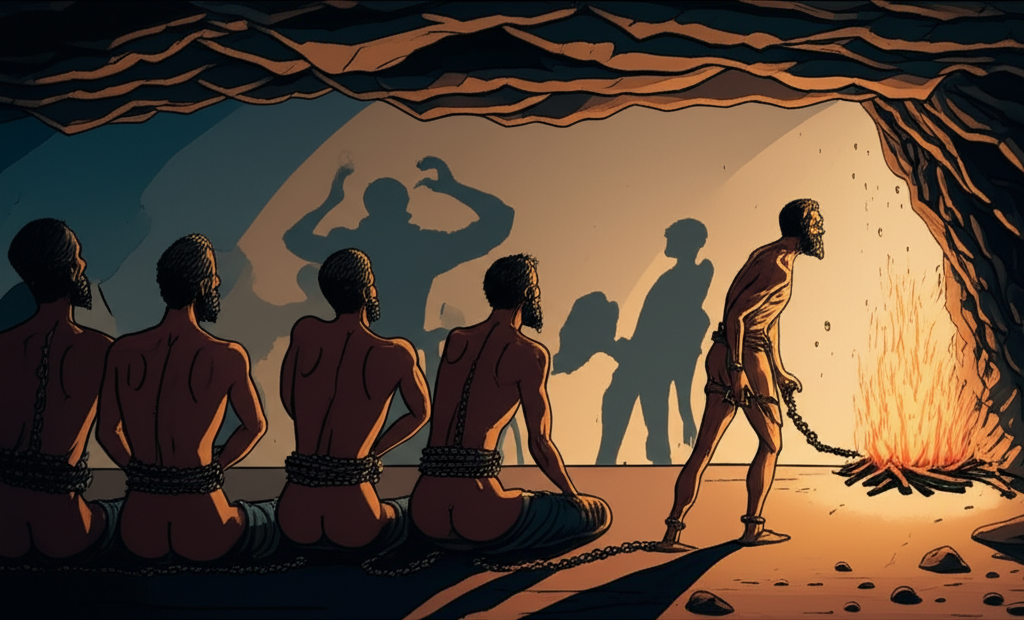 to knowledge (true forms). The light source is distinct and bright, representing ultimate truth.)
Navigating the Landscape of Belief: From Doxa to Episteme
The journey from opinion to knowledge is not a passive one; it requires active engagement with reason, critical thinking, and a relentless pursuit of truth. It involves:
- Questioning Assumptions: Examining the foundations of our beliefs, asking "Why do I believe this?"
- Seeking Justification: Demanding evidence, logical coherence, and compelling arguments for our beliefs.
- Considering Alternatives: Exploring different perspectives and counter-arguments to test the robustness of our opinions.
- Understanding Causes: Moving beyond what is true to why it is true.
This process is fundamental to philosophy and to any genuine intellectual endeavor. It is the very essence of moving beyond the fleeting nature of doxa towards the enduring stability of episteme.
Conclusion: The Enduring Value of Understanding Opinion
While doxa might seem inferior to knowledge, understanding its nature is profoundly important. It reminds us that not all beliefs are created equal, and that even a true belief can be fragile if it lacks a firm foundation. The philosophical distinction between opinion and knowledge compels us to scrutinize our own convictions, to seek deeper understanding, and to constantly strive for the justified truth that elevates us beyond mere conjecture. In a world saturated with information and competing viewpoints, the ability to discern opinion from knowledge remains a vital skill for critical thought and the pursuit of wisdom.
YouTube Video Suggestions:
-
📹 Related Video: PLATO ON: The Allegory of the Cave
Video by: The School of Life
💡 Want different videos? Search YouTube for: "Plato Meno True Opinion Knowledge"
-
📹 Related Video: What is Philosophy?
Video by: The School of Life
💡 Want different videos? Search YouTube for: "Doxa Episteme Philosophy Explained"