

The Nature of True Opinion (Doxa): A Philosophical Inquiry
True opinion, or doxa in the classical Greek sense, occupies a fascinating and often perplexing space in the philosophical landscape. It is the realm where our beliefs align with reality, yet lack the rigorous justification and understanding that elevates them to the status of Knowledge. This article delves into the classical understanding of doxa, particularly as expounded by Plato, exploring its relationship to Truth, the role of Sense perception, and the enduring challenge of distinguishing it from genuine Knowledge. We will navigate the nuanced terrain between mere conjecture and fully apprehended truth, examining why a correct Opinion can be both valuable and inherently precarious.
The Shifting Sands of Doxa: Understanding Opinion's Role
In our daily lives, we operate largely on opinion. From judging the weather to forming political stances, our beliefs, often unexamined, guide our actions. But what separates a mere opinion from a true opinion? And what further separates a true opinion from knowledge? This distinction is crucial for anyone seeking to understand the foundations of human understanding and the pursuit of Truth. The ancient Greeks, particularly Plato, grappled extensively with this very problem, recognizing that while an opinion might happen to be correct, its accidental accuracy does not imbue it with the same certainty or explanatory power as knowledge.
Plato's Doxa: More Than Just a Hunch
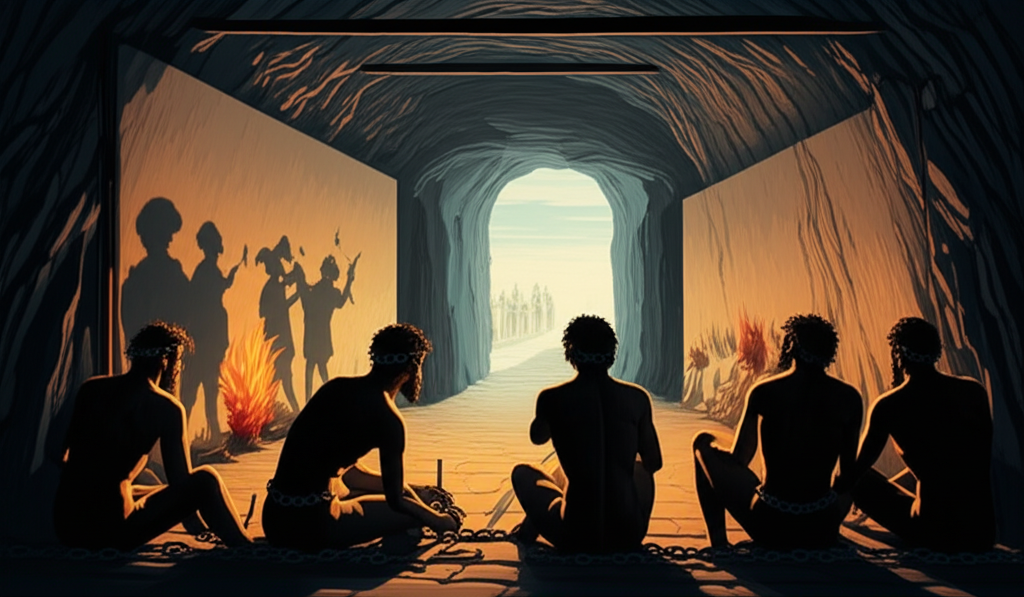
Plato, a titan among the Great Books of the Western World authors, meticulously distinguished between doxa (opinion or belief) and episteme (knowledge). For Plato, doxa is rooted in the changeable world of Sense perception and appearances, the realm of becoming rather than being. It is the understanding we derive from observing shadows, reflections, and the shifting phenomena of our physical world.
Consider Plato's famous Allegory of the Cave from The Republic. The prisoners, chained and facing a wall, perceive only the shadows cast by objects passing behind them. Their entire reality is based on these flickering images, and their pronouncements about them constitute their doxa. When one prisoner is freed and dragged into the light, he experiences the true objects, and eventually, the sun itself – a metaphor for the Good and the source of true Knowledge. His initial disorientation highlights the vast chasm between the world of opinion and the world of Truth.
Plato further elaborated this distinction with his Divided Line, categorizing modes of cognition:
- Lower Segment (Doxa - Opinion):
- Eikasia (Imagination/Conjecture): Relating to images, shadows, reflections.
- Pistis (Belief): Relating to physical objects and direct Sense perception.
- Upper Segment (Episteme - Knowledge):
- Dianoia (Thought/Understanding): Relating to mathematical objects and hypotheses.
- Noesis (Intellection/Reason): Relating to the Forms themselves, pure understanding.
This framework clearly positions doxa as a lower, less reliable form of apprehension, heavily reliant on the unreliable data of the senses.
The Paradox of True Opinion: When Being Right Isn't Enough
The most intriguing aspect of doxa is the concept of true opinion. How can an opinion be "true" yet not be knowledge? Plato explored this in the dialogue Meno. Socrates demonstrates that an uneducated slave boy can, with careful questioning, arrive at a true geometrical proposition. The boy's answer is correct, but Socrates argues that he does not possess knowledge of it because he cannot explain or justify it in a rigorous, systematic way. His correct answer is a true opinion.
The distinction lies in justification and understanding. A true opinion is like having the correct answer to a complex problem without knowing the steps or principles that lead to it. You might guess correctly, or you might have been told the answer, and it happens to be true. But if you cannot articulate why it is true, or defend it against challenges, or apply its underlying principles to new situations, then you do not possess knowledge.
Key Differences Between True Opinion and Knowledge:
| Feature | True Opinion (Doxa Alethes) | Knowledge (Episteme) |
|---|---|---|
| Accuracy | Correct; aligns with reality. | Correct; aligns with reality. |
| Justification | Lacks sufficient, robust justification or explanation. | Supported by reasons, evidence, and logical demonstration. |
| Stability | Unstable; can be easily swayed or forgotten; accidental. | Stable; "tethered" by understanding; resistant to refutation. |
| Source | Often from Sense experience, hearsay, intuition, or luck. | Derived from reason, intellectual insight, and systematic inquiry. |
| Application | Limited to specific instances; cannot derive new truths. | Generative; allows for derivation of new truths and principles. |
Aristotle's Nuance: Practical Wisdom and Endoxa
While Plato emphasized the shortcomings of doxa, Aristotle, another luminary of the Great Books, offered a slightly different perspective. He acknowledged the value of endoxa—commonly held opinions or beliefs of the wise and the many. For Aristotle, these endoxa served as important starting points for philosophical inquiry, not as definitive truths, but as positions that needed to be examined, refined, and potentially transcended through dialectic.
Aristotle also distinguished between theoretical knowledge (episteme) and practical wisdom (phronesis). Phronesis is the ability to deliberate well about what is good and advantageous for oneself and others, and it operates within the realm of the contingent and particular, often relying on a kind of refined opinion that is informed by experience and good judgment. This practical wisdom, while not the same as theoretical knowledge of eternal truths, is nonetheless a highly valued intellectual virtue.
From Sense to Truth: The Journey Beyond Opinion
The journey from relying on Sense perception and mere opinion to acquiring genuine Truth and Knowledge is the very essence of philosophical and scientific endeavor. It demands:
- Critical Examination: Questioning our assumptions and the sources of our beliefs.
- Rational Inquiry: Employing logic, reason, and systematic thought to build coherent arguments.
- Justification: Seeking robust evidence and sound reasoning to support our claims.
- Understanding of Causes: Moving beyond what is true to why it is true.
Without this rigorous process, even a true opinion remains fragile, susceptible to being undermined or replaced by a different, equally unjustified, belief. The very act of philosophical inquiry, as practiced by Socrates, was to expose the instability of unexamined opinion and to prod individuals towards a more secure foundation of knowledge.
The Value (and Peril) of Opinion in the Modern Age
In an age saturated with information, the distinction between opinion, true opinion, and knowledge has never been more critical. Social media, news cycles, and constant data streams bombard us with assertions, many of which are mere opinions, some happen to be true, and fewer still qualify as genuine knowledge.
The peril lies in mistaking a widely held opinion for knowledge, or in accepting a true opinion without understanding its basis. This can lead to intellectual stagnation, dogmatism, and an inability to adapt our beliefs when presented with compelling evidence. Conversely, embracing the pursuit of knowledge—the quest for justified true belief—empowers us to navigate complexity, make informed decisions, and contribute meaningfully to the collective understanding of Truth.
📹 Related Video: PLATO ON: The Allegory of the Cave
Video by: The School of Life
💡 Want different videos? Search YouTube for: "Plato Meno True Opinion Knowledge, Allegory of the Cave Explained"
📹 Related Video: ARISTOTLE ON: The Nicomachean Ethics
Video by: The School of Life
💡 Want different videos? Search YouTube for: "Aristotle Ethics Phronesis Practical Wisdom"
Conclusion: The Ongoing Quest for Episteme
The nature of true opinion remains a cornerstone of philosophical thought, challenging us to constantly evaluate the reliability of our beliefs. While opinion forms the bedrock of our daily interactions and initial understandings, the Great Books remind us that Truth and Knowledge demand more. They require an active, reasoned engagement with reality, a commitment to justification, and a relentless pursuit of understanding that transcends the fleeting impressions of the senses. To move beyond doxa towards episteme is to embark on the profound journey of intellectual liberation, a journey that continues to define the human quest for wisdom.