

The Nature of Time in Evolution: An Unfolding Tapestry of Existence
The intricate dance between Time and Evolution presents one of philosophy's most profound and enduring puzzles. This article delves into the philosophical dimensions of how Time shapes, enables, and is itself revealed by the grand narrative of Evolution. We explore time not merely as a linear progression but as a fundamental aspect of Nature that underpins the ceaseless Change observed in life, drawing insights from the rich intellectual heritage of the Great Books of the Western World to illuminate this complex interplay.
The Unfolding Tapestry of Existence
From the primordial ooze to the intricate complexity of sentient life, the story of existence is one of relentless transformation. Yet, what is this medium in which all Change occurs? What is the Nature of the clock that ticks through geological epochs, shaping species and ecosystems? To ponder the Nature of Time in Evolution is to engage with the very essence of being and becoming, a dialogue between the transient and the enduring that has captivated thinkers for millennia.
Time: More Than a Chronometer
Our everyday understanding of time often reduces it to a measurable, linear sequence—seconds, minutes, years. However, the philosophical inquiry into Time reveals a far more nuanced reality, especially when viewed through the lens of Evolution.
- Objective vs. Subjective Time: Is time an external, independent framework within which events unfold, or is it a construct of consciousness, an internal experience? Augustine, in his Confessions, famously pondered, "What then is time? If no one asks me, I know; if I wish to explain it to him who asks, I do not know." Evolutionary processes, however, seem to demand an objective, vast expanse of time for their gradual unfolding.
- Linear vs. Cyclical Time: Ancient philosophies often embraced cyclical views of time, where events recur. Modern evolutionary theory, however, posits a largely linear, irreversible progression, marked by speciation and extinction, leading to novel forms that have never existed before. This "arrow of time" in Evolution is crucial.
- Time as a Measure of Change: Aristotle, in his Physics, posited that time is the measure of motion and Change. Without change, time would be imperceptible. In Evolution, this relationship becomes reciprocal: time allows for change, and change, in turn, manifests time's passage.
Key Philosophical Views on Time Relevant to Evolution:
| Philosopher/School | Concept of Time | Relevance to Evolution |
|---|---|---|
| Heraclitus | Flux (Panta Rhei) | Emphasizes constant Change as inherent to reality; aligns with the dynamic nature of life. |
| Plato | Time as a "moving image of eternity" | Suggests a temporal realm imperfectly reflecting an eternal, unchanging ideal; evolutionary forms as transient reflections. |
| Aristotle | Time as the measure of motion/change | Directly links time to the processes of biological transformation and development. |
| Augustine | Subjective, present-focused time | Highlights the human experience of time, contrasting with the vast, impersonal scale of evolutionary time. |
Evolution: A Symphony of Gradual Change
Evolution is not a sudden event but an ongoing process, a continuous stream of Change driven by natural selection, genetic drift, and mutation. It is the most profound testament to the power of Time to sculpt and refine the very fabric of life.
The concept of Evolution fundamentally challenges static views of Nature. Where earlier philosophies might have sought immutable forms or essences, evolutionary thought reveals a Nature in perpetual motion, adapting, diversifying, and sometimes collapsing. This ceaseless transformation is the very essence of life's journey through deep Time.
The Nature of Change: From Potentiality to Actuality
The philosophical underpinnings of Change are central to understanding Evolution. Aristotle's concepts of potentiality and actuality offer a powerful framework. A seed has the potentiality to become a tree; an ancestral species holds the potentiality for myriad descendant forms. Evolutionary time is the medium through which these potentialities are actualized, through which genetic variations become established traits, and new species emerge.
This is not a random walk; rather, it is a cumulative process where slight advantages, conferred by genetic Change, are preserved and amplified over generations. The Nature of this Change is incremental, yet its aggregate effect over millions of years is nothing short of breathtaking.
Time's Arrow and Life's Trajectory
One of the most striking features of Evolution is its apparent directionality, often termed "Time's Arrow." While individual mutations are random, natural selection imposes a direction, favoring adaptations that enhance survival and reproduction in a given environment. This leads to an irreversible progression. A species, once extinct, cannot be precisely recreated.
- Irreversibility: The unique sequence of genetic mutations, environmental pressures, and historical contingencies that define an evolutionary path means that the past cannot be revisited. This irreversibility is a hallmark of time itself in the physical universe, and it is profoundly manifest in life's history.
- Emergence of Novelty: Over vast stretches of Time, Evolution gives rise to entirely new forms, functions, and levels of complexity. The emergence of multicellularity, consciousness, or flight represents profound qualitative leaps, all facilitated by the relentless march of Time.
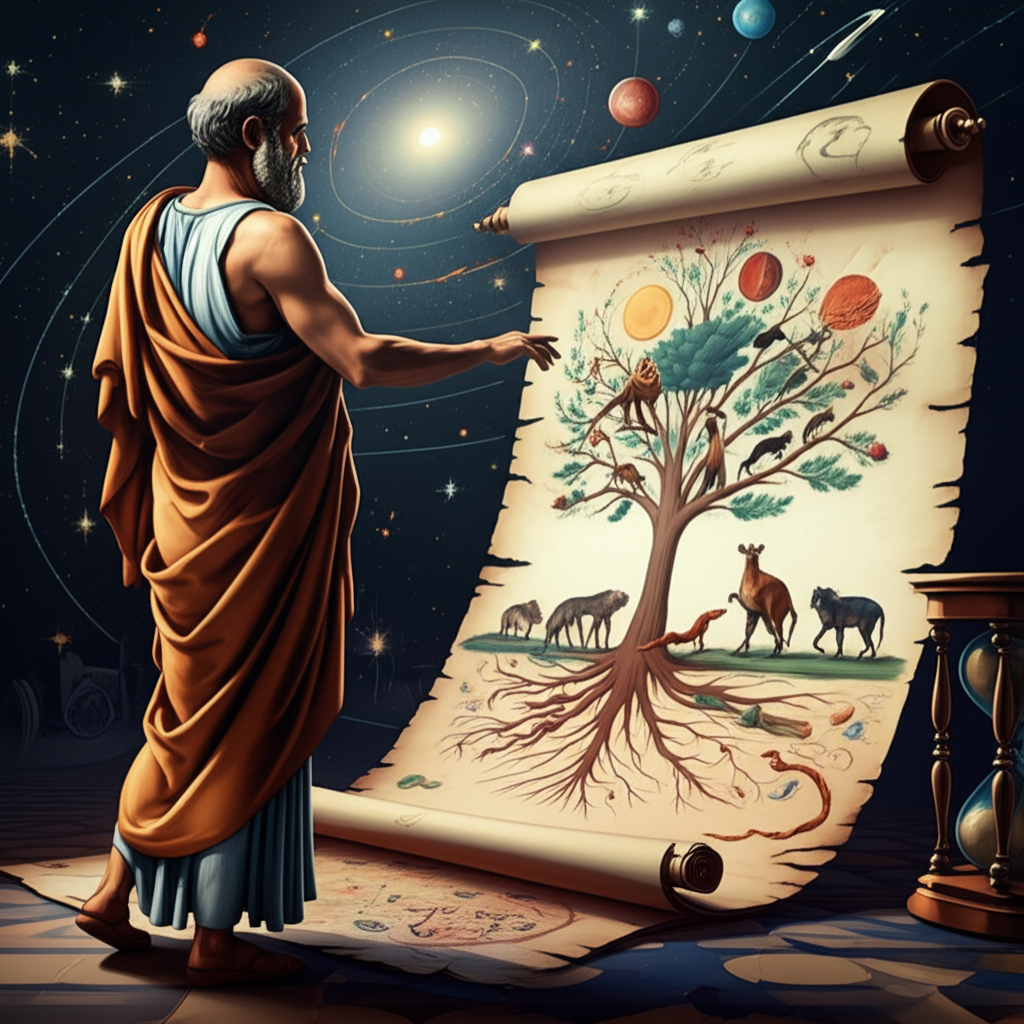
Philosophical Perspectives on Evolutionary Time
The philosophical implications of evolutionary time are far-reaching, touching upon teleology, contingency, and the very meaning of existence.
- Mechanistic vs. Teleological Views: Does Evolution have a purpose or an ultimate goal (teleology), or is it merely a blind, mechanistic process driven by natural laws and chance? While Darwinian Evolution is largely mechanistic, the sheer complexity and apparent "progress" of life over Time often tempts observers to infer purpose.
- The Problem of Contingency: If life's trajectory is dependent on countless chance events (mutations, asteroid impacts, climate shifts), then is there any necessity to the forms we see today? The "Great Books" tradition often sought underlying necessities; Evolution highlights the role of contingency in shaping Nature.
- The Scale of Time: Our human perception of Time is inherently limited. The geological and evolutionary timescales (millions and billions of years) are almost incomprehensible to us, yet they are the canvas upon which life's masterpiece is painted. This vastness forces a re-evaluation of our place in the cosmos.
The Eternal and the Temporal in Evolution
How do we reconcile the seemingly eternal laws of physics and biology that govern Evolution with the ever-changing, temporal unfolding of life itself? Plato's concept of eternal Forms, perfect and unchanging, stands in stark contrast to the mutable world of appearances. Yet, Evolution suggests that even the "forms" of life are not static but are themselves products of Change over Time. Perhaps the "eternal" aspect lies in the principles of Change and adaptation themselves, rather than in any fixed biological entity. The Nature of life, in this view, is to perpetually transform.
Conclusion: A Continuing Dialogue
The Nature of Time in Evolution is not a settled question but a vibrant philosophical frontier. It compels us to confront the profound implications of Change as the fundamental engine of existence, mediated by the ceaseless flow of Time. From the earliest philosophical inquiries into the flux of being to the modern understanding of genetic drift and natural selection, the interplay of Nature, Time, and Evolution remains a central dialogue in our quest to understand the universe and our place within it. This grand narrative, unfolding over eons, continues to challenge our assumptions and expand our understanding of what it means to be.
📹 Related Video: PLATO ON: The Allegory of the Cave
Video by: The School of Life
💡 Want different videos? Search YouTube for: ""Philosophical perspectives on time and existence""
📹 Related Video: What is Philosophy?
Video by: The School of Life
💡 Want different videos? Search YouTube for: ""Evolutionary philosophy and the arrow of time""