

The Unfolding Tapestry: Examining the Nature of Time in Evolution
Summary: The grand narrative of Evolution is fundamentally interwoven with the perplexing concept of Time. This article delves into the philosophical Nature of Time as it pertains to biological Change, drawing insights from the enduring wisdom of the Great Books of the Western World. We explore how thinkers from antiquity grappled with temporality, mutability, and permanence, and how these foundational ideas illuminate our understanding of life's gradual unfolding. Far from being a mere backdrop, Time emerges as an active, perhaps even constitutive, element in the relentless drama of organic transformation.
Time's Arrow and Life's Journey: A Philosophical Introduction
To speak of Evolution is, invariably, to speak of Change over vast stretches of Time. Yet, what is this "Time" that facilitates the intricate dance of natural selection and adaptation? Is it a linear progression, an eternal present, or something more profound? The scientific description of biological Change offers empirical evidence, but the philosophical understanding of Time itself, and its intimate relationship with the Nature of life's development, remains a fertile ground for contemplation. As we look to the intellectual giants preserved in the Great Books, we find a rich tradition of inquiry into the very fabric of existence that can inform our modern perspectives on evolutionary processes.
The Aristotelian Lens: Time as a Measure of Change
Aristotle, a cornerstone of Western thought, posited in his Physics that Time is the "number of motion in respect of 'before' and 'after'." For him, Time is not an independent entity, but rather a measure of Change. Without Change or motion, there would be no Time. This perspective is profoundly relevant to Evolution.
Consider the following implications:
- Time's Dependence: If Time is a measure of Change, then evolutionary Time is precisely the measure of biological Change – the accumulation of mutations, adaptations, and speciation events.
- The Unfolding Present: Each moment of biological Change contributes to the aggregate of evolutionary Time. The past is not merely gone but is encoded in the present forms, and the future is the potential for further Change.
- Potentiality and Actuality: Aristotle's concepts of potentiality and actuality also resonate. An organism holds the potential for adaptation, which becomes actual through the passage of Time and environmental pressures.
The very notion of species developing and transforming over millennia becomes intelligible through this lens, where Time acts as the metric by which we gauge the continuous, incremental alterations that define life's history.
Plato's Forms and Augustine's Eternal Present: The Mutable and the Immutable
While Aristotle focused on Time as a property of Change, other philosophical traditions, particularly those influenced by Plato, grappled with the distinction between the eternal and the temporal. Plato's theory of Forms suggests an unchanging realm of perfect essences, with our empirical world being a mere shadow of these eternal truths.
| Philosophical Concept | Relation to Evolution |
|---|---|
| Platonic Forms | Suggests an underlying, perhaps ideal, "nature" of species, against which empirical Change occurs. While evolution demonstrates species change, the concept of "species" itself, or the fundamental laws governing life, might hint at a more enduring, non-temporal reality. |
| Augustine's Time | In his Confessions, Augustine famously wrestled with the nature of Time, concluding it is a "distention of the soul" and that past and future exist only in the present mind (memory and expectation). This challenges the linear, external view of Time, making it an internal experience. |
How does this relate to Evolution? If Time is, in part, a construct of consciousness, then our perception of deep evolutionary Time is a monumental act of intellectual imagination, piecing together fragments from the past to form a coherent narrative of Change. The "eternal present" of Augustine invites us to consider how the present moment of natural selection, however fleeting, is the true crucible of evolutionary Change.
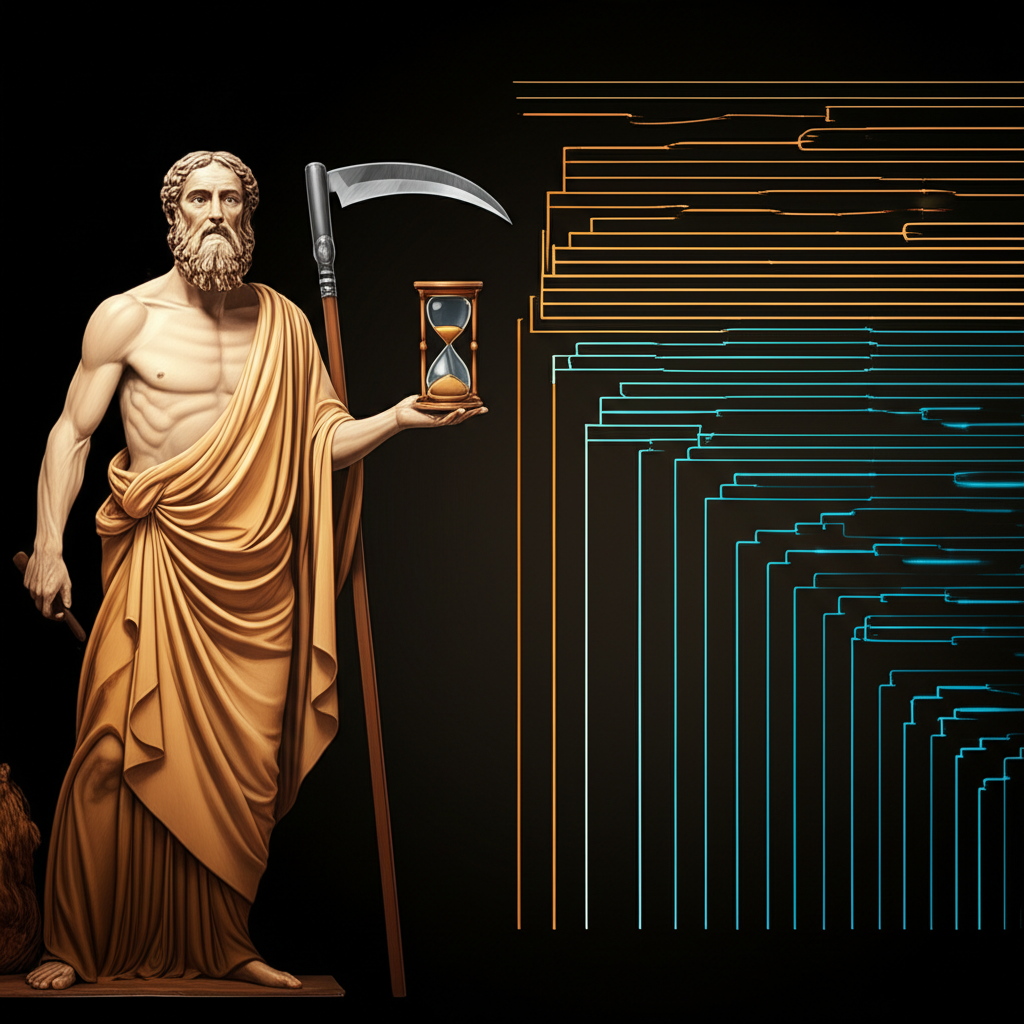
Evolutionary Time: A Philosophical Perspective
The scientific understanding of Evolution is predicated on vast stretches of geological Time. But what kind of Time is this? It is not merely a quantity; it is a quality. It is the Time of:
- Deep Duration: Millennia, epochs, eons – scales that challenge human intuition and demand a philosophical shift in our perception of temporality.
- Irreversibility: Evolutionary Change is largely irreversible. We do not see species reverting precisely to ancestral forms. This points to a directional arrow of Time within biological systems.
- Contingency and Necessity: While natural laws dictate certain necessities, the specific path of Evolution is often contingent upon chance events (mutations, environmental shifts) occurring at particular moments in Time.
This profound Change across immense Time forces us to re-evaluate our anthropocentric notions of duration and permanence. The Nature of life itself is defined by its ceaseless transformation.
The Interplay of Nature, Time, and Change
Ultimately, the Nature of Time in Evolution is a complex interplay of fundamental concepts.
- Nature as the Arena: Nature provides the stage and the raw materials for Evolution. It is the source of variation, the selective pressures, and the environment within which life unfolds. Without Nature's inherent variability and dynamic processes, there would be no Change.
- Time as the Enabler: Time is not merely a container for Evolution but an active participant. It allows for the accumulation of small, incremental Changes that lead to profound transformations. It provides the duration necessary for selection to operate, for advantageous traits to spread, and for new species to emerge.
- Change as the Process: Change is the very essence of Evolution. From the genetic level to the phenotypic expression, life is in a constant state of flux. This Change is not random but is guided by the principles of natural selection, acting over Time.
The philosophical inquiry into Time elevates our understanding of Evolution beyond mere biological mechanics, revealing it as a profound testament to the dynamic Nature of existence itself.
YouTube: "Aristotle's Philosophy of Change and Motion Explained"
YouTube: "Philosophical Implications of Deep Time and Evolution"
📹 Related Video: What is Philosophy?
Video by: The School of Life
💡 Want different videos? Search YouTube for: "The Nature of Time in Evolution philosophy"