

The Unfolding Tapestry: Exploring the Nature of Time and Eternity
Time, that relentless river we all swim in, yet whose source and destination remain shrouded in mystery. From the ticking clock on our wall to the cosmic dance of galaxies, its presence is undeniable, yet its true Nature continues to baffle philosophers and physicists alike. This article delves into the profound questions surrounding Time and its enigmatic counterpart, Eternity, drawing insights from the venerable texts of the Great Books of the Western World and touching upon modern scientific understanding. We’ll explore how these concepts shape our understanding of reality, existence, and our place within the grand scheme.
The Elusive Fabric of Existence: What is Time?
We experience Time as a linear progression: past, present, future. We measure it, schedule by it, and often feel its pressure. Yet, when pressed to define it, the task becomes surprisingly difficult. Saint Augustine, in his Confessions, famously pondered, "What then is time? If no one asks me, I know; if I wish to explain it to one who asks, I know not." This candid admission perfectly encapsulates the philosophical challenge. Is time a fundamental aspect of reality, an independent dimension through which events unfold, or is it merely a construct of the human mind, a way we organize our perceptions of change?
Philosophical Lenses on Time's Nature
Throughout history, thinkers have grappled with the essence of Time, offering diverse perspectives that continue to shape our discourse.
-
Plato's Moving Image: In his Timaeus, Plato describes Time not as an ultimate reality, but as a "moving image of Eternity." For Plato, Eternity is a state of changeless, perfect being, and Time is the way this perfection is imperfectly reflected in the created, changing world, marked by celestial motions. It's a derivative, a shadow of a higher, timeless truth.
-
Aristotle's Measure of Motion: Contrasting with Plato, Aristotle, in his Physics, posited that Time is "the number of motion in respect of 'before' and 'after'." For him, Time is not a substance but an attribute, inextricably linked to change and movement. If nothing changed, there would be no Time. It exists only as a measure of events, not independently of them.
-
Augustine's Inner Experience: As noted, Augustine viewed Time as a "distention of the soul." He argued that the past exists in memory, the future in expectation, and the present as a fleeting instant. Thus, Time is not an external reality but an internal phenomenon, a creation that began with the world itself, not something that pre-existed it. God, for Augustine, exists in a timeless Eternity.
-
Kant's A Priori Intuition: Immanuel Kant, in his Critique of Pure Reason, revolutionized the understanding of Time by arguing it is not an empirical concept derived from experience, but an a priori form of intuition. It is a fundamental framework of the human mind, enabling us to perceive and organize sensory data. We don't perceive Time; rather, we perceive through Time.
These varied perspectives highlight the profound complexity of Time, ranging from an objective reality to a subjective construction.
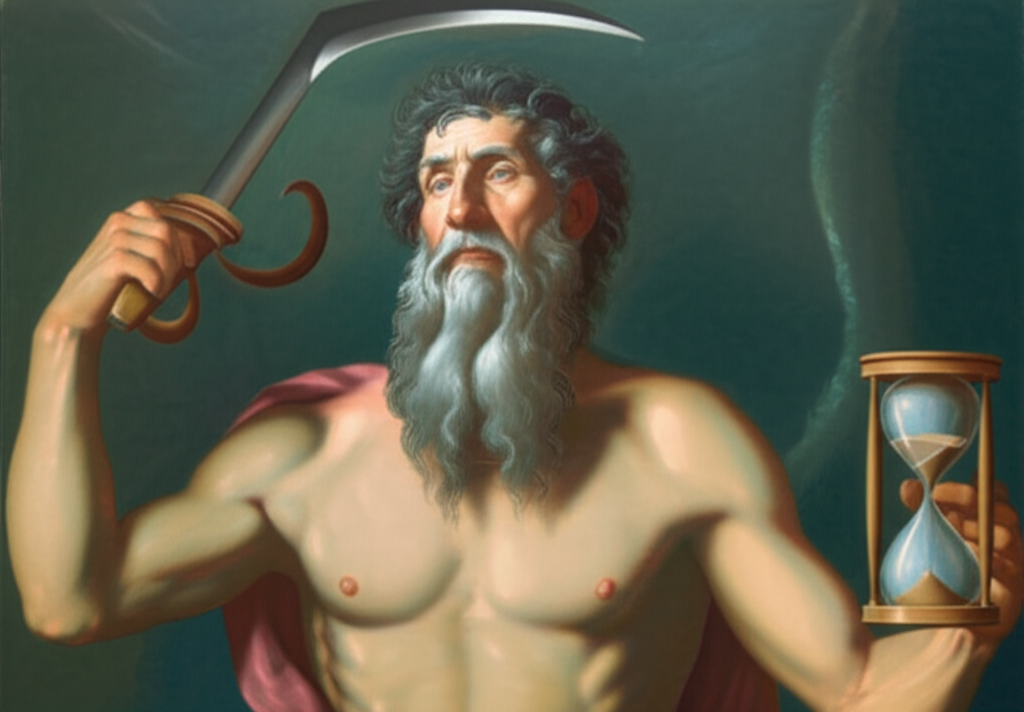 as an old, winged man, holding an hourglass and a scythe, perhaps overseeing a landscape where seasons change and civilizations rise and fall. The background could feature a starry night sky merging into a bright, timeless void to symbolize Eternity.)
Time in the Realm of Physics: Relativity and the Arrow
The advent of modern Physics has added further layers to our understanding of Time. Albert Einstein's theories of relativity fundamentally altered our classical Newtonian view.
-
Spacetime: Einstein demonstrated that Time is not absolute but relative, intertwined with space into a four-dimensional fabric called spacetime. The rate at which Time passes depends on an observer's relative motion and gravitational field. This implies that there isn't one universal Time for everyone; rather, each observer has their own personal Time.
-
The Arrow of Time: Despite the reversibility of many physical laws, our experience of Time is undeniably unidirectional – it always moves forward. This "arrow of Time" is often linked to the second law of thermodynamics, which states that the entropy (disorder) of an isolated system always increases over Time. The universe moves from order to disorder, giving Time its direction. Yet, the fundamental Nature of this arrow remains a topic of intense debate among physicists. Is Time truly flowing, or is it a static dimension we merely perceive sequentially?
YouTube: "Einstein's Theory of Relativity Explained Simply"
YouTube: "What is the Arrow of Time? Physics Explained"
Eternity: Beyond the Chronological
If Time is change, what then is Eternity? For many, Eternity is simply Time without end – an infinite duration. However, a deeper philosophical and theological understanding often distinguishes Eternity from mere endless Time.
-
Timelessness vs. Infinite Time: Boethius, in The Consolation of Philosophy, offered a crucial distinction. He defined Eternity as "the whole, simultaneous and perfect possession of interminable life." This suggests Eternity is not an endless succession of moments, but rather a state entirely outside of Time, where past, present, and future are apprehended as a single, indivisible whole. It is a state of changeless presence.
-
Divine Eternity: This concept of Eternity is often applied to the divine. God, in many theological traditions, is not bound by Time but exists eternally, seeing all moments simultaneously. This radical difference between divine Eternity and human Time has profound implications for understanding concepts like free will, predestination, and divine providence.
| Concept | Description | Key Thinkers / Fields |
|---|---|---|
| Time | A measure of change, a dimension, or a subjective experience of succession. | Aristotle, Augustine, Kant, Einstein, Modern Physics |
| Eternity | Timelessness; a state of complete and perfect possession of being, outside of sequence. | Plato, Boethius, Theological Philosophy |
The Interplay: Time, Eternity, and Human Experience
Our understanding of Time and Eternity profoundly shapes our worldview. If Time is a linear progression towards an inevitable end, it instills a sense of urgency, purpose, and often, existential dread. If Eternity offers a timeless realm, it can provide solace, a sense of ultimate meaning, or a challenge to our temporal attachments.
The tension between our lived experience of linear Time and the philosophical concept of timeless Eternity compels us to ponder the very Nature of reality. Are we merely fleeting moments in an endless sequence, or do we touch upon something eternal within our temporal existence? The Great Books remind us that these questions are not merely academic exercises but are central to understanding the human condition itself.
A Continuing Inquiry
The Nature of Time and Eternity remains one of philosophy's most enduring and fascinating puzzles. From ancient Greek contemplation to the cutting edge of quantum Physics, humanity continues to probe the fabric of existence, seeking to unravel the mysteries of our temporal passage and the possibility of a realm beyond it. As Grace Ellis, I find solace and stimulation in this ongoing dialogue, knowing that the journey of inquiry itself is a testament to the boundless curiosity of the human spirit.
📹 Related Video: What is Philosophy?
Video by: The School of Life
💡 Want different videos? Search YouTube for: "The Nature of Time and Eternity philosophy"