

The Enduring Riddle: Distinguishing Between Being and Essence
The bedrock of much philosophical inquiry, particularly within Metaphysics, rests upon fundamental distinctions that, at first glance, might seem abstract or even pedantic. Yet, it is precisely in the careful parsing of such concepts that we gain clarity about the nature of reality itself. One of the most profound and persistent of these distinctions is that between Being and Essence. Simply put, Being refers to the act of existing, the sheer fact that something is. Essence, on the other hand, refers to what something is—its fundamental nature, its intrinsic qualities, its very Definition. This distinction, explored deeply across the Great Books of the Western World, is not merely an academic exercise; it shapes our understanding of everything from a stone to a deity, from a concept to consciousness itself.
Unpacking Existence and Nature: A Metaphysical Foundation
In the grand tapestry of Metaphysics, few threads are as crucial or as finely woven as the understanding of existence and nature. To grapple with the question of Being is to confront the ultimate mystery: why is there something rather than nothing? To delve into Essence is to seek the intelligible structure of that something, to articulate its whatness. This seemingly straightforward separation has profound implications, inviting us to consider whether existence is a property, a predicate, or an act, and whether essence precedes, follows, or is identical with existence. The journey through this distinction requires precision in language and a willingness to engage with some of the most challenging Ideas ever conceived.
What is "Being"? The Act of Existence
At its most fundamental level, Being refers to the sheer fact of existence. It is the actuality of something, the "is-ness" that allows anything to be present in reality. For many philosophers, particularly those in the Aristotelian and Thomistic traditions, Being is not merely a static state but an act—the actus essendi, the act of existing.
Consider a simple object, like a chair. Its Being is the fact that it exists, that it is present in the world. Without this act of existing, the chair, no matter how perfectly conceived in its Essence, would be nothing.
- Universality: Being is the most universal of all concepts; everything that is, participates in Being.
- Elusiveness: Despite its universality, Being is notoriously difficult to define directly, as any attempt to define it seems to presuppose it. It is often understood through analogy or through its opposite, non-being.
- Primacy: For many, Being is primary, the fundamental given without which nothing else can be.
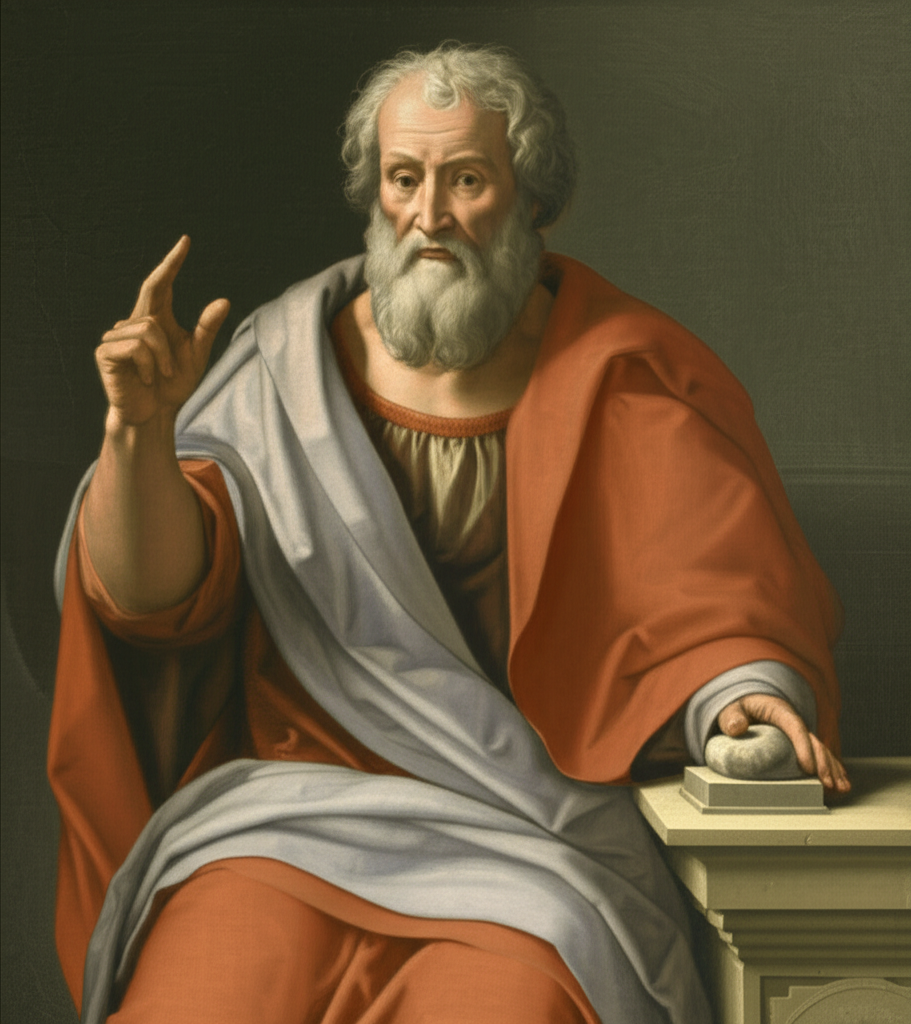 and an abstract, glowing geometric form or an ethereal concept (representing essence), with other scholars in deep discussion in the background, all bathed in the light of inquiry.)
What is "Essence"? The "Whatness" and the Idea
If Being answers the question "Does it exist?", Essence answers "What is it?" It is the inner nature, the defining characteristics, the blueprint or Idea that makes a thing what it is and not something else. It is the intelligible structure that allows us to form a Definition of a thing.
For our chair, its Essence includes its properties as a piece of furniture designed for sitting, typically having a seat, back, and legs. This Essence can be conceived even if no such chair currently exists.
- Definition: Essence provides the Definition of a thing, its quiddity (from the Latin quid, meaning "what").
- Intelligibility: It is through understanding the Essence of something that we can truly know it.
- Form: In Aristotelian terms, essence is closely related to the substantial form of a thing. In Platonic thought, it aligns with the eternal, unchanging Forms or Ideas.
The Interplay: How Being and Essence Relate
The relationship between Being and Essence is where the philosophical rubber truly meets the road. Are they distinct? If so, how? And what are the implications?
| Aspect | Being | Essence |
|---|---|---|
| Question | That something is (existence) | What something is (nature) |
| Focus | Actuality, existence, the fact of being | Potency, nature, the defining characteristics |
| Prior to | Presupposes nothing (except itself) | Can be conceived prior to actual existence |
| Example | The fact that this chair exists | The Idea or Definition of a chair |
| Philosopher | Parmenides, Aquinas (as actus essendi) | Plato (Forms), Aristotle (Substantial Form) |
In classical Metaphysics, particularly within the Thomistic tradition, the distinction is crucial:
- In Created Beings: Being and Essence are really distinct. A created thing has an essence (its nature), and it receives its existence (its Being). Its essence is a potentiality that is actualized by its existence. This composition of essence and existence is what makes a created thing contingent—it could not exist.
- In God: Being and Essence are identical. God's essence is His existence; He is pure actus essendi, Ipsum Esse Subsistens (Subsistent Being Itself). This identity is what makes God a necessary being, incapable of not existing.
Historical Perspectives from the Great Books
The distinction between Being and Essence has been a central theme throughout the history of Western philosophy, evolving with each major thinker.
- Parmenides (Pre-Socratics): Emphasized the absolute unity and unchanging nature of Being, dismissing non-being and thus, in a sense, conflating essence with a singular, eternal Being.
- Plato: For Plato, the Essence of things resided in the eternal, immutable Forms or Ideas, which exist independently of the sensible world. A particular, existing chair (its Being) is merely a fleeting, imperfect copy of the ideal Form of Chairness (its Essence). Here, essence holds a superior ontological status.
- Aristotle: While rejecting Plato's separate Forms, Aristotle still maintained a robust distinction. For him, Essence (the substantial form) is inherent within the particular thing, making it what it is and providing its Definition. Being refers to the actuality of this form in matter, but also to the primary ousia (substance) itself. The Great Books show Aristotle's meticulous analysis of how form and matter, and thus essence and existence, are intertwined in concrete reality.
- Medieval Philosophers (e.g., Avicenna, Aquinas): Building on Aristotle, thinkers like Thomas Aquinas formalized the distinction between Essence (or quiddity) and Existence (esse or actus essendi) in created beings. This distinction was vital for understanding creation ex nihilo and the nature of God as pure Being. The very possibility of a thing existing or not existing points to a distinction between its whatness and its thatness.
- Modern Philosophy (e.g., Descartes, Kant, Sartre): Descartes, in his ontological argument, wrestled with whether existence is a perfection inherent in the Idea of God. Kant famously argued that "existence is not a predicate," meaning that Being does not add to the concept of a thing's essence. Later, Jean-Paul Sartre inverted the classical view with his famous dictum, "existence precedes essence," arguing that for humans, we first exist, and then define our essence through our choices and actions.
Why This Distinction Matters: Implications for Metaphysics
The philosophical exploration of Being and Essence is far from an academic triviality. Its implications ripple through almost every branch of philosophy and theology:
- Understanding Reality: It provides a framework for understanding the fundamental structure of reality, distinguishing between what things are and the fact that they are.
- The Problem of Universals: It informs discussions about whether universal Ideas (essences) exist independently of particular things, or only within them.
- The Nature of God: For many religious traditions, the distinction is crucial for defining God as pure Being whose essence is identical with His existence, thus differentiating Him from all created beings.
- Human Nature: The debate over "existence precedes essence" in existentialism profoundly impacts our understanding of human freedom, responsibility, and the meaning of life.
- Knowledge and Definition: Understanding a thing's Essence is key to forming accurate Definitions and acquiring genuine knowledge, while grasping its Being relates to empirical observation and confirmation.
Conclusion: A Foundational Idea in Philosophy
The distinction between Being and Essence stands as one of the most enduring and fruitful Ideas in the history of philosophy. From the ancient Greeks to contemporary thinkers, the effort to precisely articulate what it means to be and what it is to be a particular thing has driven profound insights into Metaphysics, theology, and human experience. It compels us to look beyond superficial appearances and delve into the very fabric of reality, reminding us that the most fundamental questions often require the most meticulous distinctions. Engaging with this concept, as illuminated by the vast tradition of the Great Books, is an essential step for anyone seeking to understand the philosophical quest for truth.
📹 Related Video: PLATO ON: The Allegory of the Cave
Video by: The School of Life
💡 Want different videos? Search YouTube for: ""Aquinas Being Essence Distinction Explained""
📹 Related Video: PLATO ON: The Allegory of the Cave
Video by: The School of Life
💡 Want different videos? Search YouTube for: ""Plato Aristotle Metaphysics Essence Existence""