

Beyond Mere Existence: Unpacking the Distinction Between Being and Essence
In the grand tapestry of philosophical inquiry, few distinctions are as fundamental, as perplexing, and as illuminating as that between Being and Essence. For millennia, thinkers have grappled with the profound implications of these two concepts, recognizing that to truly understand anything – from a simple stone to the divine – one must first untangle what it is from the sheer fact that it is. This distinction lies at the very heart of Metaphysics, providing the conceptual tools necessary to dissect the nature of reality itself.
The Fundamental Divide: A Summary
At its core, the distinction is straightforward: Being refers to the act of existing, the sheer "is-ness" of a thing. It’s the answer to the question, "Does it exist?" Essence, on the other hand, refers to what a thing is, its fundamental nature, its Definition, or its "whatness." It’s the answer to the question, "What kind of thing is it?" While intimately related, even inseparable in reality, the idea of them can be distinct, allowing us to explore the profound implications of each.
Being: The Act of Existing
When we speak of Being, we are touching upon the most universal and primary concept imaginable. It is the raw fact of existence, prior to any specific quality or characteristic. As early as Parmenides, the ancient Greeks recognized the undeniable reality of Being, declaring that "what is, is." For Aristotle, Being was not a genus but rather a concept analogously applied across various categories, with "substance" being the primary sense of Being.
Consider anything you encounter: a tree, a thought, a number. Before you can describe its properties, its color, its size, or its function, you must first acknowledge that it is. This act of existing, this participation in Being, is what allows it to be anything at all. Without Being, there is simply nothing – no essence to define, no qualities to describe. It is the ultimate ground of all reality.
Essence: What a Thing Is
If Being is the that of a thing, then Essence is the what. It is the intrinsic nature, the quiddity, the very Idea that makes a thing precisely what it is and not something else. When we ask for the Definition of something, we are seeking its essence. What is a human being? A rational animal. What is a triangle? A three-sided polygon. These definitions articulate the essence of those things.
Plato, in his theory of Forms, posited that true essences exist independently as perfect, unchanging archetypes in a separate realm. The "Essence of Beauty" or the "Essence of Justice" were more real than any particular beautiful object or just act. Aristotle, while bringing essences down to earth, still emphasized their importance as the substantial form within individual things, that which makes a particular oak tree an oak tree and not a stone. The essence is the principle of intelligibility; it's what allows us to know and categorize the world.
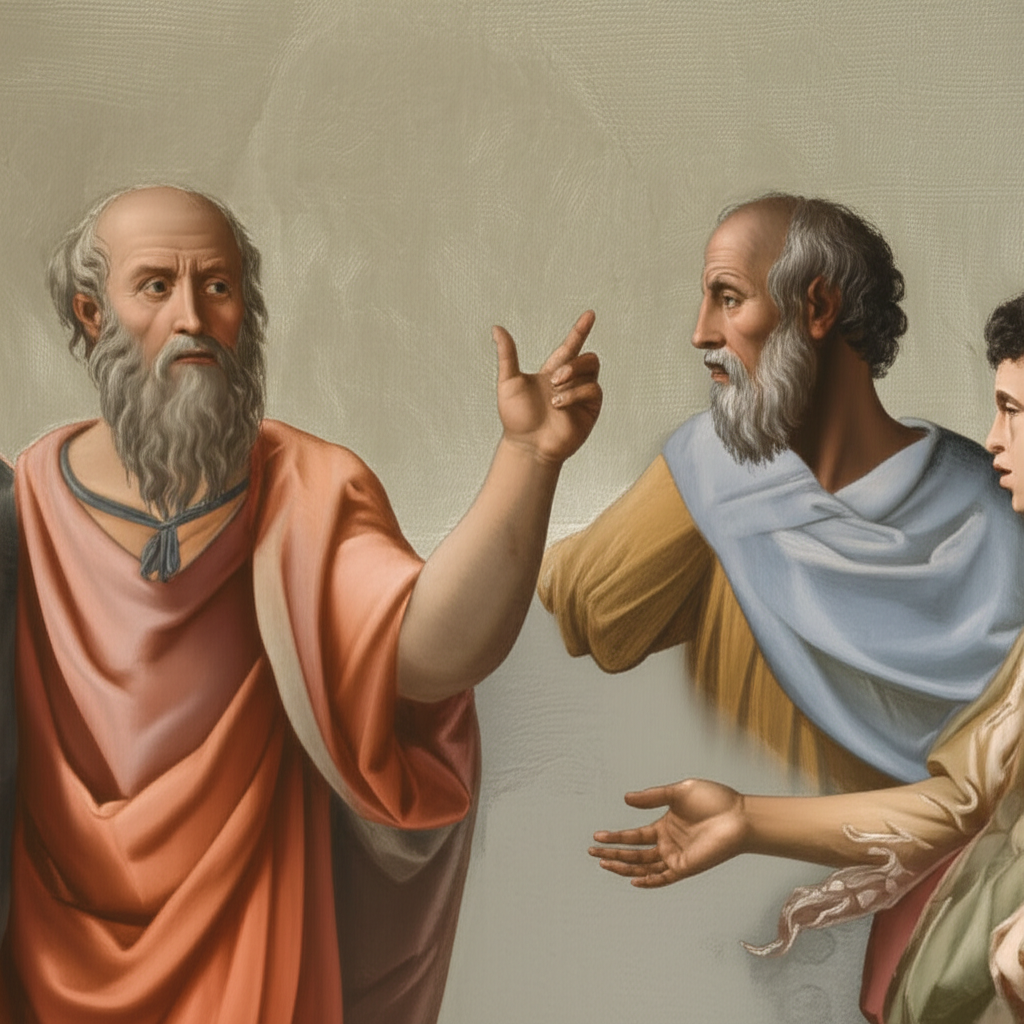
The Conceptual Chasm: Being vs. Essence
The distinction becomes clearer when we consider how they relate. Can an essence exist without being? Philosophically, yes, in the realm of possibility or thought. We can conceive of a unicorn (its essence), even though unicorns do not have being in our world. However, a thing cannot be without having an essence. Everything that exists is something.
The medieval scholastic philosophers, particularly Thomas Aquinas, profoundly developed this distinction, arguing that in all created things, Being (or esse, the act of existing) is distinct from their Essence (essentia, what they are). This means that a created thing's existence is not inherent to its nature; it receives its existence. Only in God, Aquinas argued, are Being and Essence identical – God's essence is to exist. This philosophical insight has profound theological implications, underscoring the contingency of creation.
Let's summarize their key differences:
| Feature | Being | Essence |
|---|---|---|
| Primary Question | That it is? (Existence) | What it is? (Nature, Quiddity) |
| Focus | Act of existing, actuality | Form, nature, definition, potentiality |
| Universality | Most universal concept | Specific to a kind or species |
| Relation | Prior condition for anything to be | The intelligibility of what is |
| Example | The fact that a tree is | The Idea of "tree" (its structure, function) |
Philosophical Journey Through the Great Books
The "Great Books of the Western World" are replete with explorations of this fundamental distinction.
- Plato's Republic and Phaedo introduce the Forms as eternal, unchanging essences, existing independently of any particular instance. A beautiful object participates in the Form of Beauty, but the Form itself is pure beauty.
- Aristotle's Metaphysics dedicates significant portions to analyzing "being qua being," dissecting the various senses of Being and emphasizing the role of substantial form (essence) in defining individual substances. His concept of ousia (substance) is a composite of matter and form, where form is the essence.
- Thomas Aquinas's Summa Theologica builds upon Aristotle, making the radical distinction between esse (existence) and essentia (essence) in created beings, a cornerstone of his metaphysics and theology. This distinction allows for a clear understanding of contingency and the nature of God as pure Act of Being.
- Even later philosophers, like Leibniz, with his monads possessing their own complete concepts (essences), or Kant, who distinguished between analytic (essence-based) and synthetic (existence-based) judgments, continued to grapple with these foundational concepts, albeit through different lenses. The Idea of distinguishing what a thing is from the fact that it is, has shaped philosophical inquiry for millennia.
Why This Distinction Matters
Understanding the difference between Being and Essence is not merely an academic exercise; it's crucial for grappling with profound questions:
- Knowledge: How can we know what things are? By grasping their essences.
- Reality: What is the ultimate nature of reality? Is existence primary, or is essence?
- Theology: What is the nature of God? Is God's existence distinct from His essence? (For Aquinas, no, they are identical).
- Science: Scientific inquiry often seeks to uncover the essences (the fundamental laws and structures) of natural phenomena.
The distinction between Being and Essence remains a vibrant area of philosophical discussion, underscoring the enduring power of fundamental Metaphysics to illuminate the deepest truths about ourselves and the cosmos.
📹 Related Video: PLATO ON: The Allegory of the Cave
Video by: The School of Life
💡 Want different videos? Search YouTube for: ""Aquinas Being and Essence Explained""
📹 Related Video: ARISTOTLE ON: The Nicomachean Ethics
Video by: The School of Life
💡 Want different videos? Search YouTube for: ""Aristotle Metaphysics Substance and Form""