

The Indivisible Fabric: How Being and Quality Intersect in Metaphysics
The relationship between Being and Quality forms a cornerstone of metaphysical inquiry, probing not just what exists, but how it exists and what kind of thing it is. This article delves into the profound philosophical relation between existence itself and the characteristics that define it, drawing insights from the Great Books of the Western World. We will explore how various thinkers have grappled with whether Quality is merely an accidental attribute of Being, or if, in some fundamental sense, Quality is inherent to, or even constitutive of, Being itself. This journey through classical thought reveals the intricate ways philosophers have sought to understand the fundamental nature of reality, bridging the abstract concept of existence with the concrete attributes we perceive.
The Core Question: Is Quality Intrinsic to Being?
At the heart of metaphysics lies the question of Being – what it means for something to exist. But merely existing isn't enough; we immediately encounter the concept of Quality. A thing doesn't just is; it is something. It is red, it is heavy, it is just, it is intelligent. These are qualities. The philosophical challenge then becomes: what is the relation between this fundamental Being and the qualities that describe it? Are qualities mere adornments, separable from the essence of a thing, or are they inextricably woven into its very fabric of existence?
This question has profound implications, shaping our understanding of reality, identity, and change. To explore this, we turn to the foundational texts that have illuminated this complex interplay for millennia.
Aristotle's Categories: Quality as a Mode of Being
Perhaps no philosopher laid a more systematic groundwork for understanding the relation between Being and its attributes than Aristotle. In his Categories, he meticulously outlines ten fundamental ways in which something can be predicated of a subject, or ten ways in which a thing can be. While Substance (what a thing is – e.g., "a man," "a horse") is primary Being, Quality stands as one of the most significant accidental categories.
Aristotle defines Quality as "that in virtue of which people are said to be such and such." He further breaks down Quality into four types:
- States and Dispositions: Enduring (knowledge) or temporary (warmth) characteristics.
- Capacities or Incapacities: Abilities (skill in boxing) or lack thereof.
- Affective Qualities: Qualities that cause affections (sweetness, bitterness).
- Figure and Shape: Geometrical or physical forms (straight, curved).
For Aristotle, a quality is not the Being itself, but rather a characteristic of a Being. A man's Being is his substance; his quality might be "wise" or "tall." These qualities inhere in the substance. While a substance can exist without a particular quality (a man can cease to be wise), a quality cannot exist independently of a substance. There is no "wisdom" floating around without a wise being. This establishes a clear, hierarchical relation: Being (substance) is primary, and Quality is secondary, dependent on that primary Being.
Plato's Forms: Quality as Pure Being
Before Aristotle, Plato offered a different, more radical perspective on Quality. For Plato, true Being resides not in the imperfect, changing objects of the sensible world, but in the eternal, immutable Forms. These Forms are the perfect exemplars of qualities.
Consider the Quality of "Justice." In the sensible world, we encounter just acts, just people, just societies – all imperfect manifestations. But for Plato, there exists a perfect, self-subsisting Form of Justice in the intelligible realm. This Form is Justice itself; it is the very Being of Justice. Similarly, the Form of Beauty is Beauty, the Form of Goodness is Goodness.
In this Platonic framework, Quality is not merely an attribute of Being; in its purest sense, Quality is Being. The Forms are the ultimate realities, and they embody the perfect essence of various qualities. The objects we perceive in the world merely participate in these Forms, thereby acquiring their qualities. This presents a much tighter, indeed almost identical, relation between Being and Quality at the highest metaphysical level.
Medieval Synthesis: Essence, Existence, and Accidental Qualities
Building upon Aristotle and engaging with Platonic ideas through a theological lens, medieval philosophers, notably St. Thomas Aquinas, further refined the understanding of Being and Quality. Aquinas adopted Aristotle's categories, distinguishing between essence (what a thing is, its defining characteristics) and existence (that a thing is).
For Aquinas, God's Being is unique: in God, essence and existence are identical. God's Being is pure act, pure perfection, and thus, all divine qualities (goodness, wisdom, omnipotence) are not accidental attributes but are constitutive of His very Being. God is goodness; He does not merely possess goodness.
In created beings, however, essence and existence are distinct. A creature has an essence (what it is) and it receives existence. Furthermore, created beings possess both essential qualities (those necessary for its essence, e.g., rationality for a human) and accidental qualities (those that can change without altering its essence, e.g., being tall or short). This intricate metaphysical system maintains a relation where Quality can be either profoundly inherent (in God, or as essential to a created nature) or contingently attached (as an accident).
| Philosophical Perspective | Primary Understanding of "Being" | Relation to "Quality" |
|---|---|---|
| Plato | Eternal, immutable Forms | Quality is Being (in Forms); sensible things participate in Qualities |
| Aristotle | Substance (primary reality) | Quality inheres in Being (substance); it is an attribute of Being |
| Aquinas | God (pure Act); Created Beings (essence + existence) | God's Being is Quality; created beings have essential and accidental Qualities |
Modern Perspectives: Perception and the Nature of Qualities
The modern era introduced new dimensions to the relation between Being and Quality, particularly through the lens of epistemology and perception. Thinkers like John Locke distinguished between primary qualities (inherent in the object itself, like solidity, extension, motion) and secondary qualities (power to produce sensations in us, like color, sound, taste). For Locke, primary qualities are inseparable from the object's Being, while secondary qualities are mind-dependent, existing only in our perception.
Immanuel Kant further complicated this metaphysical landscape by arguing that our minds actively structure our experience of reality. We perceive phenomena (things as they appear to us), which are necessarily ordered by categories of understanding, including Quality. The "thing-in-itself" (noumenon) remains unknowable. This suggests that the qualities we attribute to Being are, at least in part, a product of our cognitive apparatus, rather than purely objective features of an independent reality. The relation here becomes one mediated by human understanding.
The Enduring Metaphysical Puzzle
The journey from Plato's Forms to Kant's categories reveals a persistent philosophical tension:
- Is Quality an objective feature of Being, or a subjective projection?
- Can Being exist without Quality, or is every instance of Being necessarily qualified?
- What is the ontological status of qualities themselves?
These questions continue to fuel contemporary metaphysics, demonstrating the profound and intricate relation between the concept of existence and the myriad ways in which we describe and understand what exists. The inquiry into Being is never truly separate from the inquiry into Quality, for to be is always to be something.
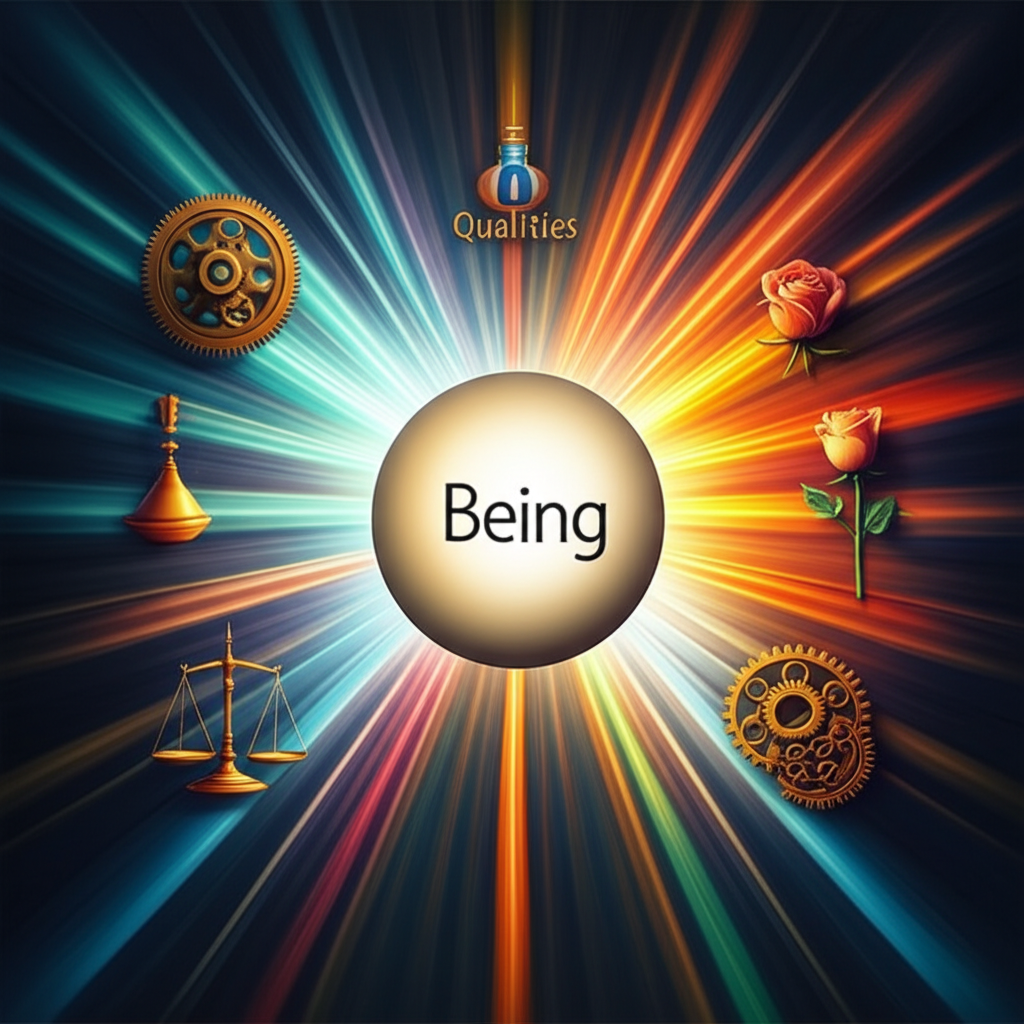 . The rays visually connect the central sphere to these qualities, illustrating their emanation from or inherence in Being, set against a backdrop of ancient philosophical texts.)
📹 Related Video: ARISTOTLE ON: The Nicomachean Ethics
Video by: The School of Life
💡 Want different videos? Search YouTube for: ""Aristotle Categories explained""
📹 Related Video: PLATO ON: The Allegory of the Cave
Video by: The School of Life
💡 Want different videos? Search YouTube for: ""Plato's Theory of Forms explained""