

The Unfolding Enigma: Prophecy, Time, and the Architectures of Knowing
Prophecy, an ancient whisper echoing through the corridors of history, posits a radical claim: knowledge of the future. But what does it truly mean to know what is yet to be? This foundational question thrusts us into a profound philosophical exploration of Time itself, the nature of Religion and belief, and the very limits of human Knowledge. This article delves into how various philosophical traditions, particularly those found within the Great Books of the Western World, have grappled with the perplexing relationship between prophecy and our understanding of time, causality, and free will. From the eternal present of divine consciousness to the linear march of human experience, we examine the intellectual landscapes shaped by this enduring human fascination.
I. Prophecy: A Glimpse Beyond the Veil
Throughout history, across diverse cultures and belief systems, the phenomenon of prophecy has manifested as a compelling human experience. It is often portrayed as a divine revelation, a foretelling of events, or an insight into hidden truths, challenging our conventional understanding of sequential existence.
A. Defining Prophecy in Philosophical Terms
At its core, prophecy is the assertion of foreknowledge. This isn't mere prediction based on observable patterns, like meteorology, but rather an insight into events that are seemingly uncaused or unknowable through empirical means. Philosophically, it raises critical questions:
- Epistemological: How can future events be known before they occur? What is the source and validity of this knowledge?
- Metaphysical: Does prophecy imply a predetermined universe? What does it say about the nature of time itself?
- Ethical: If the future is known, does human free will still exist? What are the implications for moral responsibility?
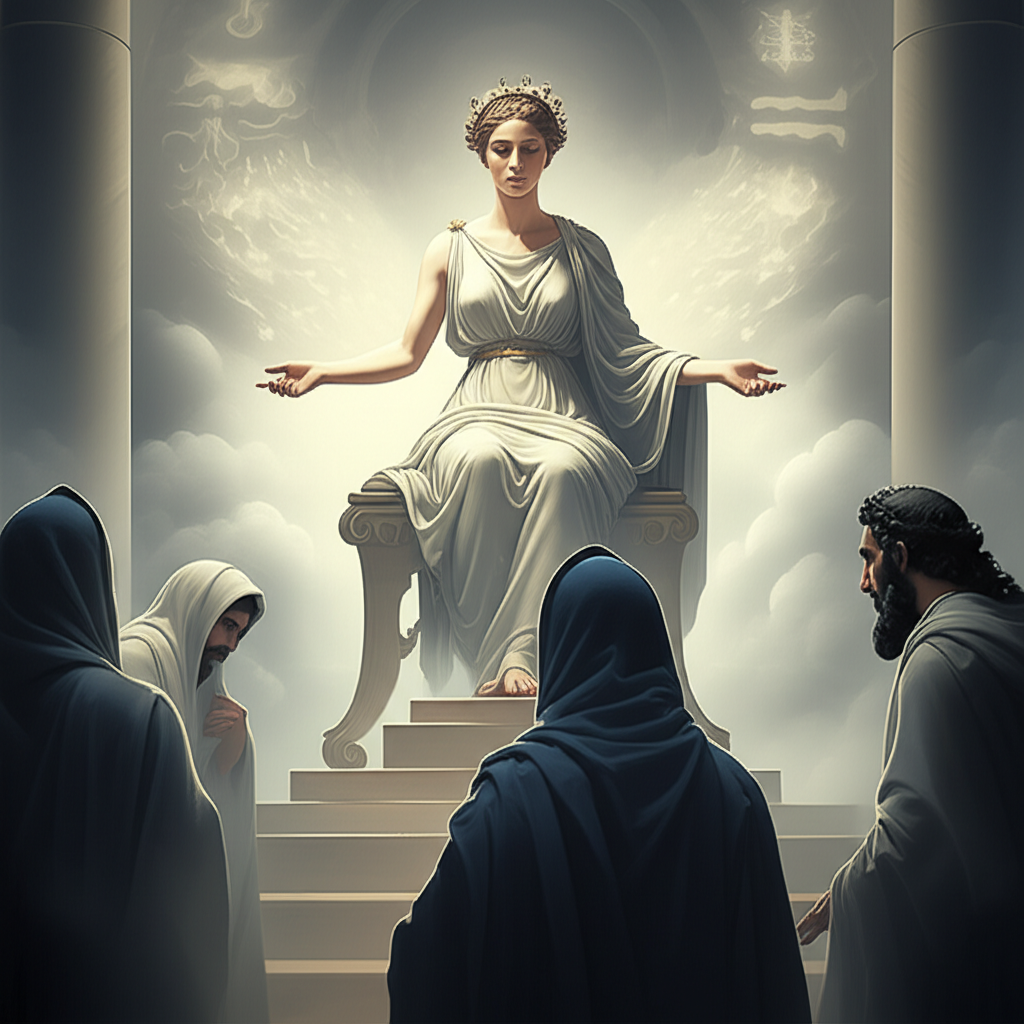
B. The Ubiquity of Prophecy in Religion and Mythology
From the oracles of ancient Greece to the prophets of Abrahamic faiths, prophecy is inextricably linked to Religion. It often serves as a cornerstone of faith, validating divine authority and offering guidance or warning.
Table 1: Examples of Prophetic Traditions
| Tradition/Culture | Key Figures/Concepts | Nature of Prophecy |
|---|---|---|
| Ancient Greece | Delphic Oracle, Sibyls | Divine inspiration, often ambiguous; political and personal guidance. |
| Judaism | Moses, Isaiah, Jeremiah | Direct divine communication; moral instruction, foretelling of covenants and messianic era. |
| Christianity | Jesus, John of Patmos | Fulfillment of Old Testament prophecies; revelations of spiritual truths and eschatological events. |
| Islam | Muhammad | Direct divine revelation (Quran); guidance for community, ethical precepts. |
| Indigenous Traditions | Shamans, Seers | Visions, dreams, ancestral guidance; often tied to natural cycles and community well-being. |
II. Time: The Unyielding River and the Eternal Now
The concept of Time is perhaps the most fundamental philosophical challenge posed by prophecy. Is time a linear progression, an eternal present, or something else entirely? Our understanding of time directly impacts how we interpret the possibility of knowing the future.
A. Ancient Perspectives on Time and Fate
Early philosophers wrestled with the idea of fate and determinism.
- Pre-Socratics: Many pondered the cyclical nature of existence, where events recur.
- Plato: In Timaeus, he describes time as a "moving image of eternity," created alongside the cosmos. For Plato, true reality exists in the eternal Forms, transcending temporal change.
- Aristotle: In Physics, he defines time as the "number of motion with respect to 'before' and 'after'." He saw time as intrinsically linked to change and movement, not an independent entity. While he believed in causality, he also allowed for contingency, which leaves room for human choice.
B. Augustine and the Divine Present
One of the most profound contributions to the philosophy of time comes from St. Augustine of Hippo in his Confessions. He famously asks, "What then is time? If no one asks me, I know; if I wish to explain it to one who asks, I know not."
Augustine's key insights:
- Subjectivity of Time: Past exists as memory, future as expectation, present as attention. Time, therefore, is a "distention of the soul."
- God's Eternal Present: For God, there is no past or future, only an eternal, unchanging present. God sees all of history simultaneously. This resolves the paradox of divine foreknowledge and human free will: God doesn't see a future event as we would (as something yet to happen), but rather knows it as eternally present. This doesn't compel human action but encompasses it.
This Augustinian perspective, foundational in Christian theology and philosophy, provides a robust framework for understanding how prophecy might operate from a divine vantage point, where the entire temporal sequence is laid bare in an eternal "now."
C. Kant and Time as an Intuition
Later, Immanuel Kant, in his Critique of Pure Reason, revolutionized the understanding of time. He argued that time is not an objective reality existing independently in the world, but rather a pure intuition or a fundamental form of our sensibility.
- We cannot perceive objects without perceiving them in time.
- Time is a condition for all appearances; it's how our minds organize sensory experience.
- This perspective complicates prophecy, as it suggests that our experience of sequential time is inherent to our cognitive apparatus, not necessarily reflective of an ultimate, external reality that could be "seen" ahead of schedule.
III. The Epistemology of Prophecy: Knowledge or Interpretation?
The crucial question remains: Does prophecy offer genuine Knowledge? If so, what kind? And how do we discern true prophecy from mere speculation or delusion?
A. The Challenge of Verification
Unlike empirical science, prophecy often defies direct verification before the event. Its truth value is typically assessed retrospectively, leading to issues of:
- Ambiguity: Many prophecies are couched in vague or symbolic language, allowing for multiple interpretations.
- Retrospective Fitting: Once an event occurs, it's often easy to "fit" it to a prior prophecy, even if the original intent was different.
- Self-Fulfilling Prophecy: The act of believing a prophecy can sometimes influence actions that bring about its fulfillment.
B. Prophecy, Revelation, and Faith
For many, prophecy is not primarily about empirical knowledge but about revelation – a communication from a higher source. In a religious context, accepting prophecy often requires an act of Faith.
- Thomas Aquinas, building on Augustine and Aristotle, distinguished between different types of knowledge. He viewed prophetic knowledge as a special gift, a "gratuitous grace" bestowed by God, allowing the prophet to apprehend truths inaccessible through natural reason alone. This knowledge is not a product of human intellect but a divine infusion.
- The authority of the prophet often rests on the perceived divine source of their message, rather than on their logical deduction or empirical observation.
IV. Prophecy, Free Will, and the Fabric of Reality
The interplay between prophecy and human agency presents one of philosophy's most enduring paradoxes. If the future is known, is it fixed? Do we possess true free will?
A. Determinism vs. Indeterminism
- Determinism: The belief that all events, including human actions, are ultimately determined by causes external to the will. If prophecy is true, it seems to support a deterministic view.
- Indeterminism: The belief that not all events are predetermined, and human beings possess genuine free will, allowing for choices that could alter potential futures.
Philosophers like Augustine and Aquinas sought to reconcile divine foreknowledge with human freedom by positing God's knowledge as outside of time, not as a causal force within time. God knows what free agents will choose, but doesn't cause them to choose it.
B. The Multiverse and Branching Futures
More contemporary philosophical and scientific thought, particularly in physics, occasionally touches upon ideas that resonate with the prophecy dilemma. Concepts like the multiverse theory, where every decision creates a new branching reality, offer a speculative way to think about "potential futures" rather than a single, fixed one. While not directly addressing traditional prophecy, these ideas highlight our ongoing struggle to conceptualize time and causality.
Conclusion: The Enduring Mystery
The nature of prophecy and time remains a profound philosophical frontier. From the eternal Forms of Plato to the subjective time of Augustine and the transcendental aesthetics of Kant, thinkers have continuously grappled with how we comprehend the past, present, and future, and whether knowledge of what is to be is truly possible. Prophecy, deeply intertwined with Religion and our yearning for ultimate Knowledge, forces us to confront the limits of our perception, the nature of causality, and the very essence of our temporal existence. It challenges us to look beyond the linear progression of moments and consider the possibility of deeper, more intricate architectures of reality, where the future might already be, in some sense, eternally present.
📹 Related Video: What is Philosophy?
Video by: The School of Life
💡 Want different videos? Search YouTube for: ""Augustine on Time and Eternity | Philosophy of Time""
📹 Related Video: What is Philosophy?
Video by: The School of Life
💡 Want different videos? Search YouTube for: ""Free Will and Determinism | Crash Course Philosophy""