

Unveiling the Enigma: The Nature of Prophecy and Time
Summary: Prophecy, as a purported foreknowledge of future events, stands as one of humanity's most enduring fascinations and profound philosophical challenges. This article delves into the intricate relationship between prophecy and time, exploring how various philosophical and religion traditions, particularly those found within the Great Books of the Western World, grapple with its implications for knowledge, free will, and the very structure of existence. We will examine the historical manifestations of prophecy and the deep epistemological questions it raises regarding our capacity to grasp, or even influence, what is yet to come.
The Human Longing for Foreknowledge
From the mists of antiquity, humanity has yearned for a glimpse beyond the veil of the present. This desire for knowledge of the future, often manifesting as prophecy, has shaped cultures, guided empires, and profoundly influenced individual lives. Whether whispered by oracles in ancient Greece, declared by prophets in the Judeo-Christian tradition, or interpreted from omens in Roman society, the idea that certain individuals or sacred texts can reveal what will be has persisted across millennia. But what does this tell us about the nature of time itself, and our place within its unfolding narrative?
Philosophers throughout history have wrestled with the implications of such foreknowledge. If the future can be known, does it imply a predetermined path, stripping away our agency? Or is prophecy merely a form of insight, a deeper understanding of present forces converging towards probable outcomes? These are not mere theological questions; they strike at the heart of metaphysics and epistemology.
Prophecy Across the Ages: A Philosophical Journey
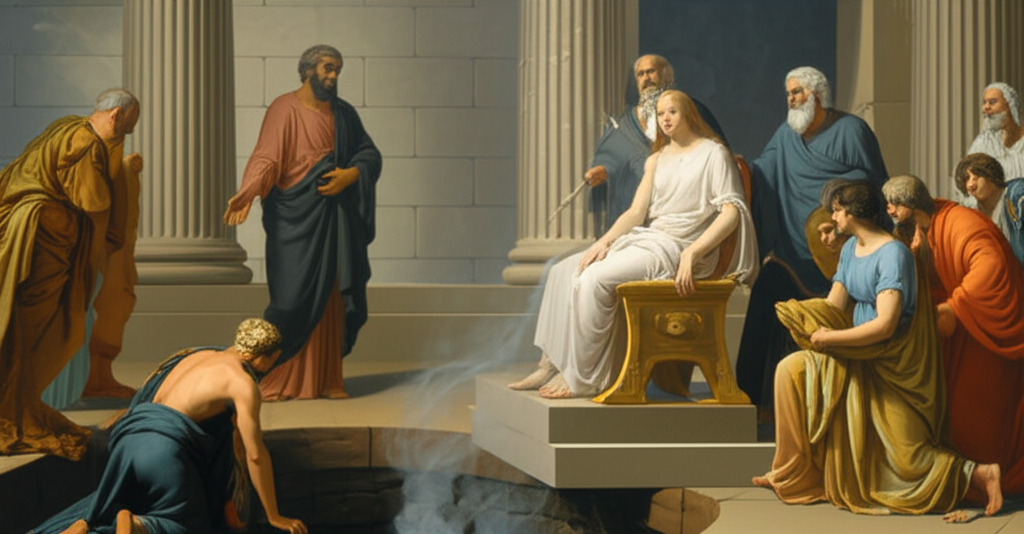
The Great Books of the Western World offer a rich tapestry of perspectives on prophecy. In ancient Greece, figures like Plato pondered the nature of divine inspiration and the knowledge it might convey. While not always directly discussing "prophecy" in the biblical sense, his dialogues, such as Timaeus, explore the relationship between the eternal and the temporal, hinting at a divine order that underpins all events. The Pythia at Delphi, though often ambiguous, was a pivotal source of guidance, demonstrating the cultural weight placed on such pronouncements.
For the Roman world, as chronicled by Virgil in the Aeneid, omens and augury played a crucial role in decision-making, reflecting a belief that the gods communicated through signs. This wasn't always about explicit verbal prophecy but rather the interpretation of natural phenomena to infer future events.
However, it is perhaps in the Abrahamic religions that prophecy takes on its most direct and ethically charged form. The Old Testament prophets, from Isaiah to Jeremiah, delivered divine messages that were not merely predictions but often calls to repentance, warnings, or promises of future redemption. Here, prophecy is inextricably linked to divine will and moral responsibility.
Key Forms of Prophetic Expression:
- Divine Revelation: Direct communication from a deity, often through a chosen individual (e.g., biblical prophets).
- Oracular Pronouncements: Ambiguous or symbolic messages delivered by a sacred figure or institution (e.g., the Oracle of Delphi).
- Omens and Augury: Interpretation of natural phenomena, dreams, or signs to discern future events (e.g., Roman augurs).
- Visionary Experiences: Personal, often vivid, insights into future occurrences.
The Philosophical Nexus: Prophecy, Time, and Free Will
The most profound philosophical quandary posed by prophecy lies in its relationship to time and human freedom. If a future event is truly prophesied, does that mean it is destined to happen? And if so, what becomes of free will?
Table 1: Philosophical Challenges of Prophecy
| Philosophical Concept | Prophecy's Implication | Leading Thinkers
This challenge has been a recurring theme in the history of philosophy and religion.
- Divine Foreknowledge vs. Human Freedom: St. Augustine, in The City of God, grappled with God's perfect
knowledgeof the future and its implications for human free will. He argued that God's foreknowledge doesn't cause our actions but rather perceives them, much like our memory perceives the past. Our will remains free, even if its outcome is known to an omniscient being. Later, Thomas Aquinas, in Summa Theologica, further refined this, distinguishing between God's eternal present (where alltimeis simultaneously accessible) and our temporal, linear experience. - The Problem of Causality: If a prophecy states an event will happen, can our actions change it? The Greek myth of Oedipus is a tragic example of attempts to defy prophecy only serving to fulfill it. This suggests a deterministic view of
time, where the future is already set, and our choices are merely part of the mechanism by which it unfolds. - Epistemology of the Future: How can we have
knowledgeof something that doesn't yet exist? Aristotle, in On Interpretation, discussed the truth value of statements about future contingents (events that may or may not happen). He argued that while past and present statements have definite truth values, future contingents do not necessarily, to preserve the possibility of choice. This philosophical stance directly challenges the notion of absolute, certainprophecy.
The Interpretation of Prophecy: A Human Endeavor
Rarely is prophecy delivered in plain, unequivocal terms. Its power often lies in its ambiguity, requiring interpretation. This act of interpretation is where human knowledge and perspective intersect with the purported divine or mystical insight. The symbolic language, visions, and parables used in many prophecies necessitate careful thought, making the fulfillment of a prophecy as much about human understanding and action as it is about predetermined events.
This interpretive aspect reminds us that prophecy, even when considered genuine, is mediated by human consciousness and culture. It forces us to confront the limits of our knowledge and the complexities of communicating truths that transcend ordinary experience.
Conclusion: The Enduring Mystery of Time's Unveiling
The nature of prophecy and time remains a fertile ground for philosophical inquiry. Whether viewed as divine revelation, a deep intuition, or merely a sophisticated form of prediction, prophecy continues to challenge our understanding of causality, free will, and the very fabric of existence. The Great Books of the Western World provide an invaluable framework for navigating these profound questions, reminding us that the human quest for knowledge of what lies ahead is as ancient as time itself, and perhaps, as eternal. The true value of engaging with prophecy might not be in knowing the future, but in how it compels us to reflect on our present choices and the nature of our reality.
YouTube Video Suggestions:
-
📹 Related Video: What is Philosophy?
Video by: The School of Life
💡 Want different videos? Search YouTube for: ""determinism free will philosophy" - Explore videos discussing the philosophical debate between determinism and free will, crucial for understanding the implications of prophecy."
2. ## 📹 Related Video: What is Philosophy?
Video by: The School of Life
💡 Want different videos? Search YouTube for: ""ancient greek oracles philosophy" - Look for videos that delve into the role of oracles like Delphi in ancient Greek thought and their philosophical significance."