

The Unfolding Enigma: Prophecy, Time, and the Human Quest for Knowledge
Summary:
This article explores the intricate relationship between prophecy and time, delving into the philosophical paradoxes that arise when foreknowledge confronts human free will. We examine how different philosophical and religious traditions have conceptualized time and integrated prophetic insights, highlighting the profound implications for our understanding of destiny, agency, and the very nature of knowledge.
There's something inherently captivating, almost magnetic, about the idea of prophecy. It whispers of a future already written, a grand narrative unfolding before our very eyes, yet just beyond our grasp. But what does it truly mean to "know" the future? And how does this foreknowledge square with our lived experience of time as a continuous, dynamic flow where our choices seem to genuinely matter? For centuries, thinkers from the ancient Greeks to medieval theologians and modern philosophers have grappled with this profound tension, seeking to reconcile the seemingly predetermined nature of prophecy with the undeniable sensation of free will. It’s a quest for knowledge that touches the very core of what it means to be human, to exist within the currents of time, and to ponder the ultimate truths of our existence, often within the frameworks of religion.
The Paradox of Prophecy and Free Will
At the heart of the philosophical debate surrounding prophecy lies a fundamental paradox: if the future is truly knowable, even by a divine or exceptional mind, what then becomes of human freedom? This isn't just a theological quibble; it's a deep philosophical problem that has vexed some of the sharpest minds in history.
Consider the implications:
- Determinism vs. Agency: If a prophecy states an event will happen, does it strip away any genuine choice leading up to that event? Are our actions merely instruments in a cosmic play, or do they hold genuine causal power? The Great Books, from Boethius's Consolation of Philosophy to Augustine's City of God, wrestle with God's foreknowledge and human responsibility, often concluding that divine knowledge doesn't cause events, but merely perceives them across an eternal present.
- The Nature of Knowledge: What kind of knowledge is prophetic knowledge? Is it akin to knowing a mathematical truth, immutable and eternal? Or is it a special kind of insight that transcends typical empirical observation? This question pushes us to consider the very limits and possibilities of human understanding.
Bold statement: The very essence of our moral and ethical frameworks hinges on the premise that our choices are real, not merely echoes of a predestined script.
Time: A River, A Dimension, or an Illusion?
To understand prophecy, we must first confront our understanding of time itself. Is time a linear progression, a series of discrete moments moving from past to present to future? Or is it something more complex, perhaps a dimension, a human construct, or even an illusion?
Philosophers have offered diverse perspectives:
-
Augustine's Subjective Time: In his Confessions, St. Augustine famously pondered, "What then is time? If no one asks me, I know; if I wish to explain it to one who asks, I do not know." He concluded that time is not a physical substance but a "distention of the soul," existing primarily in the human mind as memory (past), attention (present), and expectation (future). For Augustine, God exists outside of time in an eternal present, seeing all moments simultaneously. This perspective offers a way to reconcile divine omniscience with human freedom, as God's knowledge isn't prior in a temporal sense, but rather encompassing.
-
Kant's Transcendental Idealism: Immanuel Kant argued that time is not an objective feature of the world-in-itself, but rather a fundamental "form of intuition" inherent in the human mind. We perceive events in time because our minds are structured to do so. This makes time a condition for our experience, not an independent reality that we merely observe. If time is a mental construct, then prophetic knowledge might operate on a different plane of reality, one unconstrained by our ordinary temporal perceptions.
-
Cyclical vs. Linear Time: Ancient philosophies, particularly in the East and even some Greek thought (e.g., the Stoics, Nietzsche's eternal recurrence), often conceived of time as cyclical, with events repeating themselves. Western religion, particularly Abrahamic faiths, largely adopted a linear view of time, with a creation, a progression, and an ultimate end, providing a distinct framework for understanding unique, unfolding prophecies.
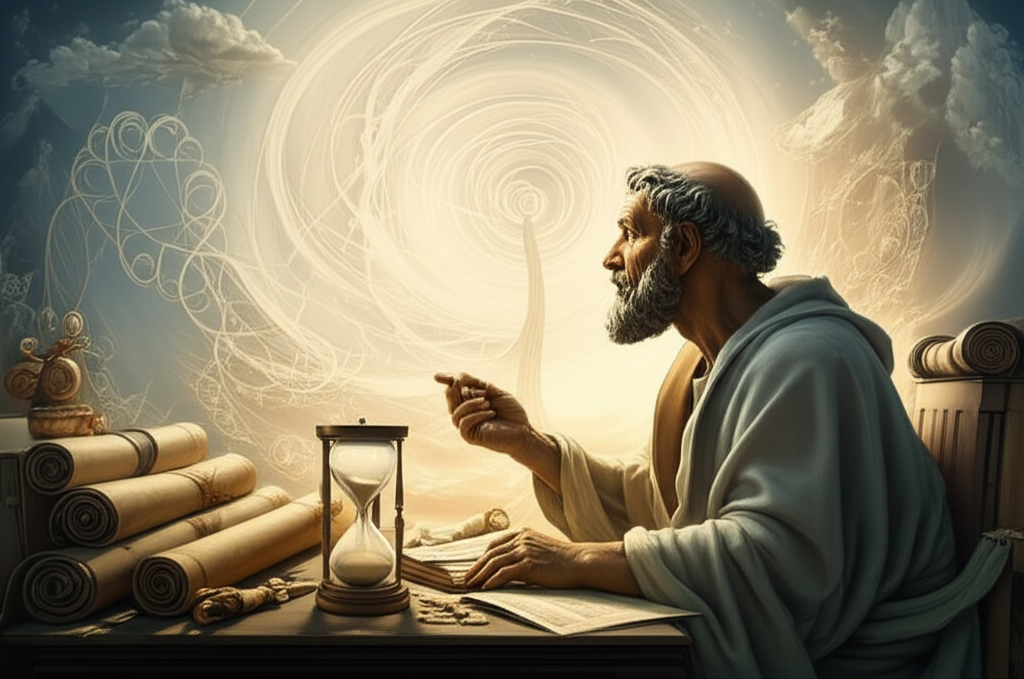
Prophecy's Enduring Role in Religion and Society
Beyond its philosophical conundrums, prophecy has played an undeniably potent role in religion and society throughout history. It offers comfort, guidance, and a sense of purpose, often shaping the destinies of nations and individuals alike.
- Divine Revelation: In many religions, prophecy is seen as a direct channel to divine will, providing moral laws, future warnings, or promises of salvation. The prophets of the Old Testament, the oracles of ancient Greece, or the seers in various indigenous traditions all served as conduits for knowledge believed to originate from a higher power. This imbues prophetic pronouncements with immense authority and shapes the beliefs and actions of entire communities.
- Social Cohesion and Control: Prophetic narratives can create a shared vision of the future, uniting people under a common cause or identity. They can also be used to legitimize power structures or to instigate revolutionary movements. The promise of a messianic age, for example, has historically offered hope and direction to oppressed populations.
- The Psychological Appeal: The human desire to alleviate uncertainty about the future is powerful. Prophecy, even when vague or symbolic, taps into this innate human need for security and understanding. It offers a narrative framework to interpret chaotic events and provides a sense of meaning in an often unpredictable world.
Seeking Knowledge Beyond the Veil
The enduring fascination with prophecy speaks to a deep human yearning for ultimate knowledge – not just of what is, but of what will be. It's an aspiration that challenges the very limits of our perception and reason.
- The Limits of Human Knowledge: Philosophers like David Hume questioned the possibility of knowing the future through reason alone, arguing that our knowledge is primarily derived from experience. We can infer probabilities, but not certainties, without an external, non-empirical source.
- The Value of Uncertainty: Some philosophical traditions, particularly those emphasizing existential freedom, might argue that the unknowability of the future is precisely what gives life its meaning and moral weight. If everything were predetermined and known, would our struggles, our triumphs, and our choices truly matter?
- Wisdom vs. Foreknowledge: Perhaps the true quest isn't for foreknowledge of specific events, but for a deeper wisdom that allows us to navigate time with integrity, understanding our place within the larger cosmic order, and making choices that align with our values, irrespective of what the future holds.
Conclusion: Embracing the Temporal Mystery
The relationship between prophecy and time remains one of philosophy's most profound and enduring mysteries. It forces us to confront fundamental questions about causality, free will, the nature of knowledge, and the very fabric of reality itself. Whether viewed through the lens of religion, metaphysics, or epistemology, prophecy challenges our linear perception of time and our cherished belief in absolute agency.
Ultimately, perhaps the value of contemplating prophecy isn't in deciphering an exact future, but in prompting us to reflect on our present, to consider the weight of our choices, and to cultivate a deeper appreciation for the unfolding enigma of existence itself. The Great Books remind us that this journey of inquiry is as ancient as humanity, a timeless pursuit of understanding our place within the grand, temporal tapestry.
YouTube Suggestions:
-
📹 Related Video: What is Philosophy?
Video by: The School of Life
💡 Want different videos? Search YouTube for: "Augustine on Time Philosophy"
2. ## 📹 Related Video: What is Philosophy?
Video by: The School of Life
💡 Want different videos? Search YouTube for: "Determinism vs Free Will Philosophy Debate"