

The Unveiling Veil: The Nature of Prophecy and Knowledge Across Time
The allure of the unknown, particularly the future, has captivated humanity since time immemorial. Prophecy, in its various manifestations, stands as a testament to this enduring fascination, challenging our understanding of knowledge itself. This article delves into the philosophical underpinnings of prophecy, exploring its relationship with human cognition, the concept of Time, and its treatment within the foundational texts of Western thought. We will examine how prophecy confronts the limits of empirical understanding, raises profound questions about determinism versus free will, and ultimately compels us to re-evaluate what it truly means to "know."
Understanding Prophecy: A Philosophical Distinction
At its core, prophecy purports to offer foreknowledge of future events, often attributed to divine inspiration or a profound, non-empirical insight. This immediately distinguishes it from mere prediction, which relies on observable patterns, scientific laws, or statistical probabilities. While a meteorologist predicts tomorrow's weather based on current atmospheric conditions, a prophet speaks of events not deducible from present data, often with an air of absolute certainty or divine imperative.
The philosophical challenge lies in reconciling such claims with our conventional understanding of knowledge. If knowledge is justified true belief, how can one justify a belief about an event that has not yet occurred and may not even be determined? This tension forms the bedrock of our inquiry.
Knowledge, Time, and the Fabric of Reality
Our concept of knowledge is intrinsically tied to Time. We typically "know" what is or what has been. To claim knowledge of what will be introduces a unique set of philosophical quandaries:
- Epistemological Hurdles: How can an event that exists only as potentiality be an object of certain knowledge? Does prophetic knowledge imply a different mode of knowing, perhaps one that transcends the linear progression of time?
- The Problem of Determinism: If a future event is truly known, does that imply it is fixed, thereby negating free will? Philosophers like St. Augustine, in Confessions and The City of God, grappled extensively with God's foreknowledge and human freedom, concluding that divine knowledge does not cause events but rather perceives them as eternally present. God's knowledge is not in time, but of all time.
- The Nature of Time Itself: Is time a fundamental, flowing reality, or merely a construct of human perception? If, as some suggest, all moments exist simultaneously in a higher dimension, then prophetic insight might be a glimpse into this eternal present. Boethius, in The Consolation of Philosophy, further explored God's eternal present, where all time is simultaneously "now."
The very nature of time, as explored by the likes of Aristotle in Physics and later by figures like Immanuel Kant, shapes our ability, or inability, to comprehend foreknowledge. For Aristotle, time is the measure of motion, linking it firmly to the changing world of experience. Prophecy, then, would require a form of insight that either transcends or fundamentally reinterprets this empirical framework.
Prophecy in the Great Books of the Western World
The intellectual landscape of the Great Books offers a rich tapestry of perspectives on prophecy, reflecting its pervasive influence on human thought:
-
Ancient Greece: Oracles and Divine Madness
- In Homer's epics, such as The Odyssey, figures like Tiresias possess profound prophetic powers, guiding heroes through perilous journeys. These prophecies are often delivered through divine inspiration, serving as reflections of the gods' will and the inexorable hand of fate.
- Plato, in dialogues like Phaedrus, speaks of a "divine madness" (mania) that can inspire poets, lovers, and prophets, lifting them beyond ordinary human reason. While Plato generally champions rational inquiry, he acknowledges a realm of inspired insight, though perhaps distinct from the rigorous episteme (true knowledge) he sought. The Forms themselves, as eternal and unchanging truths, might be seen as a kind of prophetic knowledge for the philosopher who ascends to grasp them, offering insight into the true nature of reality beyond temporal flux.
-
The Abrahamic Tradition: Revelation and Divine Plan
- The Bible presents prophecy as a cornerstone of divine revelation, where God communicates His will and future plans through chosen individuals. Figures like Moses, Isaiah, and Jeremiah are conduits for divine messages, often concerning the destiny of nations or the coming of a messiah. Here, prophecy is not merely prediction but a covenantal act, shaping human history according to a divine purpose.
- St. Augustine, deeply influenced by Biblical tradition, viewed prophecy as an undeniable aspect of God's interaction with humanity. He meticulously analyzed how prophecies fulfilled in Christ demonstrated the truth of Christianity, underscoring God's ultimate sovereignty over Time and destiny.
-
Medieval Scholasticism: Reconciling Faith and Reason
- St. Thomas Aquinas, in his Summa Theologica, systematically addressed prophecy within a rational theological framework. He classified prophecy as a gratuitous grace, a special gift from God that perfects the intellect to know future contingent events. For Aquinas, God's knowledge is eternal and comprehensive, encompassing all past, present, and future as if simultaneously present. Prophecy, therefore, is a participation in this divine foreknowledge, not contradictory to reason but transcending it.
-
The Enlightenment and Beyond: From Revelation to Reason
- With the rise of empiricism and rationalism, figures like Francis Bacon and René Descartes shifted the focus of knowledge acquisition firmly towards observation, experimentation, and logical deduction. Prophecy, in its traditional sense, became increasingly difficult to accommodate within this new scientific paradigm. It was often reinterpreted as metaphorical insight, psychological projection, or simply dismissed as superstition. Even in later philosophical works, the discussion of prophecy often moves from its literal truth to its sociological or psychological impact.
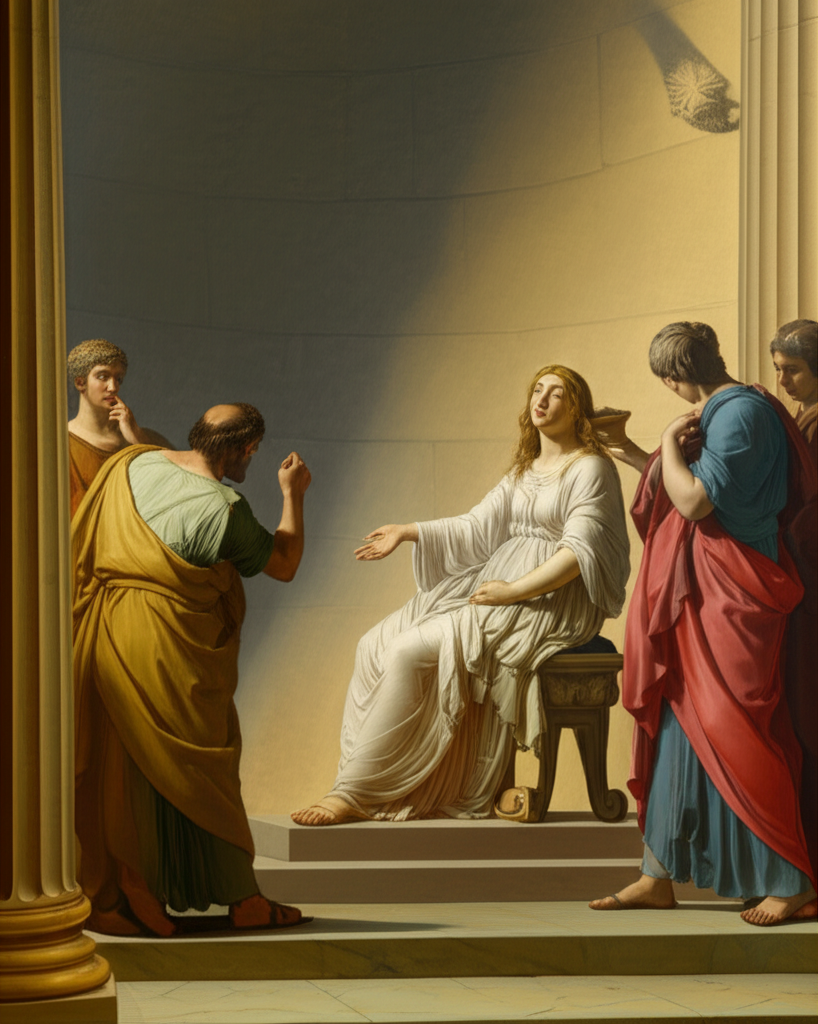
The Nature of Prophetic Knowledge: A Synthesis
Can prophetic knowledge be truly "known" in the same way we know that the sun rises in the east? The philosophical journey suggests a more nuanced understanding. Prophecy, particularly divine prophecy, often operates outside the empirical framework that defines much of our modern concept of knowledge. It invites us to consider:
- A Different Epistemology: Perhaps prophetic knowledge represents an alternative mode of knowing—an intuitive, revelatory, or even non-linear understanding that bypasses the sensory and rational filters we typically employ.
- The Role of Interpretation: Prophecies are often cryptic, requiring interpretation. This suggests that even if the "source" is true, human understanding remains fallible, introducing an element of contingency.
- Its Enduring Philosophical Value: Regardless of whether one believes in the literal truth of prophecy, its study compels profound philosophical reflection on Time, causality, determinism, free will, the limits of human cognition, and the potential for transcendent experience.
To clarify these distinctions, consider the following:
| Type of Future-Oriented Insight | Basis of Knowledge | Relationship to Time | Certainty/Nature |
|---|---|---|---|
| Scientific Prediction | Empirical data, natural laws | Extrapolates from past/present | Probabilistic, conditional |
| Intuitive Foresight | Subconscious pattern recognition, "gut feeling" | Glimpse of potential outcomes | Subjective, often unreliable |
| Philosophical Speculation | Reason, logical deduction of consequences | Hypothetical future states | Logical consistency, not factual |
| Divine Prophecy | Supernatural revelation, direct divine insight | Transcends linear time (God's view) | Absolute (if truly divine), often veiled in human language |
Conclusion: The Enduring Enigma
The nature of prophecy and its relationship to knowledge remains one of philosophy's most enduring and captivating inquiries. From the oracles of ancient Greece to the intricate theological doctrines of medieval scholars, humanity has relentlessly sought to pierce the veil of Time, yearning for a glimpse of what lies ahead. While modern thought often approaches such claims with skepticism, the philosophical questions raised by prophecy are timeless.
Prophecy, whether literal or symbolic, serves as a powerful lens through which we explore the boundaries of human understanding, the concept of destiny, and the very fabric of reality. It challenges us to consider that knowledge might encompass more than what is empirically verifiable or rationally deducible, inviting us to ponder realms where Time itself might bend, and where the future, for some, is already known.
**## 📹 Related Video: What is Philosophy?
Video by: The School of Life
💡 Want different videos? Search YouTube for: "Philosophy of Time and Free Will"**
**## 📹 Related Video: KANT ON: What is Enlightenment?
Video by: The School of Life
💡 Want different videos? Search YouTube for: "Ancient Greek Oracles and Prophecy"**