

The Unveiling of Tomorrow: Exploring the Nature of Prophecy and Knowledge
The human fascination with the future is as old as consciousness itself. From ancient oracles to modern data analytics, the desire to pierce the veil of what is to come remains a powerful drive. This article delves into the profound philosophical relationship between the Nature of Prophecy and the very essence of Knowledge, particularly as it intersects with our understanding of Time. We will explore how philosophical traditions, especially those found within the Great Books of the Western World, have grappled with the possibility and implications of knowing events before they unfold, distinguishing between mere foresight and a deeper, perhaps more elusive, prophetic insight. Ultimately, this inquiry compels us to reflect on the limits of human understanding and the intricate structure of reality itself.
I. The Perennial Question: What is Prophecy?
Prophecy, in its broadest sense, refers to the declaration of future events. Yet, its philosophical import extends far beyond simple prediction. It forces us to confront fundamental questions about causality, determinism, free will, and the very fabric of reality. Is prophecy a divine gift, a profound intuition, or a highly refined form of rational inference?
Throughout history, various interpretations have emerged:
- Divine Revelation: Many traditions, particularly Abrahamic ones, view prophecy as a direct communication from a divine source, transcending human intellect. Figures like Moses or Isaiah in the biblical tradition serve as conduits for a higher truth.
- Inspired Intuition: Plato, in dialogues such as Ion or Phaedrus, speaks of a divine madness or inspiration that can grant individuals access to truths beyond ordinary reason, hinting at a form of prophetic insight that isn't purely rational but divinely infused.
- Rational Foresight: Philosophers like Aristotle, while acknowledging the role of chance, also laid the groundwork for logical inference and the understanding of potentiality and actuality, which can lead to predictions based on observed patterns and principles of Nature.
- Cosmic Determinism: Some ancient Stoics believed in a predetermined cosmos where all events are fated. In such a system, prophecy would be the revelation of an already fixed future, knowable to those with sufficient insight into the universal order.
The Nature of prophecy, therefore, is not monolithic. It ranges from the supernatural to the deeply rational, each challenging our conventional understanding of Knowledge.
II. Prophecy and the Architecture of Knowledge
To speak of prophecy is to speak of a particular kind of Knowledge – a knowledge of what is not yet. This immediately distinguishes it from empirical knowledge (derived from sensory experience of the present or past) and even much of rational knowledge (deduced from universal principles).
Consider the following distinctions in the pursuit of knowing the future:
- Empirical Prediction: Based on observed regularities and scientific laws. For example, predicting an eclipse. This is a form of Knowledge derived from understanding the Nature of celestial mechanics.
- Rational Foresight: Involves logical deduction and extrapolation from current trends and data. An economist predicting a recession based on market indicators falls into this category. This is contingent Knowledge, subject to change.
- Prophetic Knowledge: This is the more challenging category. It implies knowing events that are not merely probable or deducible from current data, but are somehow revealed or directly apprehended. This raises questions about:
- Access to Future Truths: How can something that does not yet exist be known? Does it imply a non-linear view of Time?
- Certainty vs. Contingency: Is prophetic Knowledge absolute and unchangeable, or can it be influenced by human action?
- The Knower's Role: Is the prophet merely a passive receiver, or does their understanding and interpretation shape the prophecy?
Philosophers like Augustine, in his Confessions, grappled with the Nature of Time itself, noting that the future exists only as an expectation in the mind. If the future is not yet real, what is it that prophecy "knows"? This suggests that prophetic Knowledge might not be of a present future, but rather of a divine plan or an eternal truth that transcends temporal limitations.
III. Time: The Unyielding Constraint and Enabling Canvas
The relationship between Prophecy, Knowledge, and Time is perhaps the most intricate. Our ordinary experience of Time is linear – a progression from past to present to future. This linearity poses a significant challenge to the concept of knowing the future.
- Linear Time and Determinism: If the future is truly open and undetermined, then genuine Prophecy (beyond rational foresight) seems impossible, as there is nothing concrete to "know." However, if the future is predetermined, then Prophecy becomes a revealing of what is already fixed, raising questions about free will. Philosophers like Spinoza, with his emphasis on a deterministic Nature governed by immutable laws, would suggest that perfect Knowledge of the present would logically entail Knowledge of the future, though such perfect Knowledge is beyond human grasp.
- Non-Linear or Eternal Time: Some philosophical and theological perspectives propose a different view of Time. For God, or a supreme intellect, all Time (past, present, and future) might be eternally present. From this vantage point, Prophecy would be the partial revelation of this eternal present to beings trapped in linear Time. Aquinas, for instance, distinguished between God's eternal Knowledge (which encompasses all Time simultaneously) and human temporal knowledge.
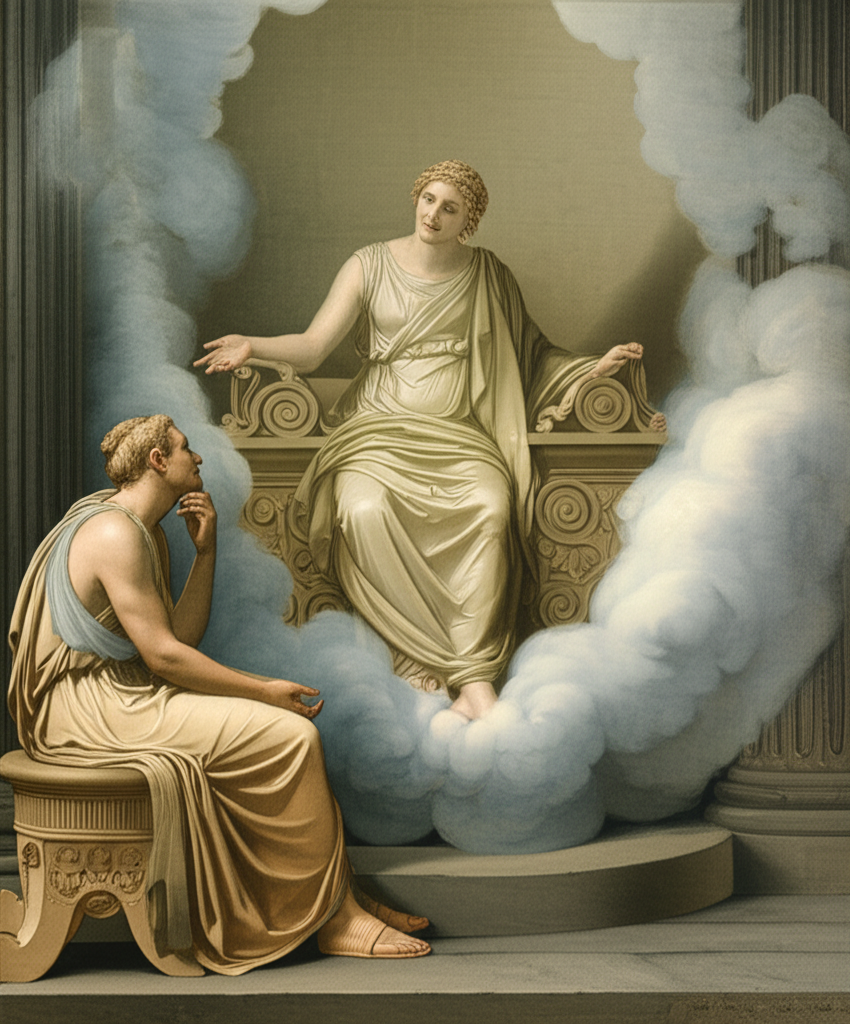
IV. Foresight vs. True Prophecy: A Critical Distinction
It is crucial to differentiate between rational foresight, which is a sophisticated form of Knowledge based on empirical and logical reasoning, and what we might call "true" prophecy, which implies a direct, non-inferential apprehension of future events.
| Feature | Rational Foresight (Prediction) | True Prophecy (Philosophical/Divine) |
|---|---|---|
| Basis | Empirical data, logical inference, statistical probability, understanding of cause and effect in Nature. | Intuition, revelation, inspiration, direct apprehension of a future truth. |
| Source of Knowledge | Human reason, observation, scientific principles. | Supernatural, divine, or profound, non-discursive philosophical insight. |
| Relationship to Time | Extrapolates from present and past trends into the future. Assumes linear Time. | Often implies transcending linear Time, accessing events as if already present. |
| Certainty | Probabilistic, contingent, subject to error or unforeseen variables. | Often presented as absolute, undeniable, or divinely guaranteed. |
| Nature of Knowledge | Inductive (from particulars to general laws), deductive (from general laws to particulars). | Direct apprehension, insight, revelation – a different mode of knowing. |
| Examples | Weather forecasting, economic modeling, scientific predictions. | Oracular pronouncements, biblical prophecies, philosophical visions of the future. |
The Great Books continually invite us to scrutinize claims of Prophecy through the lens of reason, even while acknowledging the limits of reason itself. Can one truly "know" the future without undermining the very concept of an open, dynamic reality?
V. The Enduring Philosophical Implications
The inquiry into the Nature of Prophecy and Knowledge is not merely an academic exercise; it has profound implications for how we understand ourselves and our place in the cosmos.
- Human Agency and Free Will: If the future is knowable through Prophecy, does this negate free will? Or does true Prophecy account for human choices as part of a larger, predetermined tapestry? This tension is a recurring theme in philosophical and theological debates, from Augustine to Kant.
- The Limits of Reason: The existence of Prophecy (if accepted as genuine) challenges the Enlightenment ideal that all Knowledge must be empirically verifiable or rationally deducible. It suggests there might be modes of knowing that transcend our ordinary faculties, perhaps touching upon the Nature of reality as understood by a divine intellect.
- The Search for Meaning: For many, Prophecy offers a sense of meaning and purpose, suggesting that events are not random but part of a larger plan. This can provide solace or inspire action, shaping human history and cultural narratives.
Conclusion: The Unfolding Tapestry of Time and Truth
The Nature of Prophecy and its relationship to Knowledge remain one of philosophy's most compelling and elusive subjects. From the ancient insights of the Great Books to contemporary reflections, the attempt to understand what it means to "know" the future forces us to confront the very essence of Time, the boundaries of human reason, and the fundamental Nature of existence. Whether viewed as divine revelation, profound intuition, or sophisticated foresight, Prophecy continues to challenge our assumptions, inviting us on a perpetual quest for deeper understanding into the mysteries that unfold with each passing moment.
**## 📹 Related Video: PLATO ON: The Allegory of the Cave
Video by: The School of Life
💡 Want different videos? Search YouTube for: ""Plato on Knowledge and Reality" or "Augustine's Philosophy of Time""**
**## 📹 Related Video: What is Philosophy?
Video by: The School of Life
💡 Want different videos? Search YouTube for: ""Determinism vs Free Will Philosophy""**