

The Enigmatic Interplay: Deconstructing the Nature of Prophecy and Knowledge
The human fascination with the future is as ancient as consciousness itself. From the oracles of Delphi to modern predictive algorithms, we ceaselessly strive to pierce the veil of what is to come. This enduring quest brings us to a profound philosophical inquiry: The Nature of Prophecy and Knowledge. At its core, this discussion grapples with the very limits of human understanding, the fabric of Time, and the elusive pathways to certainty. Is prophecy a form of divine insight, a sophisticated intuition, or merely a sophisticated guess? And how does our understanding of Knowledge shape, and is shaped by, our interpretation of such foretellings? This article delves into these intricate questions, drawing on the rich tapestry of thought presented in the Great Books of the Western World, to explore the philosophical underpinnings of foresight and understanding.
The Ancient Echoes of Foresight: Defining Prophecy
To speak of Prophecy is to immediately confront its multifaceted Nature. Historically, prophecy has been understood primarily as a divine revelation – a direct communication from a higher power, granting insight into future events or divine will. Figures like the Hebrew prophets, the Sibyls of ancient Greece, or even the seers in epic poems embody this traditional understanding. Yet, philosophy compels us to scrutinize this definition, asking:
- Is prophecy a unique cognitive faculty?
- Does it bypass conventional reasoning?
- Can it be distinguished from mere conjecture or skilled prediction?
Within the Great Books, we find discussions ranging from the theological certainty of prophetic utterances in sacred texts to Plato's exploration of divine madness (mania) in works like the Phaedrus, where certain forms of inspiration are deemed superior to ordinary sanity for apprehending truth. Aristotle, ever the empiricist, might approach such claims with a more cautious eye, seeking rational explanations or empirical evidence, yet even he acknowledges phenomena beyond immediate sensory perception.
Knowledge: The Foundation and the Frontier
Our understanding of Prophecy is inextricably linked to our concept of Knowledge. What constitutes knowledge? Is it justified true belief, as Plato famously explored in the Theaetetus? Or is it something more, something that transcends empirical observation and logical deduction? If prophecy offers a glimpse into the future, does this future knowledge adhere to the same epistemological criteria as knowledge of the past or present?
Consider the following distinctions in the pursuit of knowledge:
| Type of Knowledge | Description | Relation to Prophecy |
|---|---|---|
| A Priori Knowledge | Independent of experience (e.g., mathematical truths, logical deductions). | Prophecy, if true, might be a priori in its source but a posteriori in its verification. |
| A Posteriori Knowledge | Dependent on experience (e.g., scientific observations, historical facts). | Prophecy challenges this, purporting knowledge of events before experience. |
| Empirical Knowledge | Derived from sensory experience and observation. | Prophecy often claims to bypass empirical means. |
| Rational Knowledge | Derived from reason and logical inference. | Can prophecy be a form of rational insight, or is it suprarational? |
The core tension lies in how a future event, which by definition has not yet occurred and thus cannot be empirically observed, can be "known." This pushes the boundaries of traditional epistemology.
The Crucial Role of Time
Time is the ultimate arbiter and the greatest mystery in the discussion of prophecy. If prophecy is truly foreknowledge, it implies a non-linear or at least a highly privileged access to the temporal dimension.
- Does the prophet "see" a fixed future, suggesting determinism?
- Or do prophecies merely indicate tendencies, possibilities, or divine intentions that can be altered?
Augustine, in his Confessions and City of God, grappled extensively with the Nature of Time, particularly in relation to God's eternal Knowledge. For Augustine, God exists outside of Time, perceiving all moments – past, present, and future – simultaneously. From this perspective, prophecy is simply a divine communication of what is eternally known, rather than a "seeing into the future" in a human sense. This theological framework offers a powerful explanation for how prophecy could be possible without necessarily implying a deterministic human fate.
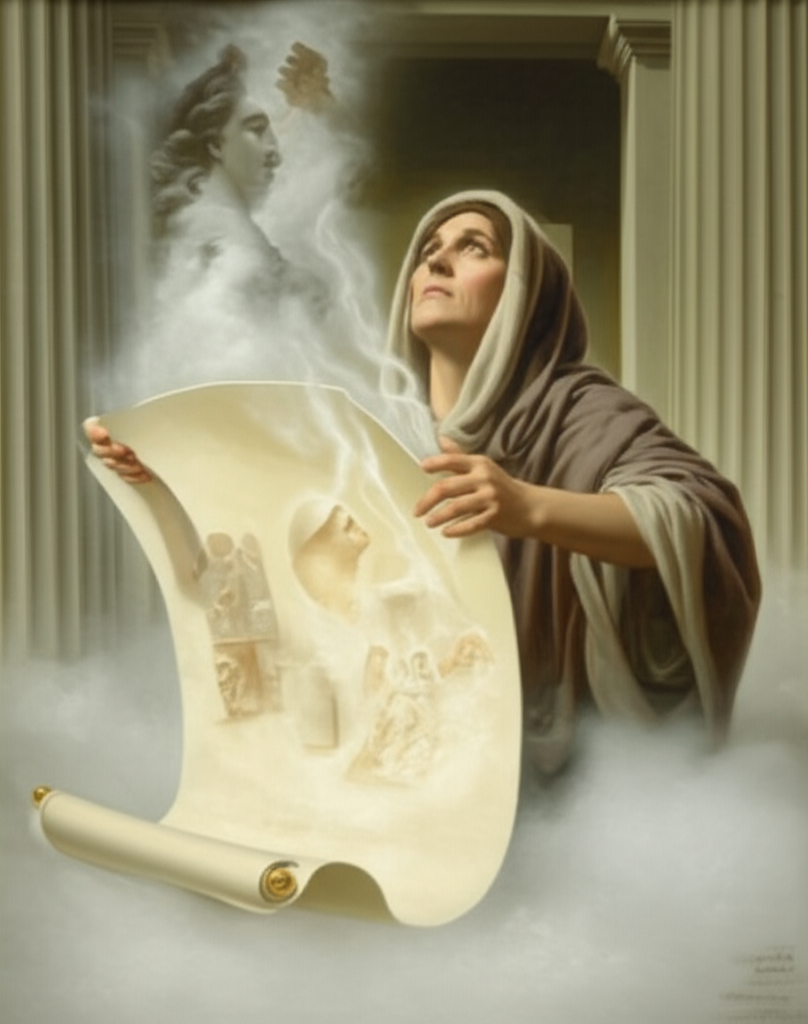
Distinguishing True Prophecy from Conjecture and Delusion
The challenge, then, is to discern genuine prophetic insight from mere speculation, charlatanism, or self-delusion. Throughout history, the Great Books offer guidance:
- Verification: The most straightforward test, though often only applicable post-factum, is whether the prophesied event comes to pass.
- Moral and Ethical Content: Many philosophical and theological traditions argue that true prophecy serves a higher moral or divine purpose, rather than merely predicting mundane events.
- Source and Authority: Is the source credible? Does it align with established truth or divine revelation? Aquinas, for instance, would emphasize the divine origin and conformity to theological truth.
- Clarity vs. Ambiguity: Oracles were often notoriously ambiguous, allowing for multiple interpretations. Does true prophecy offer unambiguous Knowledge, or is its Nature often veiled?
Kant, in his critical philosophy, would likely approach claims of prophecy with profound skepticism, placing emphasis on the limits of human reason and the impossibility of empirical Knowledge of the future. He would distinguish between the realm of phenomena (what we can experience) and noumena (things in themselves), and prophecy would likely fall into the latter, unknowable category for human reason alone.
The Enduring Inquiry
The exploration of The Nature of Prophecy and Knowledge remains a vital philosophical endeavor. It forces us to confront the boundaries of our own understanding, the elusive essence of Time, and the very definition of truth. Whether viewed as a divine gift, a profound psychological phenomenon, or a philosophical puzzle, prophecy challenges our conventional notions of Knowledge and causality. It compels us to ask not just what we know, but how we know, and whether there are dimensions of reality and Time that transcend our ordinary grasp.
YouTube:
- "Plato's Theory of Knowledge: The Divided Line and the Cave"
- "Augustine on Time and Eternity"
📹 Related Video: What is Philosophy?
Video by: The School of Life
💡 Want different videos? Search YouTube for: "The Nature of Prophecy and Knowledge philosophy"