

The Poetic Canvas of the Mind: Unpacking Imagination's Role in Art
Summary: At its core, poetry is not merely a structured arrangement of words but a profound expression of human imagination, a faculty that synthesizes memory and perception to create new realities. This article explores how imagination, drawing inspiration from the Nature of existence, crafts the intricate tapestry of Poetry, elevating it to a fundamental form of Art and a unique mode of philosophical inquiry. We delve into the philosophical underpinnings of this creative process, recognizing the inseparable bond between our inner world and the outer cosmos.
The Unseen Architecture: Imagination as the Foundation of Poetry
The human mind, in its ceaseless activity, constantly shapes and reshapes the world around us. Among its most potent faculties is imagination – a power that allows us to transcend the immediate, to conceive of what is not yet, or to reconfigure what has been. For the poet, this faculty is the very wellspring of creation. It is here, in the fertile ground of the mind, that observations of Nature merge with the echoes of Memory and Imagination, giving birth to verses that resonate with universal truths.
Aristotle, in his De Anima, touches upon phantasia, or imagination, as a critical intermediary between perception and thought, enabling us to hold images in our minds even in the absence of the sensory input. This capacity is vital for poetry, allowing the poet to conjure vivid scenes, evoke complex emotions, and explore abstract concepts through concrete imagery.
Crafting Worlds: The Interplay of Memory and Imagination
The act of poetic creation is rarely an invention ex nihilo. Instead, it is a sophisticated dance between what we have experienced and what we can conceive. Memory and Imagination are inextricably linked, each feeding the other. Memory provides the raw material – the sights, sounds, feelings, and thoughts accumulated over a lifetime. Imagination then acts as the architect, selecting, arranging, and transforming these fragments into something novel and resonant.
Consider how a poet describes a sunset. They don't merely recount the colors; they imbue the scene with feeling, perhaps drawing on a past memory of solace or sorrow associated with a similar moment. This is imagination at work, not just recalling, but re-creating and re-interpreting through the lens of subjective experience.
Table: Faculties of the Mind in Poetic Creation
| Faculty | Primary Function in Poetry | Philosophical Origin (e.g., Great Books) |
|---|---|---|
| Perception | Gathers sensory data from Nature; direct observation. | Aristotle's De Anima |
| Memory | Stores past perceptions and experiences; source of imagery. | Augustine's Confessions (Book X) |
| Imagination | Synthesizes, transforms, and invents; bridges the real and ideal. | Aristotle's phantasia; Plato's Forms |
| Reason | Structures thought, analyzes concepts, applies rhetorical devices. | Plato's Republic; Aristotle's Poetics |
Poetry as a Mirror and a Lamp: Reflecting and Illuminating Nature
Poetry, as a distinct form of Art, possesses a unique ability to both reflect Nature and illuminate its deeper meanings. It is a mirror, reflecting the beauty, brutality, and intricate patterns of the world around us. Yet, it is also a lamp, shining a light into the hidden corners of human experience and the mysteries of existence.
The poet, through the power of imagination, doesn't just describe a tree; they might explore its rootedness, its resilience, its ancient wisdom, or its fleeting beauty, connecting it to the human condition. This deep engagement with Nature transcends mere observation, becoming an act of profound interpretation. The words chosen, the rhythm established, the metaphors employed – all serve to unlock a deeper understanding that prose might overlook.
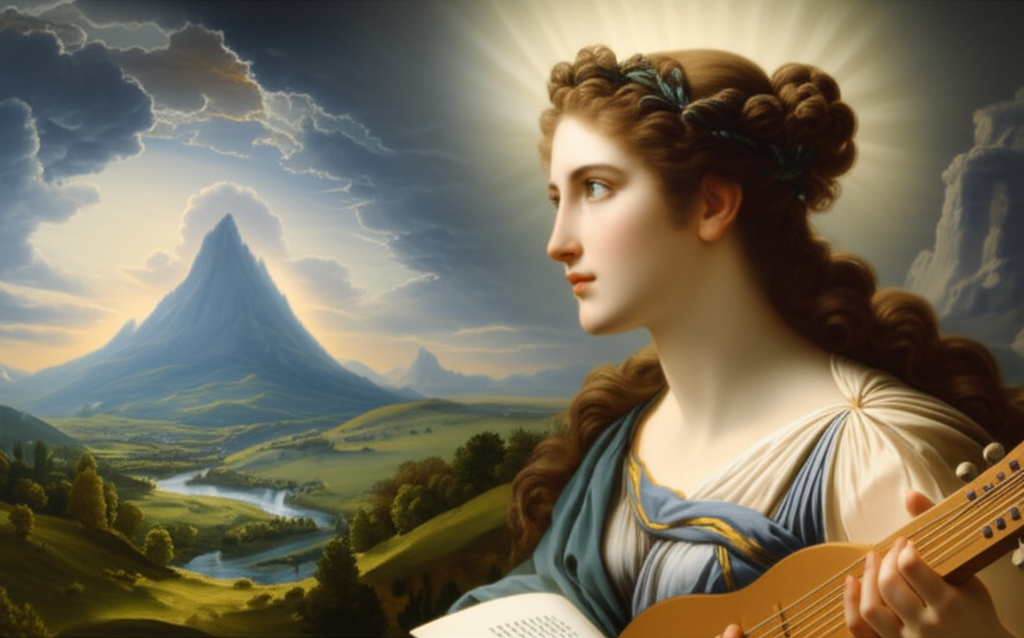
Art's Wider Embrace: Poetry's Place in Creative Expression
While poetry holds a special place, it is intrinsically linked to the broader concept of Art. Whether it's painting, sculpture, music, or drama, all forms of art are products of the human imagination seeking to express, interpret, or challenge reality. Poetry, through its medium of language, shares many aims with these other forms: to evoke emotion, to explore truth, to create beauty, and to offer new perspectives.
The philosophical discussions of Art in the Great Books of the Western World, from Plato's concerns about mimesis to Aristotle's analysis of catharsis in tragedy, highlight the power and potential pitfalls of artistic creation. Poetry, in this context, is a powerful tool for shaping understanding and feeling, capable of both elevating the soul and, as some philosophers feared, misleading it. Yet, it is precisely this power that makes it so compelling and enduring.
The Enduring Resonance: Poetry as Philosophical Inquiry
Ultimately, The Nature of Poetry and Imagination reveals itself as a continuous philosophical inquiry. Poetry, fueled by the imaginative faculty, doesn't just describe the world; it questions it, it interprets it, and in doing so, it helps us to understand ourselves and our place within the grand scheme of Nature. It is through the poet's unique vision, shaped by Memory and Imagination, that humanity seeks to articulate the ineffable, to find meaning in the mundane, and to give voice to the unspoken truths of existence.
This enduring pursuit ensures that poetry remains not just a beautiful Art form, but a vital pathway to philosophical insight, constantly inviting us to see the world anew.
YouTube Video Suggestions:
-
📹 Related Video: PLATO ON: The Allegory of the Cave
Video by: The School of Life
💡 Want different videos? Search YouTube for: ""Plato on Poetic Inspiration and Mimesis""
2. ## 📹 Related Video: ARISTOTLE ON: The Nicomachean Ethics
Video by: The School of Life
💡 Want different videos? Search YouTube for: ""Aristotle Poetics Imagination Phantasia Explained""