

The Nature of Light: A Journey Through Physics and Philosophy
Summary:
Light, that ubiquitous and indispensable phenomenon, has captivated human thought for millennia. From ancient philosophical inquiries into its essence to the profound revelations of modern physics, its nature has proven to be far more complex and intriguing than initially imagined. This article explores the evolving understanding of light, tracing its conceptual journey from a divine element to a paradoxical entity that challenges our very notions of reality, revealing how scientific discovery often deepens philosophical wonder.
The Ancient Gaze: Light as Element and Epiphany
For early thinkers, light was not merely something seen, but often seen as an element of the divine, an emanation, or a fundamental component of perception itself. In the Great Books of the Western World, we find Plato's famous Allegory of the Cave, where light symbolizes truth and enlightenment, illuminating the path from shadows to reality. Aristotle, too, pondered light not as a body, but as an activity—a quality of the transparent medium made actual by fire or similar sources, allowing for the act of seeing.
These early philosophical perspectives laid the groundwork for centuries of inquiry, positioning light not just as a physical phenomenon, but as a key to understanding existence, knowledge, and even the divine. The very nature of our perception, it was understood, was inextricably linked to the presence of light.
Early Theories: Emission vs. Undulation
As philosophical inquiry gave way to more systematic scientific observation, two primary schools of thought emerged regarding light's physical mechanics:
- Emission Theory: Advocated by thinkers like Isaac Newton, this theory proposed that light consisted of tiny particles, or "corpuscles," emitted by luminous bodies. This explained phenomena like reflection and refraction quite well.
- Undulation Theory: Championed by Christiaan Huygens, this theory posited that light traveled as waves through a medium, much like sound. This offered better explanations for phenomena like diffraction and interference.
For a time, Newton's formidable reputation lent significant weight to the corpuscular theory, but the debate was far from settled.
The Wave Revolution: Light's Elegant Mechanics
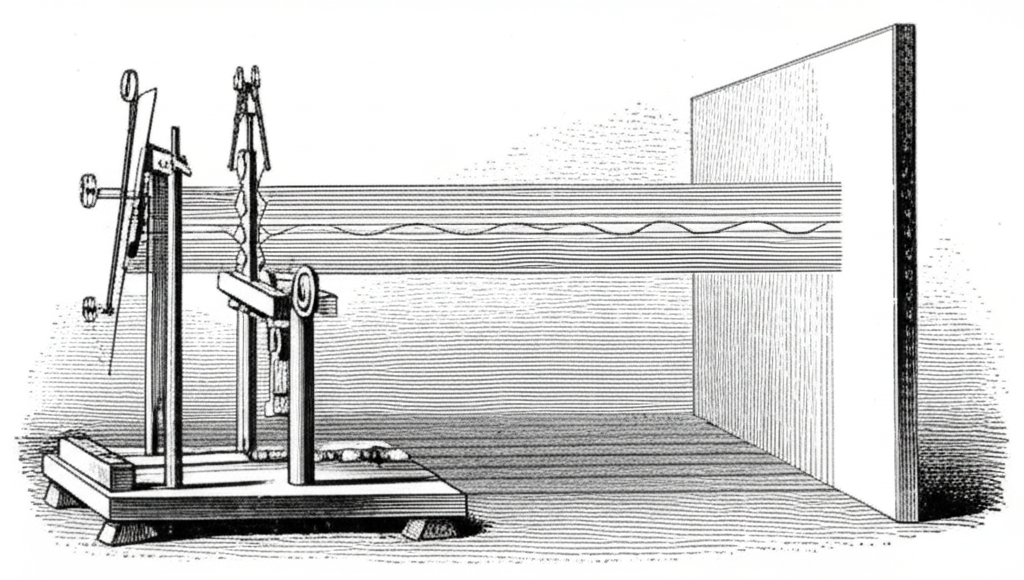
The 19th century witnessed a decisive shift in the understanding of light's nature. Experiments by Thomas Young demonstrating interference patterns provided compelling evidence for the wave theory. However, it was James Clerk Maxwell who truly revolutionized our comprehension.
Maxwell's Equations and Electromagnetic Waves:
Maxwell, through his brilliant synthesis of electricity and magnetism, predicted the existence of electromagnetic waves traveling at a specific speed. When this speed was calculated, it remarkably matched the known speed of light. This profound discovery led to the conclusion that light itself is an electromagnetic wave.
- Key Characteristics of Light as a Wave:
- Wavelength (λ): The distance between two consecutive crests or troughs.
- Frequency (f): The number of waves passing a point per second.
- Speed (c): Constant in a vacuum, approximately 299,792,458 meters per second.
- Transverse Wave: Oscillations are perpendicular to the direction of energy propagation.
This wave model beautifully explained phenomena such as:
- Reflection
- Refraction
- Diffraction
- Interference
- Polarization
The universe, it seemed, was awash in an invisible "luminiferous ether" through which these light waves propagated. The mechanics of light appeared settled—it was a wave.
The Quantum Enigma: Light as Particle and the Wave-Particle Duality
Just as the wave theory seemed to offer a complete picture, the early 20th century brought new puzzles that challenged this elegant model, forcing physics to confront a deeper, more perplexing nature of light.
Planck and the Quantization of Energy:
Max Planck, while trying to explain black-body radiation, proposed that energy is not continuous but emitted and absorbed in discrete packets, or "quanta." This was a radical idea, implying that light, even if a wave, behaved in some ways like a collection of energy packets.
Einstein and the Photoelectric Effect:
Albert Einstein, building on Planck's work, explained the photoelectric effect (where light striking a metal surface ejects electrons) by proposing that light itself consists of discrete bundles of energy, which he called "light quanta" or photons. This resurrected the particle theory of light, but in a new, quantum form.
The Paradoxical Nature: Wave-Particle Duality
The most profound revelation was the concept of wave-particle duality. Light, it turns out, exhibits properties of both waves and particles, depending on how it is observed or measured.
| Phenomenon Explained by Wave Model | Phenomenon Explained by Particle Model |
|---|---|
| Diffraction | Photoelectric Effect |
| Interference | Compton Scattering |
| Polarization | Discrete energy levels (photons) |
| Refraction |
This duality is not a contradiction but a fundamental aspect of reality at the quantum level. The mechanics of light are neither exclusively wave nor exclusively particle, but a blend of both. It forces us to reconsider the very nature of what we perceive as "real" and how we define fundamental elements of the universe.
Philosophical Echoes in Modern Physics
The journey to understand the nature of light is a testament to the enduring human quest for knowledge, bridging the gap between ancient philosophical wonder and cutting-edge scientific inquiry. The wave-particle duality, in particular, has profound philosophical implications:
- The Role of Observation: Quantum mechanics suggests that the act of observation can influence the outcome, challenging the notion of an objective reality independent of the observer.
- Limits of Classical Intuition: Our everyday experience, based on macroscopic objects, struggles to grasp the counter-intuitive nature of light at the quantum scale, pushing the boundaries of human comprehension.
- The Universe as a Mystery: Despite our advancements, light remains an element of profound mystery, constantly reminding us of the vastness and complexity of the cosmos.
YouTube Video Suggestions:
-
📹 Related Video: KANT ON: What is Enlightenment?
Video by: The School of Life
💡 Want different videos? Search YouTube for: "The Wave-Particle Duality Explained Simply"
-
📹 Related Video: KANT ON: What is Enlightenment?
Video by: The School of Life
💡 Want different videos? Search YouTube for: "Maxwell's Equations and the Speed of Light"