

The Enigmatic Dance: Unveiling the Nature of Light in Physics
Light, the very medium through which we perceive the world, has always captivated both scientists and philosophers. Its nature has been a subject of profound inquiry, evolving from ancient philosophical musings about an ethereal element to the complex tenets of modern quantum physics. This article explores the historical and scientific journey to understand light, revealing its perplexing dual mechanics as both a wave and a particle, and reflecting on the deeper philosophical implications of this fundamental aspect of our reality. From the Great Books of the Western World to the cutting edge of quantum theory, light remains a beacon for understanding the universe and our place within it.
The Dawn of Inquiry: Light in Ancient Thought
Before the advent of modern physics, the nature of light was primarily a philosophical and observational puzzle. Ancient Greek thinkers, whose foundational ideas are preserved in the Great Books of the Western World, grappled with its essence:
- Plato: In his Republic, Plato famously used the allegory of the cave, where shadows cast by light were the only reality prisoners knew. For him, light was intrinsically linked to truth and knowledge, an illuminating force that allowed perception of true Forms. It wasn't just a physical phenomenon but a metaphor for intellectual enlightenment.
- Aristotle: Unlike Plato's more abstract view, Aristotle considered light a quality or activity of a transparent medium, not a substance unto itself. He described it as the actualization of the transparent, rather than a flowing element or particle. His focus was on the mechanics of how vision occurred, suggesting light was a state rather than a thing.
These early inquiries, though lacking empirical tools, established light as a central theme in discussions about perception, reality, and knowledge, setting the stage for centuries of debate.
The Classical Debate: Waves vs. Particles
The scientific revolution brought new tools and theories to bear on light's nature. For centuries, two competing theories dominated the discourse:
The Corpuscular Theory
Championed by Isaac Newton, this theory proposed that light consisted of tiny, discrete particles or "corpuscles" emitted by luminous bodies. Newton's experiments with prisms, demonstrating light's dispersion into colors, seemed to support this view, as particles could explain reflection and refraction by simple mechanical interactions. This theory aligned well with the prevailing mechanics of the era.
The Wave Theory
Conversely, Christiaan Huygens argued that light was a wave propagating through an invisible medium called the "aether." His theory could explain phenomena like diffraction and interference, which were difficult to reconcile with a purely particle-based model. However, without direct evidence for the aether, Newton's formidable reputation often overshadowed Huygens's elegant wave mechanics.
The early 19th century saw a critical turning point with Thomas Young's double-slit experiment, which definitively demonstrated interference patterns, a hallmark of wave behavior. This provided strong evidence for light's wave nature, seemingly putting the particle theory to rest.
The Quantum Revolution: Light's Astonishing Duality
Just as the wave theory seemed victorious, new discoveries at the turn of the 20th century shattered this simple understanding, ushering in the era of quantum physics and revealing light's most profound secret:
- Planck's Quanta (1900): Max Planck, while studying black-body radiation, proposed that energy is not continuous but emitted and absorbed in discrete packets, which he called "quanta." This was a revolutionary idea, suggesting that energy, and thus light, had a fundamental, indivisible element.
- Einstein's Photons (1905): Albert Einstein extended Planck's idea to explain the photoelectric effect. He posited that light itself consists of discrete packets of energy, which he termed "photons." These photons behaved like particles, carrying momentum and energy, thus resurrecting the corpuscular view in a new form.
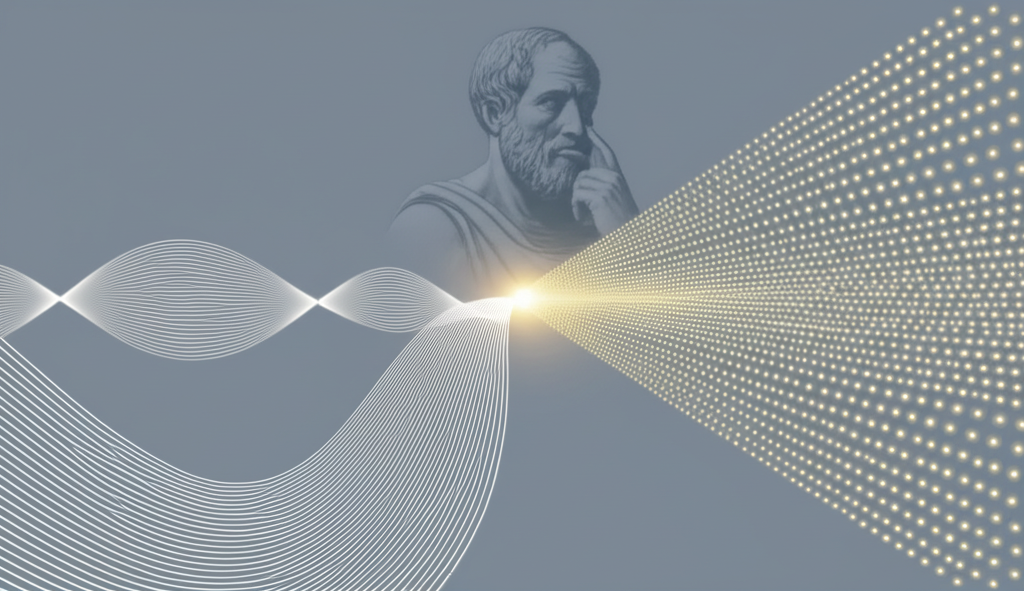
This led to the astonishing concept of wave-particle duality: light exhibits properties of both waves and particles depending on how it is observed. A photon, the fundamental element of light, is neither purely a wave nor purely a particle but possesses characteristics of both. This duality is not merely a scientific curiosity but a profound statement about the nature of reality at its most fundamental level, challenging our classical intuition and forcing a re-evaluation of how we understand existence.
Light in Modern Physics: Relativity and Quantum Fields
The understanding of light continues to evolve, deeply intertwined with the two pillars of modern physics:
- Special Relativity: Einstein's theory of special relativity is founded on the constant speed of light in a vacuum (c). This constant is not merely a speed but a universal speed limit and a fundamental constant that links space and time. Light, therefore, is not just a phenomenon but a crucial component of the very fabric of spacetime, dictating the mechanics of the universe at its grandest scales.
- Quantum Electrodynamics (QED): In quantum field theory, particularly QED, light (photons) is understood as the quantum excitation of the electromagnetic field. This view synthesizes the wave and particle aspects: the field itself is a continuous entity (wave-like), but its interactions occur via discrete quanta (particle-like). This represents the most complete and successful theory describing the nature of light and its interactions with matter, where light is seen as a fundamental force carrier.
Philosophical Echoes: Light as Metaphor and Reality
The scientific journey to understand light has profound philosophical implications, resonating with the inquiries of the Great Books of the Western World:
- The Limits of Perception: Light's wave-particle duality forces us to confront the limitations of human conceptual frameworks. Our everyday experience is built on distinct categories, yet light defies them, suggesting a deeper, more complex nature to reality than our senses or classical logic can fully grasp.
- Light as Knowledge: The ancient metaphor of light as knowledge or truth gains new depth. Just as light illuminates the physical world, the pursuit of its scientific nature illuminates the very structure of the universe, revealing its inherent strangeness and beauty. The act of observation, central to quantum mechanics, mirrors the philosophical act of inquiry – how we look at something fundamentally shapes what we perceive.
- The Fabric of Reality: From an element of perception to a fundamental constant of the universe and an excitation of a quantum field, light's evolving definition reflects our expanding understanding of the universe itself. It is not merely something we see, but something that defines the mechanics of seeing and being.
YouTube Video Suggestions:
-
📹 Related Video: ARISTOTLE ON: The Nicomachean Ethics
Video by: The School of Life
💡 Want different videos? Search YouTube for: ""Wave Particle Duality Explained Philosophically""
2. ## 📹 Related Video: What is Philosophy?
Video by: The School of Life
💡 Want different videos? Search YouTube for: ""Light in Ancient Philosophy and Modern Physics""
In conclusion, the nature of light in physics is a testament to the enduring human quest for understanding. From the philosophical inquiries of antiquity to the complex equations of quantum mechanics, light remains a source of wonder and a profound challenge to our intuitive understanding of reality. It is a fundamental element that continues to illuminate not only the cosmos but also the very limits and possibilities of human knowledge.