

The Luminous Enigma: Unpacking the Nature of Light in Physics
A Journey Through the Elemental and Mechanical Understandings of Our Universe's Primal Illuminator
Summary: From ancient philosophical musings on perception to the profound revelations of quantum mechanics, the nature of light has consistently challenged and expanded our understanding of physics and reality itself. This article delves into the historical evolution of how we've conceived of light – initially as an almost mystical element of perception, later as a subject of classical mechanics, and ultimately as a mysterious wave-particle duality that continues to spark philosophical inquiry. We trace this luminous journey, drawing connections to foundational texts that shaped our earliest thoughts on this most fundamental phenomenon.
Light: More Than Just Illumination
Since the dawn of human consciousness, light has been an undeniable, almost sacred, presence. It dictates our days, reveals our world, and, in many ancient traditions, was considered an element of creation itself. But what is light? This seemingly simple question has occupied the greatest minds in physics and philosophy for millennia, pushing the boundaries of our comprehension of the very fabric of nature. Our quest to understand light is, in essence, a quest to understand the universe.
Ancient Reflections: Light as an Element of Perception
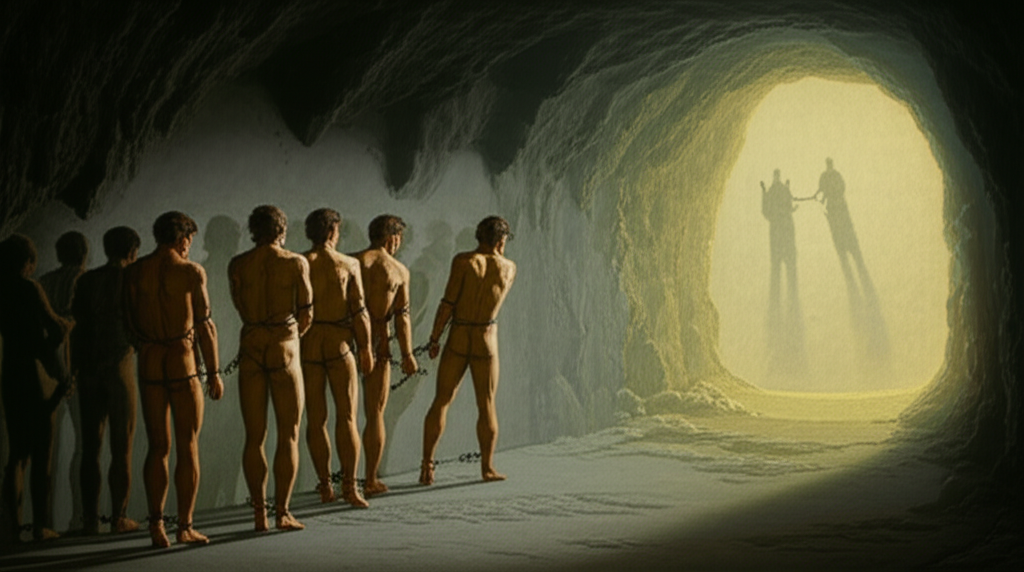
Long before the rigorous experimentation of modern physics, thinkers grappled with light's nature through observation and philosophical deduction. The Great Books of the Western World offer profound insights into these early considerations. For instance, Plato, in his Republic, uses the allegory of the cave to illustrate the journey from shadow to light, symbolizing the ascent from ignorance to knowledge. Here, light isn't just a physical phenomenon but an element essential for true understanding.
Aristotle, in his De Anima, considered light not as a body or a stream of particles, but as the actualization of the transparent medium. It was a quality, a state that allowed for vision, rather than a distinct entity traveling through space. This perspective highlights an early philosophical inclination to understand light in terms of its effect and its role in perception, rather than its intrinsic mechanics. It was an ambient condition, a fundamental element of our sensory experience.
The Dawn of Mechanics: Light's Corpuscular and Undulatory Hypotheses
The Scientific Revolution brought a new rigor to the study of nature, and light was no exception. The 17th century saw the emergence of two competing theories that laid the groundwork for modern physics:
- Corpuscular Theory (Particle Mechanics): Championed by Isaac Newton in his Opticks, this theory proposed that light consisted of tiny, discrete particles or "corpuscles" emitted from luminous bodies. This explained phenomena like reflection and refraction quite well, treating light as subject to classical mechanics. Newton's immense authority lent significant weight to this view.
- Undulatory Theory (Wave Mechanics): Contemporaneously, Christiaan Huygens argued that light was a wave propagating through an ethereal medium, explaining phenomena like diffraction and interference. While elegant, the lack of a clear medium (the "luminiferous aether") and Newton's influence meant Huygens' wave theory initially struggled for widespread acceptance.
This period marked a crucial shift: light was no longer merely an element of perception but an object of precise physical mechanics, subject to mathematical description and experimental verification.
The Unveiling of Dual Nature: A Quantum Leap in Understanding
The 19th and early 20th centuries delivered a series of groundbreaking discoveries that fundamentally reshaped our understanding of light's nature, culminating in one of the most profound paradoxes in physics.
| Experiment/Theory | Key Discovery/Implication | Nature of Light Emphasized |
|---|---|---|
| Young's Double-Slit | Demonstrated interference patterns, strongly supporting the wave mechanics of light. | Wave |
| Maxwell's Equations | Unified electricity, magnetism, and light, showing light to be an electromagnetic wave propagating at a constant speed. | Wave |
| Blackbody Radiation | Max Planck proposed that energy (and thus light) is emitted and absorbed in discrete packets called "quanta." | Particle |
| Photoelectric Effect | Albert Einstein explained this phenomenon by proposing that light itself consists of particles, or "photons," carrying quanta of energy. | Particle |
This revolutionary period led to the realization of wave-particle duality: light exhibits properties of both waves and particles, depending on how it is observed. This profound concept, central to quantum mechanics, shattered classical intuitions and forced a re-evaluation of what constitutes fundamental elements of nature. How can something be both a spread-out wave and a localized particle simultaneously? This question continues to be a wellspring of philosophical debate within physics.
Light in the Quantum Realm: An Essential Element of Reality
In the framework of quantum mechanics, light – as photons – is not merely a means by which we observe reality, but an integral element of reality itself. Photons are bosons, mediating the electromagnetic force, one of the four fundamental forces of nature. They are massless, travel at the universal speed limit, and yet their interactions define much of what we perceive.
The probabilistic mechanics of quantum theory means that even the "path" of a single photon is not entirely deterministic until it is observed. This inherent uncertainty at the most fundamental level of light's nature compels us to question our assumptions about causality and objectivity. Light, in its ultimate form, remains an elusive, yet utterly fundamental, element of the universe's grand design.
The Enduring Luminous Mystery
From the ancient philosophical contemplation of light as an element of perception to the intricate quantum mechanics that describe its dual nature, our understanding of light has undergone a breathtaking evolution. Each scientific discovery has not only deepened our knowledge of physics but also enriched our philosophical understanding of nature itself. Light is a wave, a particle, a messenger, a force, and an element of pure energy. It is the very medium through which we perceive, and simultaneously, a profound mystery that continues to illuminate the limits of our comprehension. The journey to understand light is far from over, reminding us that the most fundamental aspects of our universe often hold the most profound and enduring questions.
YouTube Suggestions:
-
📹 Related Video: What is Philosophy?
Video by: The School of Life
💡 Want different videos? Search YouTube for: ""Wave Particle Duality Explained Philosophy""
2. ## 📹 Related Video: PLATO ON: The Allegory of the Cave
Video by: The School of Life
💡 Want different videos? Search YouTube for: ""Maxwell's Equations Light Explained Simply""