

The Enigma of Illumination: Decoding the Nature of Light in Physics
Light, that ubiquitous yet profoundly mysterious element of our existence, has captivated philosophers and scientists for millennia. In Physics, its nature presents one of the most compelling narratives, shifting from simple perception to complex theoretical constructs. This article delves into the scientific understanding of light, tracing its evolution from a perceived stream of particles to an astonishing wave-particle duality, revealing how this fundamental element challenges and expands our comprehension of the universe's very mechanics. We explore the historical journey that unveiled light's dual character, a paradox that underpins much of modern physics and continues to inspire awe and inquiry.
The Elusive Element: Ancient Musings to Modern Inquiry
From the earliest philosophical inquiries, as chronicled in the Great Books of the Western World, light has been more than just a means to see; it has been a metaphor for truth, knowledge, and divine presence. Thinkers like Plato, with his allegory of the cave, understood light as essential to perceiving reality, even if its nature remained largely speculative. Aristotle considered light not as a substance itself, but as the actualization of the transparent medium. For centuries, the fundamental element of light was pondered, but it was only with the advent of systematic scientific investigation that its true, perplexing character began to emerge. The journey to understand light is, in essence, a journey to understand a core aspect of Nature itself.
Light as a Wave: The Vibrational Mechanics of the Aether
The 17th century saw a pivotal debate begin to unfold. While Isaac Newton championed the idea of light as a stream of tiny particles (corpuscles), it was Christiaan Huygens who proposed a compelling wave theory. His work, alongside later contributions, laid the groundwork for understanding light through its mechanics of propagation.
- Huygens' Principle: Every point on a wavefront can be considered a source of secondary spherical wavelets. This elegantly explained phenomena like diffraction and refraction.
- Maxwell's Electromagnetic Theory: In the 19th century, James Clerk Maxwell unified electricity, magnetism, and light, demonstrating that light is an electromagnetic wave. This was a monumental triumph, predicting that these waves travel at a constant speed in a vacuum (the speed of light, c).
Key Wave Properties of Light:
| Property | Description | Observed Phenomena |
|---|---|---|
| Wavelength | The distance between two consecutive crests or troughs. | Determines color (visible light) or energy (EM spectrum). |
| Frequency | The number of wave cycles passing a point per unit of time. | Inversely related to wavelength. |
| Amplitude | The maximum displacement or distance moved by a point on a vibrating body. | Relates to the intensity or brightness of light. |
| Interference | The superposition of two or more waves resulting in a new wave pattern. | Observed in Young's double-slit experiment. |
| Diffraction | The bending of waves around obstacles and the spreading out of waves after passing through an opening. | Light bending around corners. |
These discoveries solidified the wave model, suggesting that light was a continuous disturbance propagating through a medium, initially thought to be the "luminiferous aether." The classical physics of waves seemed to fully encompass the nature of light.
Light as a Particle: The Quantum Revelation
Just as the wave theory seemed triumphant, new experimental evidence began to challenge its completeness, pushing the boundaries of classical physics. The early 20th century brought a radical shift, introducing the concept of quantization.
- Planck's Quantum Hypothesis (1900): Max Planck, while studying black-body radiation, proposed that energy is not continuous but emitted and absorbed in discrete packets, or "quanta." The energy of each quantum is proportional to its frequency (E = hf, where h is Planck's constant). This was the first hint that energy, and therefore light, might have a granular nature.
- Einstein and the Photoelectric Effect (1905): Albert Einstein explained the photoelectric effect (where electrons are ejected from a metal surface when light shines on it) by suggesting that light itself consists of discrete packets of energy, which he called "light quanta" (later termed photons). He posited that the energy of these photons was directly proportional to the light's frequency, echoing Planck's work. This explained why only light of a certain minimum frequency (and thus minimum photon energy) could eject electrons, regardless of its intensity.
These groundbreaking insights revealed that light, in its interaction with matter, behaves as if it were composed of individual, indivisible particles – photons. This was a profound departure from the continuous wave model and ushered in the era of quantum mechanics.
The Wave-Particle Duality: A Profound Paradox
The most astonishing revelation about the nature of light is its seemingly paradoxical wave-particle duality. Light exhibits properties of both waves and particles, depending on how it is observed or measured. It's not that light is a wave and a particle simultaneously in the classical sense, but rather that it manifests these different aspects under different experimental conditions.
This duality is not merely a scientific curiosity; it is a fundamental principle of quantum mechanics that challenges our intuitive understanding of reality. How can one element be both a spread-out wave and a localized particle? This question goes beyond physics and touches upon the very limits of human conceptualization, forcing us to reconsider the nature of observation and the observed. It suggests that reality at its most fundamental level might be far more nuanced and less rigidly defined than our macroscopic experiences lead us to believe.
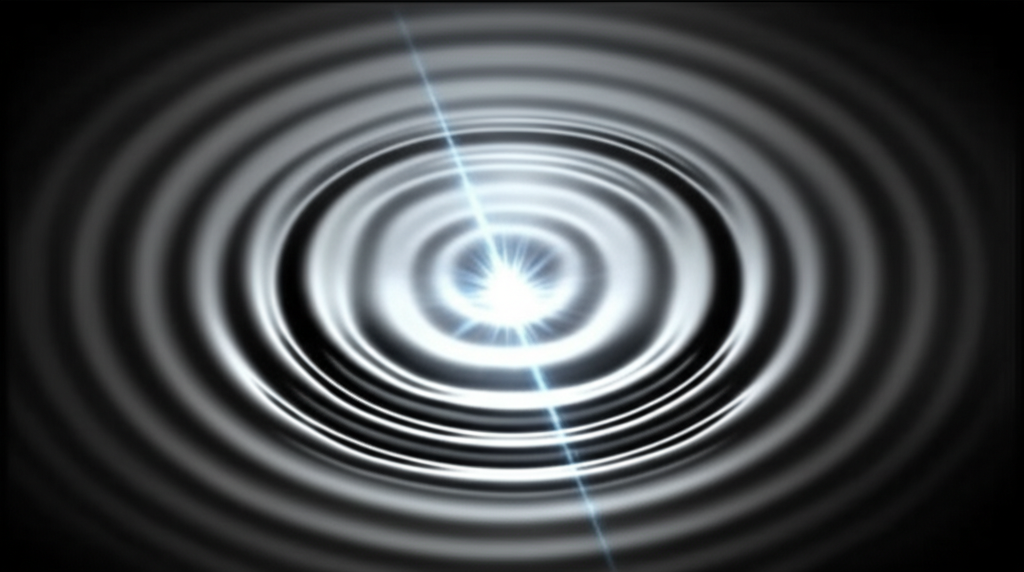 and a particle (a distinct, point-like core). The background is a cosmic tapestry of stars and nebulae, symbolizing the vastness of the universe where light travels, with faint geometric patterns subtly hinting at the underlying mathematical structure of quantum physics.)
The Enduring Quest: Light and Our Understanding of Nature
The study of light has been a continuous journey of discovery, each revelation deepening our appreciation for the intricate mechanics of the cosmos. From the ancient philosophical inquiries into its nature to the cutting-edge quantum physics that describes its duality, light remains a cornerstone of our scientific and philosophical understanding. It is the messenger from distant stars, the key to unlocking the secrets of the atom, and the very means by which we perceive the world. Understanding the element of light is, in essence, understanding a fundamental aspect of Nature itself, continually pushing the boundaries of what we thought possible and reinforcing the profound interconnectedness of all things.
YouTube Video Suggestions:
-
📹 Related Video: KANT ON: What is Enlightenment?
Video by: The School of Life
💡 Want different videos? Search YouTube for: ""Wave-Particle Duality Explained Simply""
2. ## 📹 Related Video: ARISTOTLE ON: The Nicomachean Ethics
Video by: The School of Life
💡 Want different videos? Search YouTube for: ""History of Light Theories Physics""