

The Enduring Quest: Understanding the Nature of Justice in a Democratic State
A Summary of Justice in Democracy
The concept of justice, an ideal often depicted as a blindfolded figure holding scales, is arguably the bedrock upon which any legitimate State must build itself. Yet, its realization within a Democracy presents a perpetual philosophical and practical challenge. This pillar page delves into the intricate relationship between these two monumental concepts, exploring how a democratic framework attempts to embody, enforce, and evolve the principles of justice. We will examine the historical and philosophical underpinnings from the Great Books of the Western World, dissecting the role of Law, the Government, and the Constitution in shaping a just society, while acknowledging the inherent tensions and ongoing struggles to achieve true fairness for all citizens.
Table of Contents
- Introduction: The Confluence of Ideals
- Defining Justice: From Ancient Greece to Modern Thought
- Plato's Ideal State and the Just Soul
- Aristotle's Distinctions: Distributive and Corrective Justice
- Democracy: Rule by the People, For the People
- Core Principles of Democratic Governance
- The Inherent Tensions of Popular Sovereignty
- The Democratic State as an Architect of Justice
- The Foundational Role of the Constitution
- The Legislative and Executive Arms: Crafting and Enforcing Law
- The Judiciary: Upholding and Interpreting Justice
- Challenges to Justice within a Democratic Framework
- The Tyranny of the Majority
- Economic and Social Inequality
- Protecting Minority Rights and Dissent
- The Evolving Nature of Justice
- Philosophical Perspectives on Justice in Democracy
- John Locke and Natural Rights
- Jean-Jacques Rousseau and the General Will
- John Stuart Mill and Individual Liberty
- Conclusion: The Ongoing Project of a Just Democracy
1. Introduction: The Confluence of Ideals
For millennia, humanity has grappled with the elusive ideal of justice. What does it mean for a society to be just? And how does this abstract notion manifest within the concrete reality of a State, particularly one that prides itself on the principles of Democracy? The journey to answer these questions is not merely an academic exercise; it is the very essence of political philosophy and the continuous project of self-governance. In a democratic State, the people are theoretically the ultimate arbiters of their collective destiny, yet this power must be wielded in a manner that upholds fairness, equality, and individual rights. This delicate balance, enshrined in the Constitution and enacted through Law and Government, forms the core of our exploration.
2. Defining Justice: From Ancient Greece to Modern Thought
Before we can understand justice in a democratic State, we must first attempt to define justice itself. The Great Books of the Western World offer a rich tapestry of definitions, each contributing to our contemporary understanding.
Plato's Ideal State and the Just Soul
In Plato's Republic, justice is not merely a legal concept but a fundamental principle of cosmic and individual order. For Plato, a just State mirrors a just soul, where each part performs its proper function without interfering with others. The three classes of society (rulers, auxiliaries, and producers) correspond to the three parts of the soul (reason, spirit, and appetite). When each class fulfills its role, harmony, and thus justice, prevails. This vision, while not strictly democratic, profoundly influenced later thought on the structure of a righteous Government.
Aristotle's Distinctions: Distributive and Corrective Justice
Aristotle, in his Nicomachean Ethics and Politics, offers a more practical and nuanced view. He distinguishes between:
- Distributive Justice: Concerned with the fair allocation of common advantages and burdens among members of a community. This often involves considerations of merit, need, or contribution.
- Corrective Justice: Concerned with rectifying wrongs, restoring balance when an injustice has occurred, typically through Law and the judicial system (e.g., punishment for crimes, compensation for damages).
Aristotle understood that different forms of Government (monarchy, aristocracy, polity, and their corruptions) would pursue justice in varied ways, but a truly just State would aim for the common good.
3. Democracy: Rule by the People, For the People
Democracy, derived from the Greek demos (people) and kratos (rule), signifies a system where the populace holds the ultimate power. Its appeal lies in its promise of self-determination and equality.
Core Principles of Democratic Governance
- Popular Sovereignty: The authority of the State is derived from the consent of the governed.
- Equality: All citizens are equal before the Law and possess equal political rights.
- Liberty: Protection of individual freedoms, often enshrined in a Constitution.
- Rule of Law: Governance by established Law, not by arbitrary power.
- Majority Rule, Minority Rights: Decisions are made by the majority, but the rights of minorities are protected.
The Inherent Tensions of Popular Sovereignty
While these principles are noble, Democracy is not without its internal struggles. The will of the majority, if unchecked, can become oppressive. The balance between individual liberty and collective good, between equal opportunity and equal outcome, is a constant negotiation within a democratic State. This is where the quest for justice truly becomes complex.
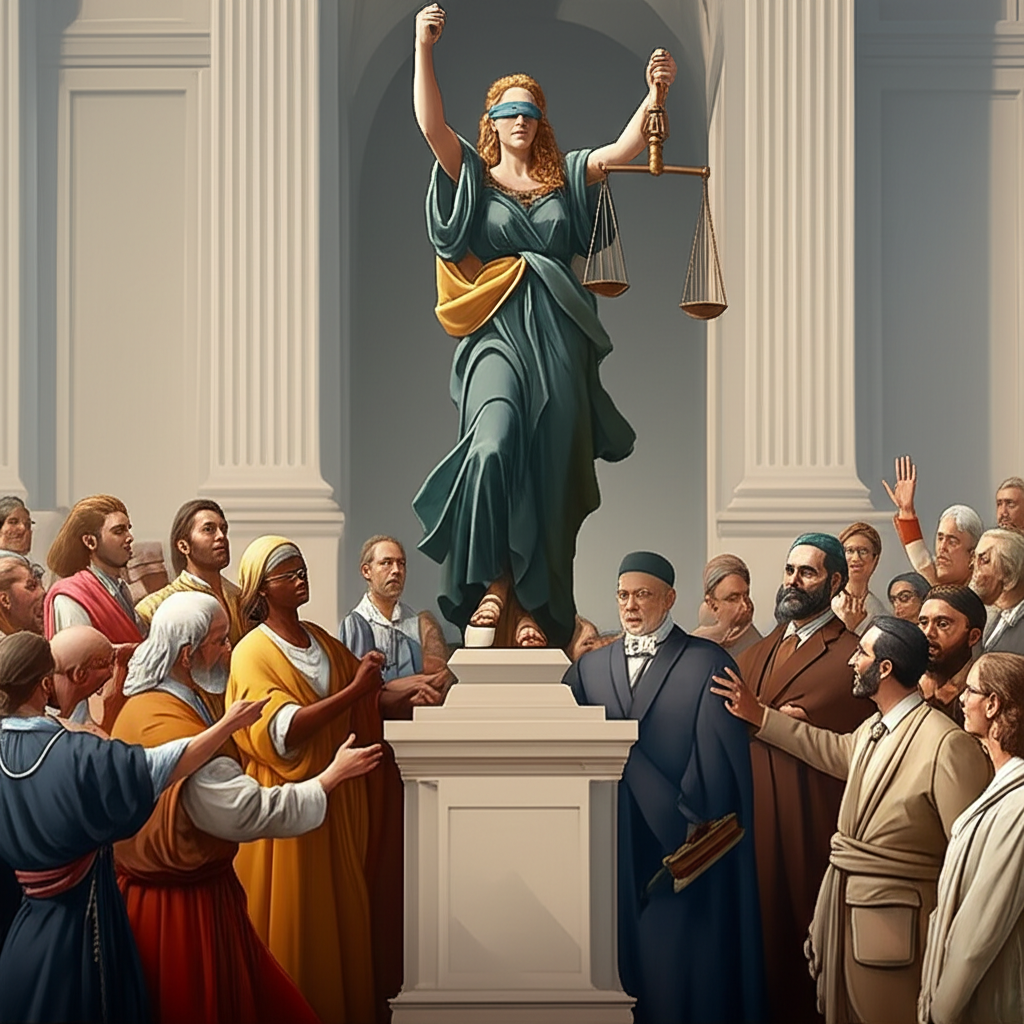
4. The Democratic State as an Architect of Justice
The democratic State is not merely a passive arena for justice; it actively constructs mechanisms to achieve it. These mechanisms are primarily manifested through its foundational documents, its Government branches, and its Laws.
The Foundational Role of the Constitution
The Constitution serves as the supreme Law of a democratic State. It outlines the structure of Government, defines the rights and responsibilities of citizens, and establishes limits on power. A well-crafted Constitution is designed to:
- Entrench Rights: Guarantee fundamental freedoms that even the majority cannot easily infringe upon.
- Separate Powers: Divide governmental authority (legislative, executive, judicial) to prevent the concentration of power and ensure checks and balances.
- Provide for Due Process: Ensure fair treatment under the Law.
The Legislative and Executive Arms: Crafting and Enforcing Law
- The Legislature (e.g., Parliament, Congress): This body is responsible for creating Laws that reflect the will of the people and aim to promote justice. This involves complex debates, compromises, and the constant adaptation of Law to societal changes.
- The Executive (e.g., President, Prime Minister): The executive arm of Government is tasked with enforcing these Laws fairly and consistently. This includes administering public services, maintaining order, and ensuring the smooth functioning of the State.
The Judiciary: Upholding and Interpreting Justice
The judiciary is perhaps the most direct embodiment of justice within the State. Independent courts interpret Laws, resolve disputes, and ensure that both the Government and citizens adhere to the Constitution. Their role is critical in:
- Protecting Rights: Striking down Laws that violate constitutional rights.
- Ensuring Fairness: Adjudicating cases impartially, ensuring due process and equal application of the Law.
- Evolving Justice: Through legal precedent, courts contribute to the ongoing definition and application of justice in society.
5. Challenges to Justice within a Democratic Framework
Despite its aspirations, a democratic State faces persistent challenges in its pursuit of justice.
The Tyranny of the Majority
One of the gravest concerns, articulated by thinkers like Alexis de Tocqueville, is the "tyranny of the majority." In a system where decisions are made by popular vote, there is always a risk that the majority may impose its will in a way that disadvantages or oppresses minority groups. This highlights the critical need for constitutional protections and robust human rights frameworks.
Economic and Social Inequality
Even with formal equality under the Law, substantive justice can be undermined by deep-seated economic and social inequalities. Disparities in wealth, access to education, healthcare, and legal representation can create a system where justice is theoretical but not practical for all citizens. Addressing these inequalities often requires active Government intervention and policy choices that are themselves subjects of intense debate.
Protecting Minority Rights and Dissent
A truly just Democracy must not only tolerate dissent but actively protect the rights of minorities, even unpopular ones. The ability to express dissenting opinions, to organize, and to challenge the status quo is essential for a healthy and evolving understanding of justice. Without these protections, the State risks becoming monolithic and oppressive.
The Evolving Nature of Justice
The definition of justice is not static. What was considered just in one era may be deemed unjust in another. Debates over civil rights, environmental protection, gender equality, and digital privacy constantly push the boundaries of our understanding of what a just society entails. A democratic State must be adaptable, allowing its Laws and institutions to evolve in response to new ethical insights and societal demands.
6. Philosophical Perspectives on Justice in Democracy
The Great Books of the Western World provide foundational insights into the relationship between the individual, the State, and the pursuit of justice.
John Locke and Natural Rights
John Locke, in his Second Treatise of Government, posited that individuals possess inherent "natural rights" to life, liberty, and property, which pre-exist the State. The primary purpose of Government, in Locke's view, is to protect these rights. This idea profoundly influenced the Constitution of many democratic nations, asserting that justice requires the State to respect and safeguard individual freedoms, rather than merely acting as an instrument of majority will.
Jean-Jacques Rousseau and the General Will
Rousseau's Social Contract introduced the concept of the "general will," arguing that legitimate Government arises from the collective will of the people, aiming for the common good. While emphasizing popular sovereignty, Rousseau also grappled with how to ensure this general will truly reflects collective justice and doesn't degenerate into a mere aggregation of private interests. His ideas underscore the importance of civic participation and a shared commitment to the public welfare in a democratic State.
John Stuart Mill and Individual Liberty
John Stuart Mill's On Liberty champions individual freedom as essential for human flourishing and societal progress. His "harm principle" states that the only legitimate reason for the State to interfere with an individual's liberty is to prevent harm to others. Mill's work is crucial for understanding how a democratic Government must balance the collective good with the protection of individual rights, ensuring that the pursuit of justice does not stifle diversity of thought or lifestyle.
7. Conclusion: The Ongoing Project of a Just Democracy
The nature of justice in a democratic State is not a fixed destination but an ongoing journey. It is a dynamic interplay between foundational principles, evolving societal norms, and the practical realities of Government. From the classical insights of Plato and Aristotle to the Enlightenment critiques of Locke, Rousseau, and Mill, the philosophical tradition underscores that a just Democracy requires constant vigilance, critical self-reflection, and a steadfast commitment to the ideals of fairness, equality, and liberty for all. The Constitution, the Laws it underpins, and the institutions of Government are merely tools; their effectiveness in delivering justice ultimately depends on the active participation and moral compass of its citizens. The quest for justice in a democratic State is, therefore, the shared responsibility of every individual within the collective.
YouTube Video Suggestions:
-
📹 Related Video: PLATO ON: The Allegory of the Cave
Video by: The School of Life
💡 Want different videos? Search YouTube for: ""Plato's Republic Justice Explained""
-
📹 Related Video: ARISTOTLE ON: The Nicomachean Ethics
Video by: The School of Life
💡 Want different videos? Search YouTube for: ""John Locke Natural Rights Democracy""