

The Nature of Justice in a Democratic State
The pursuit of justice stands as an eternal quest, a foundational pillar upon which any legitimate state must aspire to build itself. In a democratic state, this pursuit takes on a unique complexity, intertwining with the principles of popular sovereignty, individual liberty, and the rule of law. This pillar page delves into the multifaceted nature of justice within the democratic framework, examining its philosophical underpinnings, its practical manifestations through government and the constitution, and the persistent challenges it faces in an ever-evolving society. We will explore how thinkers from the Great Books of the Western World have grappled with these concepts, offering enduring insights into what it means for a people to govern themselves justly.
Defining Justice: A Philosophical Odyssey
Before we can understand justice in a democracy, we must first grapple with the concept of justice itself. It is a term often used, yet rarely fully understood, encompassing fairness, equity, moral rightness, and the proper administration of law.
Ancient Roots: Plato, Aristotle, and the Ideal State
From the earliest philosophical inquiries, the question of justice has been central. In Plato's Republic, Socrates explores justice not merely as an individual virtue but as the harmonious functioning of the state itself, where each part performs its proper role. For Plato, a just society is one guided by reason, embodied by philosopher-kings, ensuring that the state itself reflects an ideal form of order. This concept, while not democratic in the modern sense, posits that justice is an objective truth, discoverable through rigorous inquiry.
Aristotle, in his Nicomachean Ethics and Politics, offers a more pragmatic view, distinguishing between distributive justice (the fair allocation of resources and honors according to merit) and rectificatory justice (the correction of wrongs, whether in voluntary transactions or through punishment). For Aristotle, justice is deeply embedded in the nature of human communities and is essential for the flourishing of both individuals and the polis. He recognized various forms of government, including democracy, but warned against its potential for deviation into mob rule if not tempered by law and virtue.
Key Ancient Concepts of Justice:
- Plato: Justice as harmony and proper function within the individual and the state.
- Aristotle: Distributive and rectificatory justice, essential for community flourishing.
Enlightenment Echoes: Social Contract and Natural Rights
The Enlightenment era brought a seismic shift, emphasizing individual rights and the consent of the governed. Thinkers like John Locke, in his Two Treatises of Government, argued that individuals possess inherent natural rights to life, liberty, and property, which the state is formed to protect. Justice, in this view, is intrinsically linked to upholding these rights. The legitimacy of government derives from a social contract where citizens agree to be governed in exchange for the protection of their rights and the impartial application of law.
Jean-Jacques Rousseau, in The Social Contract, further explored the idea of the "general will," suggesting that true justice emerges when citizens collectively legislate for the common good, rather than individual interests. This directly informs the democratic ideal, where the people are both the subjects and the authors of the law. Immanuel Kant, in his Metaphysics of Morals, provided a rigorous ethical framework, arguing for universal moral duties and the categorical imperative, which demands that we act only according to maxims that we could will to become universal law. For Kant, justice is a matter of respecting the autonomy and inherent dignity of every rational being.
The Democratic State: Principles and Paradoxes
A democratic state is defined by the principle of popular sovereignty, where political power ultimately resides with the people. This translates into governance "of the people, by the people, for the people," as Abraham Lincoln famously articulated. However, the practical application of this ideal presents numerous paradoxes and challenges for achieving genuine justice.
Rule of Law and the Constitution
At the heart of any functioning democratic state lies the rule of law. This principle dictates that all citizens, including those in government, are subject to the same laws, which are publicly promulgated, equally enforced, and independently adjudicated. The Constitution serves as the supreme law of the land, establishing the framework for government, defining its powers, and, crucially, outlining the rights and responsibilities of citizens. A just democracy requires a robust constitutional framework that protects against arbitrary power and ensures due process.
Popular Sovereignty and Individual Liberty
The tension between the will of the majority (popular sovereignty) and the rights of the individual (individual liberty) is a perpetual challenge for democratic justice. While democracy empowers the collective, thinkers like John Stuart Mill, in On Liberty, warned against the "tyranny of the majority," where the dominant group might suppress the rights or opinions of minorities. A truly just democracy must find mechanisms to balance these forces, ensuring that the majority's power does not infringe upon fundamental freedoms.
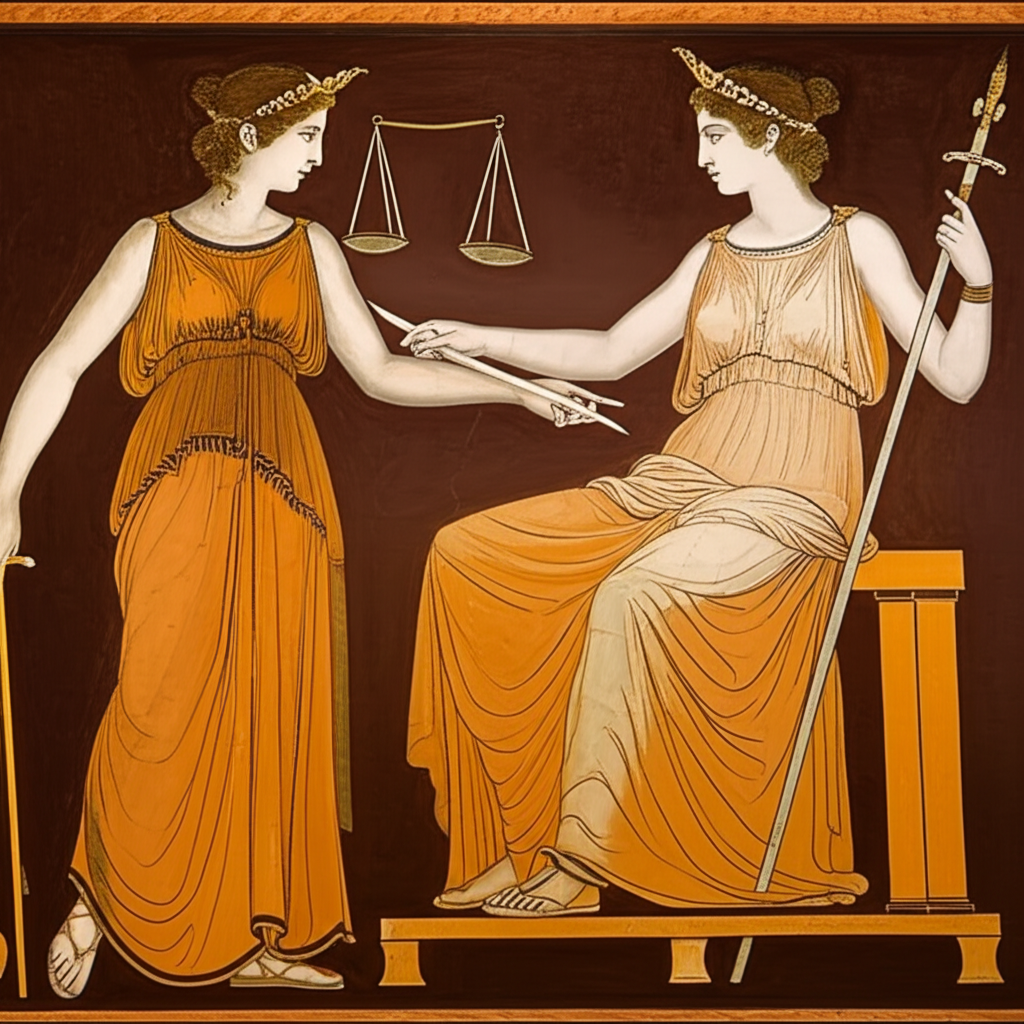 holding scales and a sword, flanked by citizens engaged in a lively debate within an ancient assembly, symbolizing the tension and balance between divine principle and human discourse in the pursuit of righteous governance.)
The Interplay: Justice in a Democratic State
How does the abstract concept of justice manifest within the concrete operations of a democratic state? It permeates every aspect, from the creation of law to its enforcement and the distribution of societal benefits.
Legislative Justice: Crafting Law
In a democracy, laws are ideally crafted through a deliberative process that reflects the will of the people, or their elected representatives. Legislative justice involves creating laws that are fair, equitable, and serve the common good, while respecting individual rights. This process often involves intense debate, compromise, and the balancing of competing interests, all within the bounds of the Constitution. The challenge lies in ensuring that these laws do not inadvertently create or perpetuate injustices.
Distributive Justice: Resource Allocation by Government
Distributive justice in a democracy concerns how the government allocates resources, opportunities, and burdens among its citizens. This includes everything from taxation and public services (education, healthcare, infrastructure) to social welfare programs. Debates around distributive justice are central to democratic politics, with different ideologies proposing varying models for achieving fairness – from egalitarian approaches emphasizing equality of outcome to meritocratic systems prioritizing equality of opportunity. The state plays a crucial role in mediating these claims to ensure a just distribution.
Retributive Justice: Accountability and Punishment
Retributive justice deals with the response to wrongdoing and the administration of punishment. In a democratic state, this is governed by the criminal justice system, which must operate under the rule of law, ensuring due process, fair trials, and punishments that are proportionate to the offense. The goal is not merely retribution but also deterrence, rehabilitation, and the restoration of social order. The legitimacy of the government in this domain hinges on its ability to administer justice impartially and humanely.
Challenges to Justice in Modern Democracies
Despite the ideals, achieving comprehensive justice in contemporary democratic states remains an ongoing struggle.
Inequality and Systemic Bias
Economic inequality, social stratification, and systemic biases (based on race, gender, religion, etc.) continue to be significant impediments to justice. These issues can undermine the principle of equality before the law, limit access to opportunities, and concentrate power in the hands of a few, thereby distorting the democratic process itself. Addressing these requires continuous reform and a commitment to dismantling entrenched prejudices.
The Tyranny of the Majority
As Mill warned, the majority can, at times, impose its will in ways that marginalize or oppress minority groups. This can manifest in discriminatory laws, social pressures, or the neglect of minority interests. Safeguarding against the tyranny of the majority requires robust constitutional protections for individual and minority rights, an independent judiciary, and a culture of tolerance and respect for diversity.
Challenges to Democratic Justice:
- Socio-economic inequality: Unequal access to resources and opportunities.
- Systemic biases: Discrimination based on identity.
- Erosion of minority rights: The majority imposing its will unfairly.
- Political polarization: Hindering consensus and the common good.
- Corruption: Undermining the rule of law and public trust.
Pathways to a More Just Democracy
The pursuit of justice in a democratic state is never complete; it is a continuous project requiring vigilance, adaptation, and a deep commitment from both citizens and their government.
Active Citizenship and Civic Virtue
An engaged and informed citizenry is the bedrock of a just democracy. Active participation in the political process, critical thinking, and the cultivation of civic virtues like empathy, integrity, and a commitment to the common good are essential. Citizens must hold their government accountable and advocate for laws and policies that promote equity and fairness.
Constitutional Safeguards and Judicial Review
Strong constitutional safeguards, coupled with an independent judiciary capable of judicial review, are vital for protecting fundamental rights and ensuring that legislative and executive actions comply with the spirit and letter of the Constitution. The judiciary acts as a check on potential abuses of power, upholding the rule of law even against popular sentiment when necessary.
📹 Related Video: PLATO ON: The Allegory of the Cave
Video by: The School of Life
💡 Want different videos? Search YouTube for: ""Plato's Republic Justice" for discussions on ancient Greek philosophy and the ideal state."
📹 Related Video: KANT ON: What is Enlightenment?
Video by: The School of Life
💡 Want different videos? Search YouTube for: ""Social Contract Theory Explained" for an overview of Enlightenment ideas on government and individual rights."
Conclusion
The nature of justice in a democratic state is a complex tapestry woven from philosophical ideals, historical struggles, and ongoing societal challenges. It demands a state committed to the rule of law, a government accountable to its people, and a Constitution that enshrines fundamental rights. As we look back at the enduring wisdom from the Great Books of the Western World, from Plato's vision of harmony to Kant's categorical imperative, we are reminded that the quest for justice is not a destination but a perpetual journey. It is a journey that requires constant deliberation, a willingness to adapt, and an unwavering commitment to the principles of fairness, equality, and human dignity within the democratic framework. Only through this sustained effort can a democratic state truly aspire to be a just one.