

The Enduring Quest: Navigating the Nature of Justice in a Democratic State
Summary: Justice, a concept as ancient as philosophy itself, finds its most complex and perhaps most vital expression within the framework of a democratic state. This pillar page explores the multifaceted nature of justice within the context of popular sovereignty, individual rights, and the rule of law. From the foundational insights of classical thinkers to the evolving challenges of modern governance, we delve into how a democratic state grapples with the ideal of a fair and equitable society, examining the role of government, the constitution, and the perpetual tension between competing claims of right.
The Unfolding Tapestry of Justice and Democracy
To speak of justice is to invoke a fundamental human aspiration – the desire for fairness, for what is right, for a proper ordering of things. To couple this with democracy is to embark on an intellectual journey through the very heart of political philosophy. How does a system predicated on the will of the people, on individual liberty, and on the principle of equality, truly embody and deliver justice? This is not a question with a singular, definitive answer, but rather a dynamic inquiry that has shaped civilizations and continues to challenge every democratic state.
Our exploration begins with the understanding that justice in a democratic context is not merely a legalistic adherence to rules, but a living, breathing ideal constantly negotiated through public discourse, legislative action, and the very fabric of society. It is a concept deeply intertwined with the legitimacy of the state and the welfare of its citizens.
I. Ancient Echoes: The Philosophical Bedrock of Justice
The quest for justice is not a modern invention. Indeed, the very notion of a well-ordered state was, for the ancient Greeks, inextricably linked to the concept of justice. Their inquiries provide the essential groundwork for understanding our contemporary dilemmas.
A. Plato's Ideal State and the Just Soul
In Plato's Republic, justice is not merely a set of external actions but an internal harmony, both within the individual soul and within the state. For Plato, a just state is one where each part performs its proper function without encroaching upon others. This hierarchical vision, while not democratic in our modern sense, posits that the government (led by philosopher-kings) must ensure that society is ordered according to reason and virtue.
- Key Idea: Justice as harmony and functional excellence.
- Application: The state has a role in cultivating virtue and ensuring each citizen contributes according to their natural aptitude.
B. Aristotle's Practical Justice and the Polis
Aristotle, in his Nicomachean Ethics and Politics, offered a more pragmatic view. He distinguished between distributive justice (the fair allocation of resources, honors, and burdens according to merit) and corrective justice (rectifying wrongs through punishment or restitution). For Aristotle, justice is a virtue that perfects social interaction, and the best form of government (polity) aims at the common good, ensuring that citizens can live a flourishing life. He recognized that law is a crucial instrument of justice, but also that equity might be needed to correct the universal nature of law in specific cases.
- Key Idea: Justice as fairness in distribution and rectification of wrongs.
- Application: A just state uses law to achieve the common good, adapting to specific circumstances when necessary.
II. The Democratic Imperative: Foundations of a Just State
The transition from ancient philosophical ideals to the modern democratic state brings new dimensions to the concept of justice. Here, the emphasis shifts to popular sovereignty, individual rights, and the rule of law as the cornerstones of legitimacy.
A. The Social Contract and the Legitimacy of Government
Thinkers like John Locke and Jean-Jacques Rousseau fundamentally altered our understanding of the state's authority. Through the concept of the social contract, they argued that legitimate government derives its power from the consent of the governed. For Locke, the primary purpose of the state is to protect the natural rights of individuals (life, liberty, and property), making justice the upholding of these inherent rights. Rousseau, conversely, emphasized the general will, arguing that a truly democratic state should enact laws that reflect the collective good, ensuring freedom for all.
- Key Idea: Justice is rooted in the protection of rights (Locke) or the expression of the general will (Rousseau) through a consented government.
B. The Rule of Law and Constitutionalism
A defining feature of any modern democratic state is its commitment to the rule of law. This principle asserts that all individuals, including those in government, are subject to and accountable under the law. It is not merely a system of rules, but a framework designed to ensure fairness, predictability, and protection against arbitrary power. The constitution stands as the supreme law of the land, outlining the powers of the government, establishing fundamental rights, and providing mechanisms for ensuring justice.
- Key Idea: The constitution and the rule of law are the foundational instruments for achieving and maintaining justice in a democratic state.
III. The Architecture of Justice: Institutions and Mechanisms
How does a democratic state translate these philosophical ideals into practical reality? It does so through a complex interplay of institutions, processes, and civic engagement.
A. The Tripartite Government and Checks and Balances
Most democratic states adopt a system of separated powers: the legislative, executive, and judicial branches. This design, famously articulated by Montesquieu, aims to prevent the concentration of power and ensure accountability, thereby safeguarding justice.
- Legislative Branch (e.g., Parliament, Congress): Responsible for creating laws that reflect the will of the people and uphold societal values.
- Executive Branch (e.g., President, Prime Minister): Responsible for implementing and enforcing laws fairly and efficiently.
- Judicial Branch (e.g., Courts): Responsible for interpreting laws, resolving disputes, and ensuring that laws are applied justly and constitutionally. This branch is often seen as the ultimate guardian of individual rights against potential overreach by the government.
B. The Role of the Constitution in Ensuring Justice
The constitution of a democratic state serves multiple critical functions in the pursuit of justice:
| Constitutional Function | Relevance to Justice |
|---|---|
| Establishes Rights | Guarantees fundamental liberties, ensuring the state cannot arbitrarily infringe upon individual freedom. |
| Limits Government | Defines the scope of state power, preventing tyranny and promoting accountability. |
| Ensures Due Process | Mandates fair procedures in legal proceedings, protecting individuals from unjust treatment. |
| Provides for Amendment | Allows for the constitution to evolve, adapting the framework of justice to changing societal norms and challenges. |
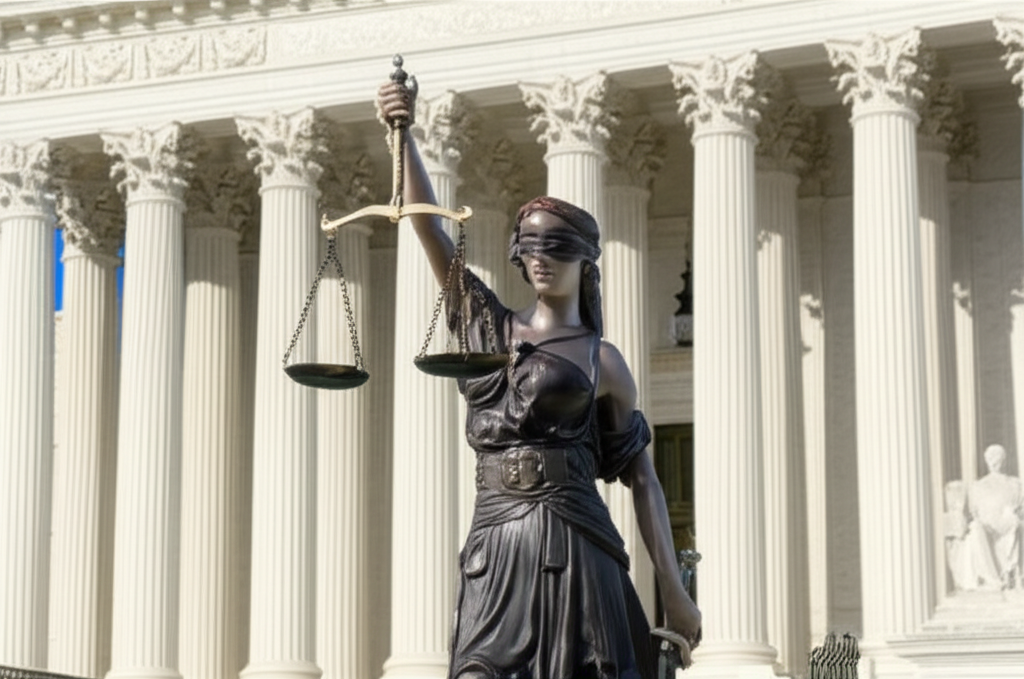
IV. Navigating the Tensions: Challenges to Justice in a Democracy
Despite its noble aspirations, the pursuit of justice in a democratic state is fraught with inherent tensions and challenges.
A. Majority Rule vs. Minority Rights
One of the most enduring dilemmas in democracy is reconciling the will of the majority with the protection of minority rights. While democracy celebrates popular sovereignty, unbridled majority rule can lead to the oppression of minority groups. A just democratic state must therefore build in constitutional safeguards and legal protections to ensure that the fundamental rights of all citizens, regardless of their numerical strength, are respected. John Stuart Mill, in On Liberty, powerfully argued for the protection of individual freedom against the "tyranny of the majority."
B. Equality Before the Law vs. Social and Economic Inequality
The principle of equality before the law is a cornerstone of democratic justice. Yet, real-world societies are often marked by deep social and economic inequalities that can undermine this ideal. Can a person truly receive justice if they lack the resources for adequate legal representation, or if systemic biases permeate the institutions of the state? This leads to ongoing debates about distributive justice and the role of the government in addressing systemic disparities.
C. The Dynamic Nature of Law and Its Interpretation
Law is not a static entity but a living framework subject to interpretation and evolution. Judges, guided by the constitution and precedent, play a crucial role in shaping what justice means in specific cases. This judicial discretion, while necessary, can also be a source of controversy, particularly when interpretations reflect differing philosophical or political views on the nature of justice itself.
V. The Ongoing Pursuit: Justice as a Democratic Ideal
The nature of justice in a democratic state is not a fixed destination but a continuous journey. It requires constant vigilance, active participation, and a willingness to confront uncomfortable truths.
- Civic Engagement: An informed and engaged citizenry is crucial for holding the government accountable and advocating for just laws and policies.
- Reform and Adaptation: Democratic institutions must be capable of self-correction, adapting to new social challenges and evolving understandings of human rights and fairness.
- Education: Fostering a deep understanding of philosophical concepts of justice, the functioning of democracy, and the significance of the constitution is paramount for future generations.
Ultimately, the quest for justice in a democratic state is a testament to the human spirit's enduring desire for a society where all individuals can flourish, where rights are protected, and where the law serves as a shield against oppression rather than a tool of it. It is a perpetual challenge, but one that defines the very essence of a truly free and equitable society.
Further Exploration:
📹 Related Video: PLATO ON: The Allegory of the Cave
Video by: The School of Life
💡 Want different videos? Search YouTube for: ""Plato's Republic Justice" for discussions on his theory of justice and the ideal state."
📹 Related Video: PLATO ON: The Allegory of the Cave
Video by: The School of Life
💡 Want different videos? Search YouTube for: ""Social Contract Theory Explained" for an overview of Locke, Rousseau, and Hobbes' ideas on government legitimacy."