

The Enduring Quest: The Nature of Justice in a Democratic State
The pursuit of justice stands as one of humanity's most ancient and persistent endeavors. When this pursuit is situated within the complex, often messy, and perpetually evolving framework of a democratic state, the questions multiply, the answers become more nuanced, and the stakes rise immeasurably. This pillar page delves into the multifaceted nature of justice in a democracy, exploring its philosophical underpinnings, its historical evolution, the mechanisms designed to uphold it, and the inherent challenges that demand constant vigilance and critical thought. We will journey through the foundational ideas that shape our understanding of law, government, and the very essence of a constitution, drawing insights from the enduring wisdom contained within the Great Books of the Western World.
I. Unpacking the Core Concepts: Justice and Democracy
At its heart, this exploration requires a clear, if not exhaustive, understanding of our two primary concepts.
A. What is Justice? A Philosophical Inquiry
From Plato's Republic, where justice is posited as the harmonious functioning of the soul and the state, to Aristotle's meticulous distinction between distributive and corrective justice, the concept has resisted singular definition. Is justice simply giving each their due? Is it fairness in distribution? Is it the strict application of law? Or is it a more profound moral compass guiding human interaction and societal structure? For many, justice is an ideal, a standard against which all laws and actions of government must be measured. It embodies principles of equity, impartiality, and the protection of fundamental rights.
B. What is Democracy? More Than Just a Vote
A democracy, in its simplest form, is rule by the people. Yet, this simplicity belies a profound complexity. It is a system of government where ultimate authority is vested in the populace, typically exercised through elected representatives. But a true democracy is more than just elections; it implies fundamental freedoms, the protection of minority rights, an independent judiciary, and a constitution that limits the power of the state. It is, as Abraham Lincoln famously articulated, government "of the people, by the people, for the people."
II. Historical Foundations: From Polis Ideals to the Modern State
The philosophical groundwork for understanding justice in a state was laid millennia ago.
A. Ancient Greek Perspectives: The Polis and the Just Soul
Plato, in his seminal work The Republic, grappled with the ideal state and the nature of justice within it. He famously argued that a just state mirrors a just individual soul, with each part—reason, spirit, and appetite—performing its proper function. For Plato, justice was not merely about law but about societal harmony, where each citizen contributed according to their natural aptitude. Aristotle, in Nicomachean Ethics and Politics, offered a more pragmatic view, distinguishing between:
- Distributive Justice: Concerned with the fair allocation of honors, wealth, and goods among citizens according to merit or need.
- Corrective Justice: Concerned with rectifying wrongs, ensuring that those who commit injustices are punished and victims are compensated.
These ancient insights highlight that justice is not a monolithic concept but involves considerations of both fairness in allocation and fairness in redress.
B. The Rise of the State and the Rule of Law
The transition from the ancient city-state (polis) to the modern state brought with it new challenges and conceptions of justice. The Roman Empire's emphasis on codified law and universal principles laid crucial groundwork. Later, Enlightenment thinkers like John Locke and Jean-Jacques Rousseau conceptualized the state as arising from a "social contract," where individuals surrender certain rights in exchange for the protection of others, most notably the right to life, liberty, and property. This framework directly implicates the government as the agent responsible for upholding this contract and, by extension, ensuring justice.
III. The Democratic Framework: Constitution, Law, and Government
In a democratic state, justice is intricately woven into the very fabric of its institutional design.
A. The Constitution: Blueprint for Justice
The constitution serves as the supreme law of the land, outlining the structure of the government, defining the powers it can exercise, and, crucially, enumerating the rights and liberties of citizens. It acts as a safeguard against arbitrary power and a foundational text for the administration of justice. A constitution embodies a society's highest aspirations for fairness, equality, and the rule of law. It is the ultimate expression of how a state intends to deliver justice to its people.
B. Law as the Instrument of Justice
In a democracy, law is the primary instrument through which justice is sought and administered. It is ideally created through a representative process, debated, and enacted to reflect the will of the people while respecting fundamental rights. The principle of the "rule of law" is paramount: no one, not even the government, is above the law. This ensures predictability, impartiality, and accountability, crucial elements for a just society.
C. The Government's Role: Balancing Power and Protecting Rights
The government in a democracy is tasked with a delicate balancing act: wielding necessary power to maintain order and provide public services, while simultaneously protecting the rights and freedoms of its citizens. This is typically achieved through a system of checks and balances, dividing power among legislative, executive, and judicial branches. Each branch plays a distinct role in the administration of justice:
- Legislature: Enacts laws that aim to be just.
- Executive: Implements and enforces those laws.
- Judiciary: Interprets laws and ensures their fair application, acting as the ultimate arbiter of justice in individual cases and constitutional disputes.
IV. Challenges to Justice in a Democratic State
Despite its noble ideals, the pursuit of justice in a democracy is fraught with inherent challenges.
A. Majority Rule vs. Minority Rights
One of democracy's central dilemmas is reconciling the will of the majority with the protection of minority rights. As Alexis de Tocqueville warned in Democracy in America, the "tyranny of the majority" can be as oppressive as any autocratic rule if unchecked. True justice in a democracy requires robust protections for minority groups, ensuring their voices are heard and their rights are safeguarded, even when their views diverge from the popular consensus.
B. Economic Inequality and Social Justice
The persistent issue of economic disparity poses a significant challenge to the ideal of justice. Can a state truly be just if vast inequalities in wealth and opportunity persist? Philosophers like John Rawls, in A Theory of Justice, argued for a conception of justice that prioritizes the welfare of the least advantaged, suggesting that social and economic inequalities are only permissible if they benefit everyone, especially the most vulnerable. This raises questions about the role of government in wealth redistribution and the provision of social safety nets.
C. The Evolving Nature of Law and Justice
Societies are not static, and neither are their moral sensibilities. What was considered just in one era may be deemed unjust in another. The constitution and existing laws must be capable of adapting to new challenges, technological advancements, and evolving understandings of human rights. This dynamic tension requires ongoing public discourse, critical self-reflection, and sometimes, fundamental legal and constitutional reform.
Table 1: Pillars of Justice in a Democratic State
| Pillar | Description | Key Challenge |
|---|---|---|
| Rule of Law | All individuals and institutions are subject to and accountable under the law. | Corruption, selective enforcement, legal loopholes |
| Equality | Equal treatment under the law, equal opportunity, protection from discrimination. | Systemic biases, economic disparity, social prejudice |
| Rights Protection | Safeguarding fundamental human, civil, and political liberties. | Majority tyranny, state overreach, erosion of freedoms |
| Accountability | Government and public officials are responsible for their actions. | Impunity, lack of transparency, abuse of power |
| Accessibility | Justice system is accessible, affordable, and understandable to all. | Cost of litigation, legal complexity, geographic barriers |
V. Mechanisms for Upholding Justice in a Democracy
Despite the challenges, democratic states employ several crucial mechanisms to strive for and uphold justice.
A. An Independent Judiciary
The judiciary's independence is the cornerstone of justice in a democracy. Judges must be free from political pressure, public opinion, and the influence of other branches of government to impartially interpret the law and apply it fairly. This independence ensures that the constitution remains the supreme law and that individual rights are protected, even against the power of the state.
B. Active Citizenship and Civic Virtue
Justice is not solely the responsibility of the government; it is also the duty of the citizenry. An active, informed, and engaged populace is essential for holding power accountable, advocating for change, and participating in the democratic process. Civic virtue—the willingness to place the common good above narrow self-interest—is a vital ingredient for a just and flourishing democracy.
C. Constitutionalism and Amendment Processes
A robust constitution with an established process for amendment allows a state to adapt its foundational law to changing societal needs and moral understandings while maintaining stability. This balance between stability and adaptability is crucial for the long-term pursuit of justice.
D. Checks and Balances and Separation of Powers
The division of government power into distinct branches (legislative, executive, judicial) with overlapping responsibilities and the ability to constrain each other is a fundamental design principle for preventing the concentration of power and safeguarding against its abuse. This system aims to ensure that no single entity can unilaterally undermine the principles of justice.
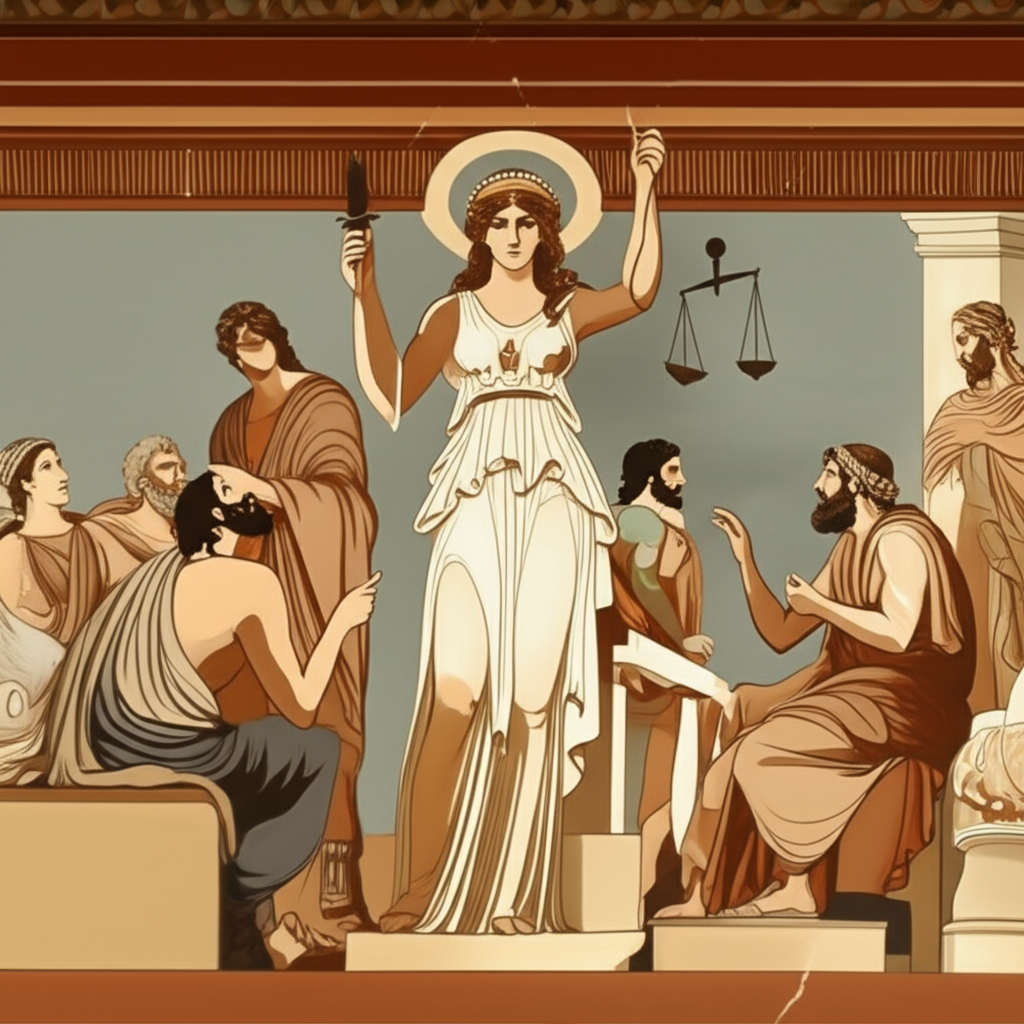
VI. Conclusion: The Ongoing Dialogue
The nature of justice in a democratic state is not a static definition to be memorized, but an ongoing, dynamic dialogue. It is a perpetual negotiation between ideals and realities, between individual liberties and collective good, between the letter of the law and the spirit of fairness. Drawing from the profound insights of the Great Books, we understand that justice is not merely a legal concept but a moral imperative, a continuous aspiration that shapes the character of a state and the lives of its citizens. The journey towards a more just democracy is a testament to humanity's enduring commitment to forging societies where dignity, equity, and freedom can truly flourish.
Further Exploration:
📹 Related Video: PLATO ON: The Allegory of the Cave
Video by: The School of Life
💡 Want different videos? Search YouTube for: ""Plato's Republic Justice" - A search for videos discussing Plato's concept of justice in his seminal work, often featuring animated summaries or lectures from philosophy professors."
📹 Related Video: ARISTOTLE ON: The Nicomachean Ethics
Video by: The School of Life