

The Elusive Pursuit: Unpacking the Nature of Happiness in Philosophy
For millennia, humanity has grappled with a fundamental question: what is happiness? Is it a fleeting emotion, a sustained state of contentment, or the ultimate purpose of human existence? This pillar page delves into the rich tapestry of philosophical thought surrounding the Nature of Happiness, exploring how thinkers from ancient Greece to the modern era have sought to define, achieve, and understand this most coveted human experience. We will journey through diverse perspectives, from the pursuit of virtue and flourishing to the embrace of pleasure, duty, and the challenging of conventional morality, revealing how our understanding of Happiness is inextricably linked to our concepts of the Good and Evil and the very essence of Philosophy.
From Fleeting Joy to Flourishing Life: Ancient Greece and the Quest for Eudaimonia
The ancient Greeks laid foundational stones for Western Philosophy's inquiry into Happiness. For them, happiness wasn't merely a feeling but a way of living, a state of human flourishing known as eudaimonia. This concept is far more robust than our modern, often superficial, understanding of happiness.
Plato's Republic: Harmony of the Soul
In Plato's Republic, Happiness is intrinsically tied to justice and the well-ordered soul. He posited that a just individual, whose rational, spirited, and appetitive parts of the soul are in harmony and governed by reason, is the truly happy individual. This internal balance, mirroring the ideal state, allows one to live a virtuous life, free from inner conflict and external discord. For Plato, understanding the Nature of Good and Evil was essential to achieving this harmonious state, as true happiness could not exist in an unjust soul.
Aristotle's Nicomachean Ethics: The Pinnacle of Human Function
Perhaps the most influential ancient treatise on Happiness comes from Aristotle's Nicomachean Ethics. Aristotle argued that every human activity aims at some good, and the highest good, the ultimate end, is eudaimonia. He famously stated that Happiness is "an activity of the soul in accordance with virtue."
For Aristotle, to understand Happiness, one must understand the unique function of human beings. Just as a flutist's function is to play the flute well, a human's function is to reason well. Therefore, Happiness is achieved by living a life of rational activity, exercising intellectual and moral virtues (like courage, temperance, justice, and wisdom) over a complete life. It's not about momentary pleasure, but a sustained, excellent way of being.
| Philosopher | Key Concept of Happiness | Relation to Virtue/Ethics |
|---|---|---|
| Plato | Eudaimonia as soul harmony | Achieved through justice and reason ruling the soul; understanding of Good and Evil is paramount. |
| Aristotle | Eudaimonia as virtuous activity | An activity of the soul in accordance with complete virtue over a complete life; the highest human good. |
Paths to Serenity: Epicurean Pleasure, Stoic Virtue, and the Cynic's Scorn
Following the classical period, Hellenistic Philosophy offered more diverse, and often more accessible, paths to Happiness, each with a distinct view on the Nature of a good life.
Epicurus: The Calm Garden of Ataraxia
Epicurus, a Greek philosopher of the Hellenistic period, famously founded a school that emphasized pleasure as the goal of life. However, his understanding of pleasure was far from hedonistic indulgence. For Epicurus, true Happiness lay in ataraxia – a state of tranquility, freedom from fear, and absence of pain (both physical and mental).
He advocated for a simple life, surrounded by friends, free from public life's anxieties, and guided by reason to discern which pleasures are truly good and which lead to greater pain. Intellectual pleasures and the avoidance of suffering were paramount. This minimalist approach to Happiness sought to master desire, not to fulfill every whim.
Stoicism: Embracing Fate and Inner Fortitude
In stark contrast to Epicurus's pursuit of pleasure, Stoicism, championed by figures like Zeno, Epictetus, Seneca, and Marcus Aurelius, found Happiness in virtue, reason, and living in harmony with nature and fate. For the Stoics, external events are beyond our control, but our reactions to them are not.
Happiness is achieved through apatheia – not apathy in the modern sense, but freedom from disturbing passions like fear, grief, and excessive desire. By cultivating wisdom, courage, justice, and temperance, and by accepting what cannot be changed, one can attain an inner citadel of peace regardless of external circumstances. The Stoic path emphasizes duty, self-control, and the understanding that true Good and Evil reside not in things, but in our judgments about them.
Reason, Rules, and the Greater Good: Happiness in the Age of Enlightenment and Industrialization
The Enlightenment brought a renewed focus on reason, individualism, and the potential for societal improvement, which profoundly impacted the philosophical discourse on Happiness.
Kant and the Categorical Imperative: Duty Over Happiness?
Immanuel Kant, a central figure of Enlightenment Philosophy, presented a radical challenge to traditional notions of Happiness as the ultimate goal. For Kant, moral action is not driven by the pursuit of Happiness, but by duty, guided by the Categorical Imperative. An action is morally good only if its maxim (the principle behind it) could be universalized without contradiction.
Kant argued that seeking Happiness as the primary motive for moral action would be unreliable and potentially lead to immoral choices. True moral worth comes from acting out of respect for the moral law itself, regardless of whether it brings personal Happiness. While not dismissing happiness entirely, Kant viewed it as a secondary consideration, a potential byproduct of a virtuous life, but never its primary aim. The Nature of Good and Evil is determined by adherence to universal moral law.
Utilitarianism: The Greatest Happiness for the Greatest Number
Emerging in the 18th and 19th centuries with thinkers like Jeremy Bentham and John Stuart Mill, Utilitarianism offered a consequentialist approach to ethics and Happiness. This school of thought posits that the morally right action is the one that produces the greatest Happiness for the greatest number of people.
Mill, in particular, refined Bentham's crude "calculus of pleasures" by distinguishing between higher and lower pleasures, arguing that intellectual and moral pleasures are superior to purely sensual ones. For Utilitarians, the Nature of Good and Evil is determined by its outcome: actions are good if they promote Happiness and bad if they produce pain. This framework shifted the focus from individual virtue to collective well-being, influencing social and political reforms aimed at maximizing overall societal Happiness.
Challenging the Consensus: Modern Perspectives on Happiness, Meaning, and the Human Condition
The 19th and 20th centuries saw significant critiques of conventional ideas of Happiness, often questioning its universality, desirability, and even its authenticity.
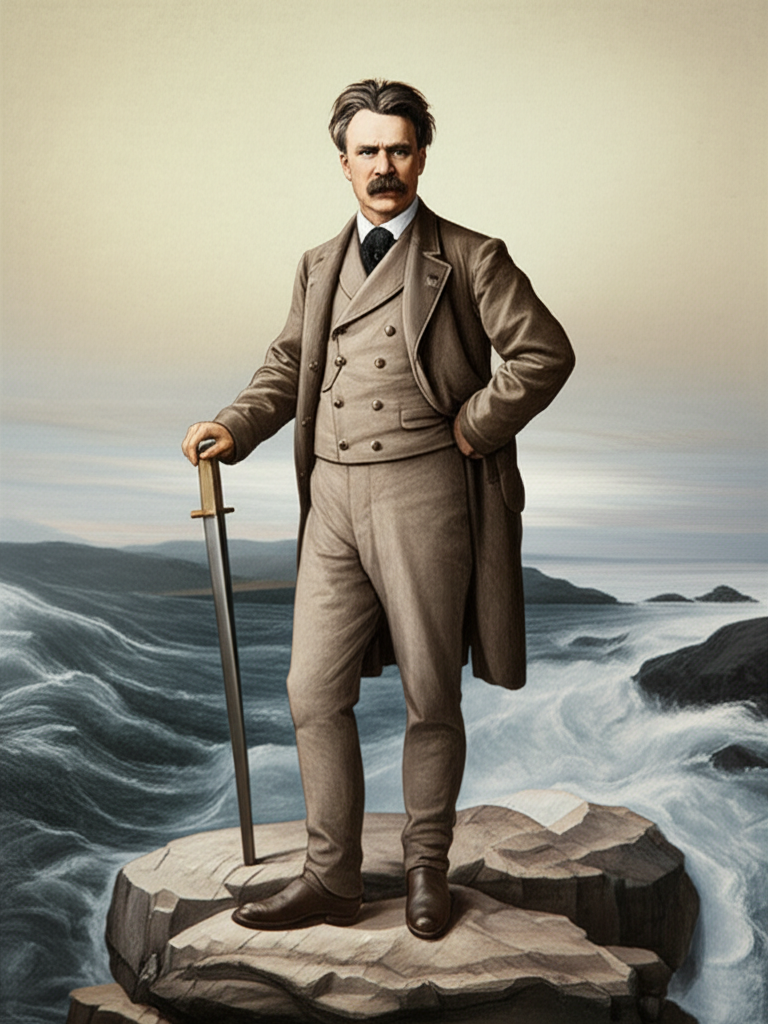
Nietzsche: Beyond Good and Evil, Beyond Happiness?
Friedrich Nietzsche, a profoundly influential German philosopher, launched a scathing critique of traditional morality and the pursuit of Happiness as a universal goal. In works like Thus Spoke Zarathustra and Beyond Good and Evil, he argued that the Christian-Platonic emphasis on humility, compassion, and the pursuit of a comfortable, Happy existence was a "slave morality" that stifled human potential.
Nietzsche posited that true human flourishing (which he called Will to Power, not happiness) involved overcoming oneself, embracing suffering, and creating one's own values rather than passively accepting pre-ordained ones. For him, the Nature of Good and Evil was a human construct, and the pursuit of a shallow, comfortable Happiness was a sign of decadence. He challenged individuals to become Übermenschen (Overmen), transcending conventional morality to forge a life of strength, creativity, and self-overcoming.
Existentialism: Freedom, Responsibility, and the Search for Meaning
20th-century Existentialist thinkers like Jean-Paul Sartre, Albert Camus, and Simone de Beauvoir offered a different lens through which to view Happiness. Confronted with a seemingly meaningless universe, they emphasized individual freedom, responsibility, and the creation of meaning.
For Existentialists, "existence precedes essence," meaning we are born without inherent purpose and must define ourselves through our choices. This freedom, however, comes with a profound sense of anguish and responsibility. Happiness, in this context, is not a given or a goal to be passively achieved, but rather a byproduct of living authentically, embracing one's freedom, confronting the absurdity of existence, and committing to meaningful projects. The Nature of Good and Evil becomes a deeply personal and subjective matter, forged through individual choices in the face of an indifferent world.
Conclusion: The Enduring Quest for a Good Life
The philosophical exploration of the Nature of Happiness reveals a profound and enduring human quest. From Aristotle's eudaimonia as virtuous activity to Epicurus's ataraxia, from Kant's emphasis on duty to Mill's utilitarian calculus, and from Nietzsche's call for self-overcoming to the Existentialist's embrace of freedom, Philosophy has continually reshaped our understanding.
What emerges is not a single, monolithic definition, but a rich spectrum of perspectives, each offering valuable insights into what it means to live a good life. Whether seen as a state of flourishing, an absence of pain, a consequence of duty, a collective good, or a byproduct of authentic self-creation, Happiness remains deeply intertwined with our understanding of human Nature, our ethical frameworks, and our ever-evolving conceptions of Good and Evil. Ultimately, the philosophical journey encourages us not just to seek Happiness, but to critically examine its Nature and to consciously forge our own path towards a meaningful and fulfilling existence.
Further Exploration:
📹 Related Video: ARISTOTLE ON: The Nicomachean Ethics
Video by: The School of Life
💡 Want different videos? Search YouTube for: "Aristotle Nicomachean Ethics explained"
📹 Related Video: STOICISM: The Philosophy of Happiness
Video by: The School of Life
💡 Want different videos? Search YouTube for: "Stoicism for a Happy Life"