

The Enduring Enigma: Navigating the Nature of God Through Theological Reasoning
Summary: The quest to understand the nature of God stands as one of humanity's most persistent and profound intellectual endeavors. This article explores how reasoning has been employed within theology and religion across Western thought, from ancient philosophical inquiries to the rigorous arguments of scholasticism and the critical analyses of the Enlightenment. We will trace the evolution of how thinkers, drawing from the wellspring of the Great Books of the Western World, have attempted to define the divine, reconcile faith with intellect, and grapple with the ultimate questions surrounding God's existence and attributes, demonstrating that the pursuit is as much about the journey of inquiry as it is about definitive answers.
The Perennial Question: Why Does God Matter to Reasoning?
From the earliest stirrings of human consciousness, the universe has presented a grand tapestry of order and chaos, beauty and terror. In response, humanity has sought ultimate explanations, often culminating in conceptions of a divine being or force. But the question isn't merely if God exists, but what God is. This inquiry into the nature of God isn't solely a matter of religion or personal belief; it is a profound philosophical challenge that demands rigorous reasoning. How can we speak coherently about that which transcends our ordinary experience? How can we construct a theology that is both intellectually satisfying and spiritually resonant?
The lineage of Western thought, beautifully preserved in the Great Books, reveals a continuous, often contentious, dialogue on this very subject. Each era, each great mind, has brought new tools of reasoning to bear, shaping and reshaping our understanding of the divine.
Early Glimmers: Philosophical Foundations of the Divine
Before the full flowering of monotheistic theology, ancient Greek philosophers laid crucial groundwork for understanding ultimate reality, which would later inform conceptions of God.
- Plato's Form of the Good: In his Republic, Plato posits the Form of the Good as the ultimate source of all truth, beauty, and being. While not a personal God in the Abrahamic sense, it functions as the supreme principle, the raison d'être for all existence, apprehended not through sense experience but through intellectual reasoning. This abstract, perfect, and eternal reality profoundly influenced later Christian theology.
- Aristotle's Unmoved Mover: Aristotle, in his Metaphysics, arrived at the concept of an "Unmoved Mover" – a pure actuality that causes all motion in the cosmos without itself being moved. This entity is the ultimate efficient and final cause, existing necessarily and eternally. It is pure thought, thinking only of itself, perfect and self-sufficient. Aristotle's rigorous logical reasoning provided a template for later proofs of God's existence, emphasizing causality and necessity.
These foundational ideas illustrate how reasoning, independent of revealed religion, naturally led to the postulation of a singular, ultimate principle governing reality – a principle that would eventually be identified with God.
The Scholastic Synthesis: Faith, Reason, and the Divine Nature
The medieval period witnessed the monumental effort to reconcile Greek philosophical reasoning with Christian revelation, giving birth to systematic theology. Figures like Augustine and Thomas Aquinas stand as giants in this endeavor.
Augustine of Hippo: The Interior Ascent
Augustine, deeply influenced by Neoplatonism, explored the nature of God through introspection and the ascent of the soul. In his Confessions, he describes God as immutable, eternal, and the source of all truth and goodness, accessible through both faith and intellectual illumination. His reasoning often moved from inner experience to the transcendent divine.
Thomas Aquinas: The Pinnacle of Theological Reasoning
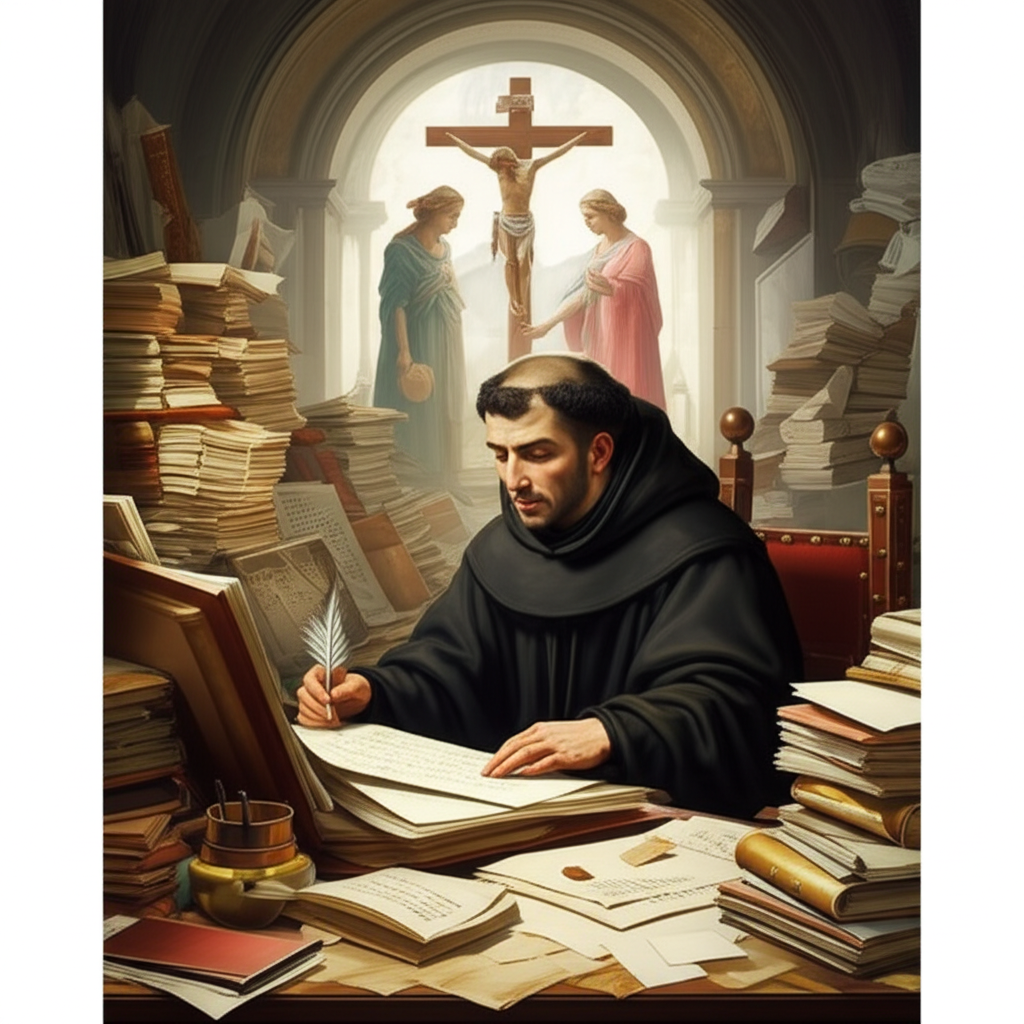
Perhaps no one exemplified the rigorous application of reasoning to theology more than Thomas Aquinas. In his Summa Theologica, he meticulously constructed arguments for God's existence and attributes, famously presenting his "Five Ways."
| The Five Ways (Proofs for God's Existence) | Core Argument |
|---|---|
| 1. The Argument from Motion | Everything in motion must be moved by something else. This chain cannot go on infinitely, so there must be an Unmoved Mover. |
| 2. The Argument from Causation | Every effect has a cause. This chain cannot go on infinitely, so there must be an Uncaused First Cause. |
| 3. The Argument from Contingency | All things in the world are contingent (they might or might not exist). If everything were contingent, at some point nothing would exist. Therefore, there must be a necessary being upon which all contingent beings depend. |
| 4. The Argument from Degrees of Perfection | We observe varying degrees of goodness, truth, and nobility in the world. These degrees imply a maximum, a perfect being that is the source of all perfection. |
| 5. The Argument from Design/Teleology | Natural bodies act for an end, even without intelligence. This implies an intelligent designer or governor who directs all natural things to their end. |
Aquinas's work demonstrates a profound belief in the harmony of faith and reason. For him, reason could establish certain truths about God (like existence and some attributes), while other truths (like the Trinity) required divine revelation. This intricate theological reasoning became the bedrock of much Western religion and philosophy.
The Enlightenment's Scrutiny: New Challenges to Divine Understanding
The Enlightenment brought a renewed emphasis on human reason as the primary means of understanding the world, often challenging traditional theology and religion.
- René Descartes and the Ontological Argument: Descartes, in his Meditations, famously argued that the very concept of God as a supremely perfect being implies His existence, as existence is a perfection. This reasoning, while powerful, became a focal point for later critiques.
- Baruch Spinoza's Pantheism: Spinoza, in his Ethics, offered a radical view, identifying God with Nature itself. For Spinoza, God is the one substance, infinite, eternal, and all-encompassing. His rigorous geometric reasoning dissolved the traditional distinction between creator and creation, presenting a universe where God is immanent in everything.
- Immanuel Kant's Critique: Kant, in his Critique of Pure Reason, delivered a monumental challenge to traditional metaphysical proofs for God's existence. He argued that while concepts of God are necessary for moral reasoning and practical life, theoretical reason cannot definitively prove or disprove the existence of a transcendent God. He distinguished between noumenal (things-in-themselves) and phenomenal (things as they appear to us) reality, asserting that God belongs to the former, thus beyond the grasp of pure theoretical reason.
These thinkers, all featured in the Great Books, illustrate the evolving, often conflicting, applications of reasoning to the nature of God, pushing the boundaries of what could be known and how.
Contemporary Reflections: The Ongoing Dialogue
In the modern era, theological reasoning continues to evolve. While traditional arguments persist, new approaches have emerged, often influenced by scientific discoveries, existential philosophy, and a globalized understanding of religion. The conversation about the nature of God now encompasses:
- Process Theology: Views God not as static and immutable, but as a dynamic, evolving entity intimately involved in the ongoing creative process of the universe.
- Existentialist Perspectives: Focus on the subjective experience of meaning and freedom in a potentially Godless or indifferent universe, challenging conventional notions of God's role.
- Philosophy of Religion: A field dedicated to analyzing the concepts, claims, and arguments found in religion, using the tools of analytic philosophy to clarify and critique.
The core tension between faith and reason, between revelation and empirical observation, remains. Yet, the enduring fascination with the nature of God ensures that theological reasoning will continue to be a vibrant and essential domain of intellectual inquiry.
The Unfolding Dialogue: A Journey, Not a Destination
The journey through the Great Books of the Western World reveals that the question of God's nature is not a problem to be solved and filed away, but a profound, unfolding dialogue. From Plato's Good to Aquinas's First Cause, from Spinoza's Substance to Kant's regulative ideal, each philosopher and theologian has contributed to a rich tapestry of understanding.
Ultimately, the persistent human drive to understand God is a testament to our innate desire for meaning, purpose, and ultimate truth. Whether approached through the lens of religion, the rigor of theology, or the critical apparatus of philosophical reasoning, the nature of God remains the grandest, most humbling, and perhaps most essential question we can ask. The pursuit of answers, even when elusive, refines our intellect, broadens our perspective, and deepens our appreciation for the enduring mysteries of existence.
YouTube Video Suggestions:
-
📹 Related Video: ARISTOTLE ON: The Nicomachean Ethics
Video by: The School of Life
💡 Want different videos? Search YouTube for: ""Thomas Aquinas Five Ways Explained" - Look for videos that clearly break down his arguments for God's existence in an accessible philosophical context."
2. ## 📹 Related Video: KANT ON: What is Enlightenment?
Video by: The School of Life
💡 Want different videos? Search YouTube for: ""Kant's Critique of Pure Reason God" - Search for discussions on Kant's arguments regarding the limits of theoretical reason concerning God's existence and the role of practical reason."