

Navigating the Divine: The Nature of God and Theological Reasoning
A Perpetual Inquiry into Faith and Intellect
The question of God's nature stands as one of humanity's most enduring and profound intellectual challenges, a cornerstone of philosophical and religious thought throughout history. This article delves into the intricate relationship between the concept of the divine and the rigorous application of human reasoning within the discipline of theology. We will explore how thinkers, from ancient philosophers to modern theologians, have grappled with defining the ultimate reality, examining the methods by which they attempt to understand the incomprehensible, and the perennial tensions and harmonies between faith, intellect, and the broader context of religion. Ultimately, we aim to illuminate the pathways and pitfalls of theological reasoning as it seeks to articulate the ineffable.
The Elusive Architect: Defining God
The very notion of "God" is a vast and multifaceted concept, shifting across cultures, epochs, and individual interpretations. From the monotheistic Yahweh, Allah, or the Christian Trinity, to the pantheistic Spinoza's God identified with nature, or Aristotle's unmoved mover, the attributes ascribed to the divine are as varied as human imagination and experience.
In the Western tradition, heavily influenced by texts found in the Great Books, we often encounter a classical conception of God as:
- Omnipotent: All-powerful, capable of anything logically possible.
- Omniscient: All-knowing, possessing perfect knowledge of all things past, present, and future.
- Omnibenevolent: All-good, perfectly moral and loving.
- Omnipresent: Present everywhere at all times.
- Transcendent: Existing beyond the physical universe, distinct from creation.
- Immanent: Present within the created world, actively involved.
These attributes form the bedrock upon which much of Western theology is built, yet each poses its own set of philosophical dilemmas, demanding sophisticated reasoning to reconcile apparent contradictions (e.g., the problem of evil with an omnibenevolent and omnipotent God).
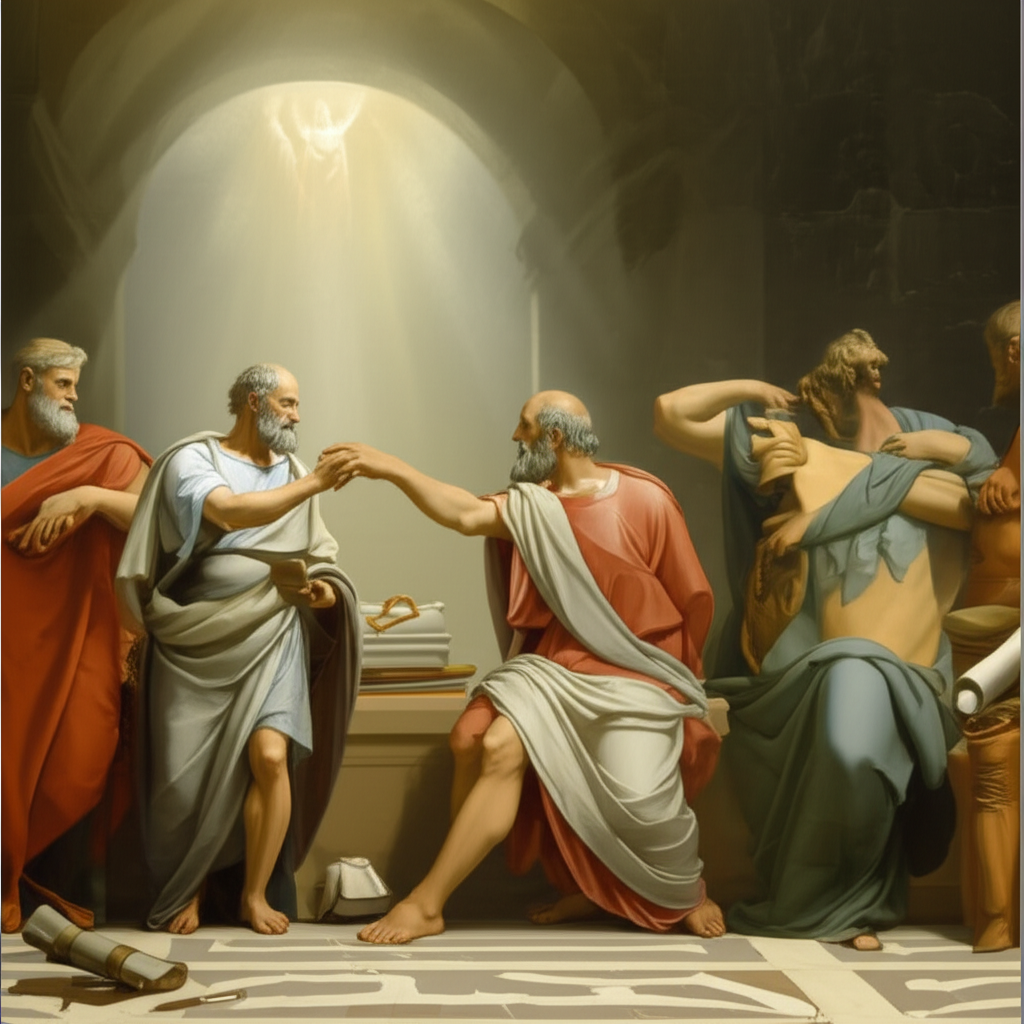
The Engine of Theological Reasoning: Faith Seeking Understanding
Theology is often described as "faith seeking understanding," a phrase attributed to St. Anselm. It is a systematic discipline that employs reasoning to explore, interpret, and defend religious doctrines and beliefs. While often rooted in revelation or sacred texts, theology is far from an anti-intellectual pursuit; rather, it is an intense engagement of the mind with the mysteries of religion.
The methods of theological reasoning draw heavily from philosophical traditions, employing:
- Deductive Reasoning: Starting from general premises (e.g., God is perfect) to arrive at specific conclusions (e.g., therefore, God must exist, as perfection entails existence, as argued in ontological arguments).
- Inductive Reasoning: Drawing general conclusions from specific observations (e.g., the intricate order of the universe suggests a designer, leading to teleological arguments).
- Abductive Reasoning: Forming the best possible explanation for a set of observations, even if not definitively proven (e.g., postulating a divine explanation for the origin of consciousness or moral law).
The Pillars of Theological Argumentation
Historically, several key arguments have dominated theological discourse, each relying on distinct forms of reasoning:
| Argument Type | Core Premise | Key Figures (Implicit in Great Books) | Focus |
|---|---|---|---|
| Ontological | God, by definition, is a being than which no greater can be conceived. | Anselm, Descartes, Spinoza | Existence from definition |
| Cosmological | Every effect has a cause; the universe must have a first cause. | Plato (Demiurge), Aristotle (Unmoved Mover), Aquinas (Five Ways) | Existence from causation |
| Teleological | The universe exhibits order, design, and purpose. | Plato (World Soul), Aquinas (Fifth Way), Paley (Watchmaker) | Existence from design |
| Moral | Objective moral laws imply a divine lawgiver. | Kant, C.S. Lewis, Augustine | Existence from morality |
| Experiential | Personal encounters with the divine. | Mystics, various religious traditions (less philosophical, more phenomenological) | Existence from subjective experience |
These arguments are not mere intellectual exercises; they represent humanity's persistent effort to bridge the gap between finite understanding and infinite mystery, offering rational scaffolding for religious belief.
Challenges and Critiques in Theological Reasoning
Despite the sophisticated application of reasoning, the nature of God and the conclusions of theology remain subjects of intense debate. Critics, often drawing from the same wellspring of philosophical inquiry found in the Great Books, highlight several enduring challenges:
- The Problem of Evil: How can an all-powerful, all-knowing, and all-good God permit suffering and evil? This paradox has fueled centuries of philosophical and theological debate, challenging the very coherence of classical theism.
- Logical Inconsistencies: Apparent contradictions within theological doctrines or between divine attributes (e.g., free will vs. divine foreknowledge).
- Limits of Human Reason: Philosophers like Immanuel Kant argued that pure reason, when applied beyond the realm of empirical experience, cannot definitively prove or disprove the existence of God. The divine, in this view, lies beyond the reach of our cognitive faculties.
- Empirical Verification: Unlike scientific inquiry, theological claims about God are generally not subject to empirical testing, leading some to question their epistemological validity.
These critiques do not necessarily invalidate theology but rather underscore its unique position: it operates in a domain where reasoning must often confront its own limitations, where certainty is elusive, and where faith often plays a crucial role in providing direction.
The Enduring Quest for Meaning
The journey to understand the nature of God through theological reasoning is a testament to the human spirit's insatiable hunger for meaning and ultimate truth. It is a dialogue that has shaped civilizations, inspired art, and driven some of the most profound intellectual achievements in history. Far from being a relic of the past, this quest continues to evolve, adapting to new scientific discoveries, philosophical insights, and societal changes, yet always returning to the fundamental questions of existence, purpose, and the divine. The interplay between God, Theology, Reasoning, and Religion remains a vibrant, essential field of inquiry, inviting each generation to contribute to this timeless conversation.
📹 Related Video: KANT ON: What is Enlightenment?
Video by: The School of Life
💡 Want different videos? Search YouTube for: ""Aquinas Five Ways Explained""
📹 Related Video: KANT ON: What is Enlightenment?
Video by: The School of Life
💡 Want different videos? Search YouTube for: ""Kant's Critique of Pure Reason God""