

Unveiling the Fabric of Existence: A Philosophical Journey Through Eternity and Time
The concepts of eternity and time stand as two of the most profound and perplexing subjects in philosophy, forming the very bedrock of our understanding of existence, change, and reality itself. This pillar page embarks on a comprehensive exploration of these intertwined metaphysical dimensions, delving into their definitions, the historical evolution of thought surrounding them, and their intricate relation to human experience and the divine. From ancient Greek contemplation to modern scientific inquiry, we will navigate the rich tapestry of ideas that seek to unravel the fundamental nature of temporal flow and timeless being. Prepare to challenge your intuitions and journey through the profound questions that lie at the heart of what it means to exist.
What is Time? Defining the Indefinable
Time, for many, is simply the relentless onward march of moments, a universal constant that governs all change. Yet, upon closer philosophical inspection, its nature proves far more elusive and contentious. Is time a fundamental aspect of reality, an objective dimension independent of observers, or merely a construct of the human mind?
The Elusive Nature of Temporal Flow
Philosophers throughout history have grappled with the definition of time, often finding it easier to describe its effects than its essence. Aristotle, in his Physics, famously defined time as "the number of motion with respect to 'before' and 'after'," suggesting it is not an independent entity but rather an attribute of change. Without motion, Aristotle argued, there would be no time.
Centuries later, Saint Augustine, in his Confessions, offered a deeply personal and introspective account. He famously mused, "What, then, is time? If no one asks me, I know; if I wish to explain it to one who asks, I do not know." Augustine concluded that time exists primarily in the human mind, as a "distension of the soul," where the past is memory, the present is attention, and the future is expectation. This challenged the notion of an objective, external time existing independently of consciousness.
Key Philosophical Perspectives on Time:
- Substantivalism: Time is a "container" or a fundamental dimension in which events occur, existing independently of those events (e.g., Newton's absolute time).
- Relationalism: Time is merely a system of relations between events; it is not an entity in itself, but rather an abstraction from the order and duration of changes (e.g., Leibniz, Aristotle).
- Subjectivism: Time is a construct of the human mind, an a priori form of intuition through which we organize our experience (e.g., Kant).
The Arrow of Time: Direction and Irreversibility
One of the most striking features of time is its apparent unidirectionality – the "arrow of time." Events move from past to future, never in reverse. This irreversibility is evident in everything from the aging process to the crumbling of mountains. While physics often describes fundamental laws as time-symmetric (meaning they work the same forwards and backward), the macroscopic world clearly demonstrates a preferred direction. This has led to discussions about entropy (the tendency towards disorder) and the initial conditions of the universe as potential sources for the arrow of time.
What is Eternity? Beyond the Bounds of Time
If time is the measure of motion and change, what then is eternity? Is it simply an unending stretch of time, or something fundamentally different – a state entirely outside of temporal succession?
Eternity as Everlastingness vs. Timelessness
The philosophical distinction between two primary conceptions of eternity is crucial:
- Everlastingness (or Semper Aeternum): This refers to existence without beginning or end, an infinite duration through time. Something everlasting endures through every moment of time, stretching infinitely into the past and future. While unbound by specific temporal limits, it is still within time.
- Timelessness (or Aeternitas): This is a more radical concept, suggesting existence entirely outside of temporal succession. A timeless being or state does not have a past, present, or future in the way we understand them. All moments are simultaneously present to it. This is often associated with the divine.
Plato, in his concept of the Forms, presented a realm of eternal, unchanging, and timeless essences that exist independently of the fleeting, temporal world we perceive. These Forms are not everlasting in the sense of enduring through infinite time, but rather exist outside of time altogether.
The Divine Eternity
The concept of divine eternity has been a cornerstone of theological and philosophical inquiry. Boethius, in The Consolation of Philosophy, offered perhaps the most influential definition of eternity: "the whole, simultaneous, and perfect possession of everlasting life." This definition emphasizes:
- Whole: God's knowledge and being encompass all of reality.
- Simultaneous: God experiences all of time (past, present, future) in a single, unified "now." There is no succession for God.
- Perfect Possession: This knowledge and being are complete and unchanging.
Thomas Aquinas, building on Boethius, further elaborated on this, arguing that God is utterly immutable and therefore cannot be subject to the succession of time. For God, all moments are eternally present, not just everlasting. This poses significant questions about God's relation to a temporal creation.
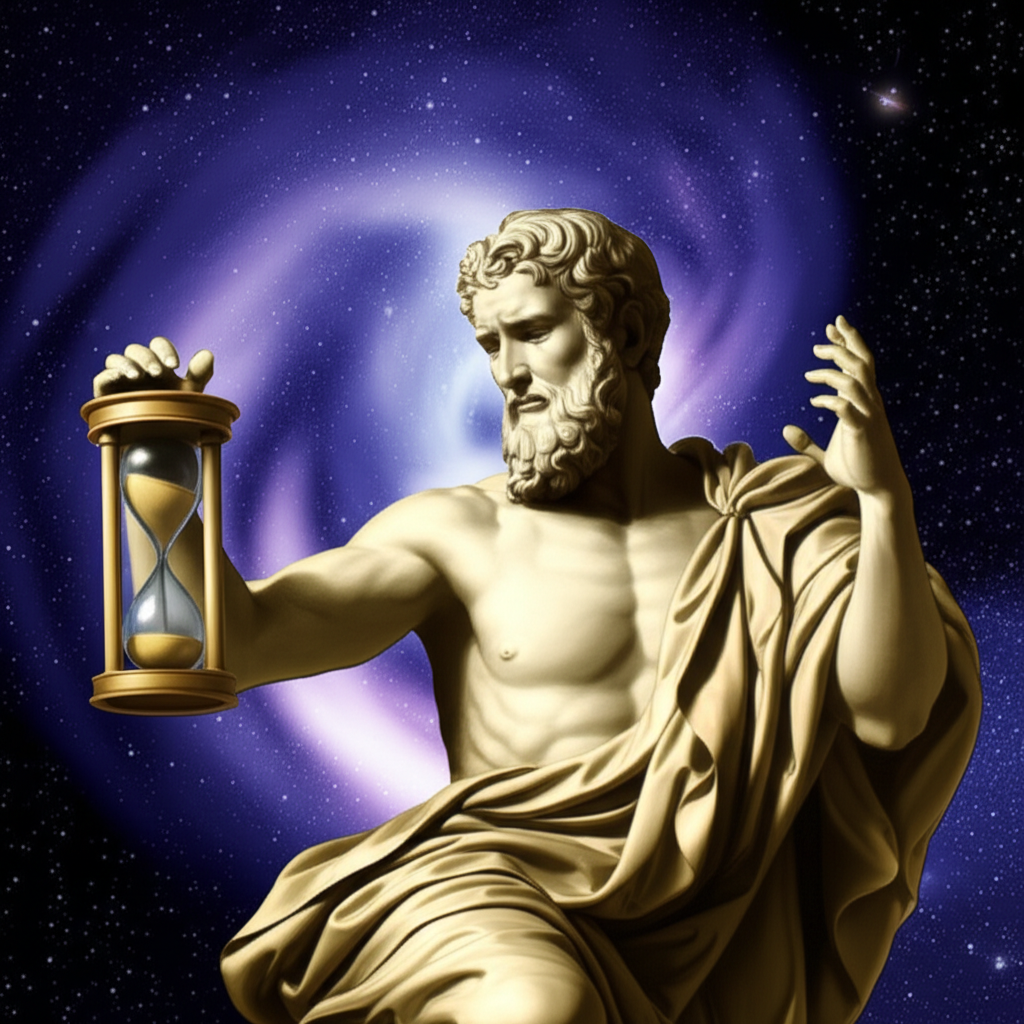
The Metaphysical Dance: How Eternity and Time Intersect
The interplay between eternity and time gives rise to some of the most profound metaphysical dilemmas. How does a timeless God interact with a temporal world? How do we, as temporal beings, conceive of or relate to eternity?
Creation and Divine Action in a Temporal World
If God is timeless, how can God act in time? The act of creation, for instance, seems to imply a "before" and an "after." Philosophers have proposed various solutions:
- Eternal Decree: God's decision to create is timeless, but its manifestation unfolds temporally for us.
- Timeless Relation: God's relation to creation is eternal, even if creation itself has a temporal beginning. It's akin to an author having the whole story in mind at once, even though the reader experiences it sequentially.
- Analogical Language: Our language, being temporal, can only describe divine actions analogically, not literally.
This discussion often involves thinkers like Leibniz, who proposed a pre-established harmony where God's initial creation set up the universe to unfold perfectly, without direct intervention in every temporal moment. Spinoza, on the other hand, conceived of God and Nature as identical, with all events necessarily flowing from God's eternal essence, removing the distinction between a timeless creator and a temporal creation.
Human Experience and the Glimpse of Eternity
While we are undeniably creatures of time, human beings often experience moments that seem to transcend temporal bounds. These might include:
- Deep contemplation: Losing oneself in thought or meditation.
- Artistic creation or appreciation: Moments of profound aesthetic experience.
- Love and connection: Feeling an "eternal" bond with another.
- Spiritual or mystical experiences: Sensations of unity or timelessness.
These experiences suggest that while our physical existence is bound by time, our consciousness might possess an innate capacity to intuit or even briefly participate in something akin to eternity. This raises questions about the human soul and its potential for an existence beyond the temporal.
Table: Key Distinctions Between Time and Eternity
| Feature | Time | Eternity |
|---|---|---|
| Nature | Succession of moments, change, duration | Timelessness or infinite duration |
| Experience | Past, Present, Future | All moments simultaneously present (for God) |
| Direction | Unidirectional (Arrow of Time) | Non-directional, static, or omni-directional |
| Relation to Being | Events happen in time | Being is eternally |
| Example | Human life, the unfolding of the universe | Plato's Forms, Boethius's Divine Eternity |
Contemporary Perspectives and Enduring Questions
The philosophical inquiry into eternity and time continues unabated, informed by advancements in physics and renewed metaphysical debates.
Physics, Relativity, and the Block Universe
Modern physics, particularly Einstein's theories of relativity, has profoundly impacted our understanding of time. Relativity demonstrates that time is not absolute but relative to the observer's motion and gravitational field. The concept of "spacetime" as a unified four-dimensional manifold suggests a "block universe" model, where all past, present, and future events exist simultaneously. This view, while not equivalent to philosophical timelessness, challenges the intuitive notion of a constantly flowing present and raises questions about free will if the future is already "there."
The Eternal Recurrence and Meaning
Friedrich Nietzsche's concept of "eternal recurrence" offers a starkly different, non-theistic take on eternity. He posited the idea that all events in the universe will repeat themselves infinitely, in exactly the same way. This thought experiment serves as a profound ethical challenge: if you knew every moment of your life would recur infinitely, would you live it differently? Would you affirm it? For Nietzsche, embracing eternal recurrence became a test of one's love for life and a path to creating meaning in a world devoid of conventional eternal promises.
The Unending Quest
The nature of eternity and time remains one of philosophy's most enduring puzzles. Whether we view time as a fundamental cosmic dimension or a subjective human construct, and eternity as infinite duration or timeless transcendence, these concepts force us to confront the limits of our understanding and the profound mysteries of existence itself. Our journey through these metaphysical landscapes is not merely an academic exercise but a deeply personal quest to comprehend our place within the grand relation of all things.
YouTube Video Suggestions:
-
📹 Related Video: ARISTOTLE ON: The Nicomachean Ethics
Video by: The School of Life
💡 Want different videos? Search YouTube for: ""Philosophy of Time: Augustine, Aristotle, and Newton""
2. ## 📹 Related Video: KANT ON: What is Enlightenment?
Video by: The School of Life
💡 Want different videos? Search YouTube for: ""Boethius and the Problem of Divine Eternity""