

The Enduring Dance: Democracy, Rhetoric, and the Shaping of Opinion
Summary: Democracy, by its very nature, is inextricably linked to rhetoric. From its ancient Athenian origins, the health and trajectory of democratic governance have depended on the art of persuasion, the crafting of arguments, and the open exchange of opinion. This article explores the profound and often complex relationship between these two forces, drawing on classical philosophical insights to illuminate how rhetoric can be both a vital tool for informed deliberation and a potent weapon for manipulation, fundamentally shaping the democratic landscape.
The Foundations: Where Oratory Met Governance
It’s a curious thought, isn't it? That the grand experiment of self-governance, which we call democracy, emerged alongside the rigorous study of how to persuade. One cannot truly understand the nature of the other without appreciating their shared genesis. When we turn to the "Great Books of the Western World," we find that the very cradle of democratic thought – ancient Greece – was also the birthplace of formal rhetoric.
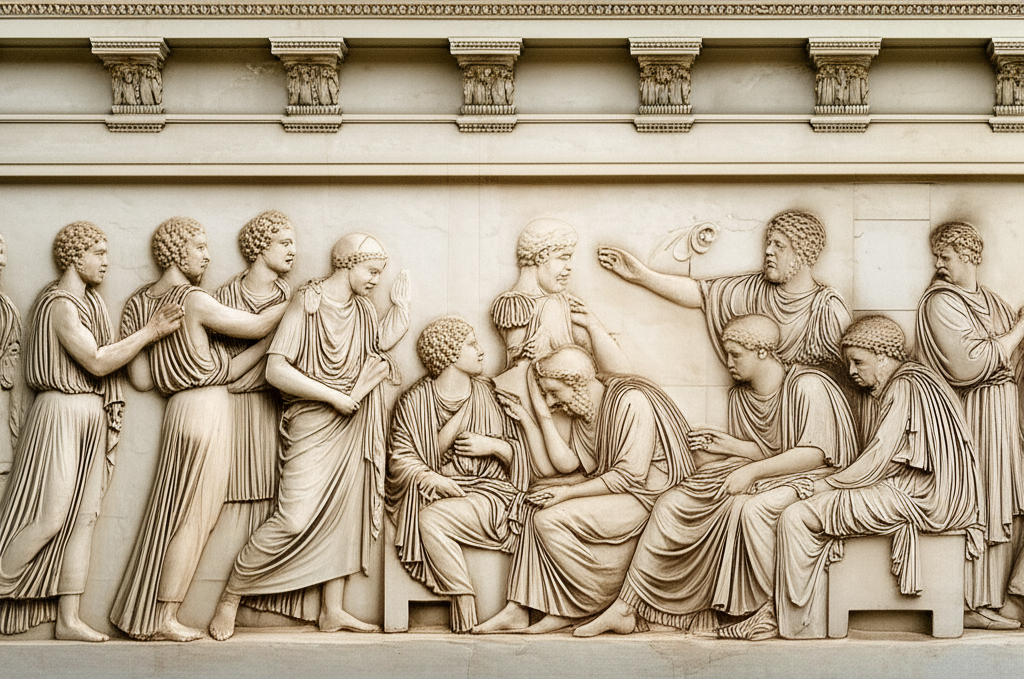
Think of the Athenian Agora, not just as a marketplace for goods, but as a vibrant marketplace of ideas. Here, citizens gathered to debate, to propose laws, to elect leaders, and to decide the fate of their polis. What tool did they employ? The spoken word, artfully arranged, passionately delivered. This was rhetoric in its purest form: the art of effective or persuasive speaking or writing.
Plato, in his dialogues like Gorgias, famously grappled with the ethical dimensions of rhetoric. He was deeply suspicious of the Sophists, who he believed used persuasive techniques not to uncover truth, but to sway opinion for personal gain, often at the expense of justice. For Plato, mere persuasion, detached from genuine knowledge and virtue, was a dangerous force in a society striving for the good.
Aristotle, however, offered a more pragmatic and perhaps more balanced view. In his Rhetoric, he defined it not as manipulation, but as "the faculty of observing in any given case the available means of persuasion." He saw it as a neutral tool, capable of being used for good or ill, essential for public discourse, and a necessary complement to dialectic and logic. In a democracy, where collective decisions are made through deliberation, the ability to articulate, defend, and critique arguments is not just a skill; it's a fundamental civic responsibility.
Rhetoric's Double Edge: Persuasion, Truth, and Deception
The inherent nature of rhetoric is its power to influence. This power, however, is a double-edged sword, capable of both elevating and undermining democratic ideals.
- The Illuminating Power: When employed ethically, rhetoric can clarify complex issues, present diverse perspectives, and inspire citizens to civic action. It can be the engine of public education, helping individuals form informed opinions by understanding the nuances of policy and philosophy. A skillful orator, grounded in truth and reason, can galvanize a populace towards noble goals.
- The Shadow of Sophistry: Yet, the very same tools of persuasion can be weaponized. Demagogues throughout history have exploited rhetorical techniques – emotional appeals, logical fallacies, the selective presentation of facts – to manipulate public opinion, sow division, and consolidate power. This is the danger Plato warned against: the glib speaker who charms the crowd without substance, prioritizing popularity over truth. The ease with which rhetoric can be divorced from verifiable facts and instead appeal purely to emotion or prejudice remains a constant challenge for any democracy.
Table: The Dual Faces of Rhetoric in Democracy
| Aspect | Ethical Rhetoric (Aristotle's Ideal) | Unethical Rhetoric (Plato's Critique of Sophistry) |
|---|---|---|
| Purpose | To inform, persuade based on reason, seek consensus, reveal truth. | To manipulate, deceive, gain power, sway opinion without substance. |
| Foundation | Logic (logos), credible character (ethos), appropriate emotion (pathos). | Fallacies, misrepresentation, ad hominem attacks, pure emotional appeal. |
| Impact on Opinion | Fosters informed, deliberated opinion. | Creates uninformed, easily swayed, or prejudiced opinion. |
| Result | Strengthens democratic discourse and decision-making. | Weakens democratic processes, fosters distrust and irrationality. |
The Democratic Arena: Where Opinions Collide
A democracy, perhaps more than any other form of governance, thrives on the collision and refinement of opinion. It postulates that from the diverse perspectives of its citizens, the best path forward can be discerned. But this process is rarely purely rational; it is deeply human, steeped in emotion, experience, and the very human desire to be heard and understood.
This is where rhetoric becomes indispensable. It is the language of the public sphere, the mechanism through which ideas are presented, challenged, and ultimately, either accepted or rejected by the body politic. The vibrant exchange of ideas, the vigorous debate, the very act of trying to convince another of your viewpoint – these are the lifeblood of a healthy democracy.
However, the proliferation of rhetoric also demands a highly discerning citizenry. The freedom of speech, a cornerstone of democracy, means that all manner of arguments, both sound and specious, will enter the public discourse. The challenge, then, lies not just in the speaker's responsibility to use rhetoric ethically, but in the listener's responsibility to critically evaluate what is being said. Developing this critical faculty, this philosophical skepticism, is paramount for safeguarding the integrity of democratic processes.
Rhetoric in the Digital Agora: New Challenges for Democracy
In our contemporary world, the arena of democratic discourse has expanded exponentially, moving from the physical agora to the boundless digital realm. The nature of rhetoric remains the same – the art of persuasion – but its delivery mechanisms have transformed profoundly. Social media platforms, 24/7 news cycles, and the ease of information dissemination mean that rhetorical messages, both profound and superficial, spread with unprecedented speed and reach.
This presents new challenges for democracy. Echo chambers can amplify existing opinions without exposure to counter-arguments. Misinformation, often crafted with sophisticated rhetorical techniques, can go viral before truth can catch up. The very speed of communication can reduce complex issues to soundbites, eroding the space for thoughtful deliberation.
Yet, the core philosophical questions remain. How do we distinguish between genuine argument and manipulative persuasion? How do we cultivate an informed citizenry capable of discerning truth from falsehood in a cacophony of voices? These are not new questions, but they are questions made more urgent by the pervasive nature of modern communication.
Navigating the Rhetorical Current: A Call for Deliberation
Ultimately, the relationship between democracy and rhetoric is a perpetual dance, a dynamic tension that defines the very nature of self-governance. We cannot wish rhetoric away, for it is inherent to any system that relies on collective decision-making and the formation of public opinion.
Instead, our task is to understand its power, to appreciate its ethical dimensions, and to cultivate both the skill of effective communication and the wisdom of critical reception. As citizens of a democracy, we are not merely passive recipients of rhetorical appeals; we are active participants, both as speakers and listeners, shaping the discourse that shapes our shared future. The ongoing health of our democratic experiment hinges on our collective ability to navigate the rhetorical current with wisdom, integrity, and a steadfast commitment to reasoned deliberation.
YouTube Video Suggestions:
- "Plato's Gorgias Rhetoric Philosophy"
- "Aristotle Rhetoric Persuasion Democracy"
📹 Related Video: What is Philosophy?
Video by: The School of Life
💡 Want different videos? Search YouTube for: "The Nature of Democracy and Rhetoric philosophy"