

The Unspoken Agreement: How Rhetoric Shapes the Nature of Democracy
The very nature of democracy is inextricably linked to the art of rhetoric. From the bustling agoras of ancient Athens to the digital town squares of today, the ability to persuade, to articulate an opinion, and to sway the collective will has been the lifeblood—and sometimes the poison—of self-governance. This article delves into this complex relationship, exploring how rhetoric defines, challenges, and sustains the democratic ideal.
The Dance of Persuasion and Power: Understanding the Core Connection
At its heart, democracy is a system built on discourse, deliberation, and the often-messy process of reaching a consensus (or at least a majority). Unlike monarchies or oligarchies where power resides in the few, democracy vests authority, however imperfectly, in the many. But how do the many decide? How do diverse viewpoints coalesce into a unified course of action? This is where rhetoric steps onto the stage, not merely as a tool, but as an inherent component of the democratic mechanism itself.
Rhetoric, as explored by Aristotle in his seminal work, is not just about flowery language; it's the faculty of discovering the available means of persuasion in any given case. In a democracy, these "means" are crucial for:
- Articulating Policy: Presenting complex ideas and proposals in an understandable and appealing way.
- Mobilizing Support: Rallying citizens behind a cause, a candidate, or a vision for the future.
- Debating Alternatives: Offering different perspectives and scrutinizing opposing arguments.
- Shaping Public Opinion: Influencing beliefs, values, and attitudes within the populace.
Without rhetoric, democracy would be a silent assembly, a collection of disconnected individuals unable to communicate their needs or aspirations effectively.
Democracy: A Marketplace of Ideas (and Opinions)
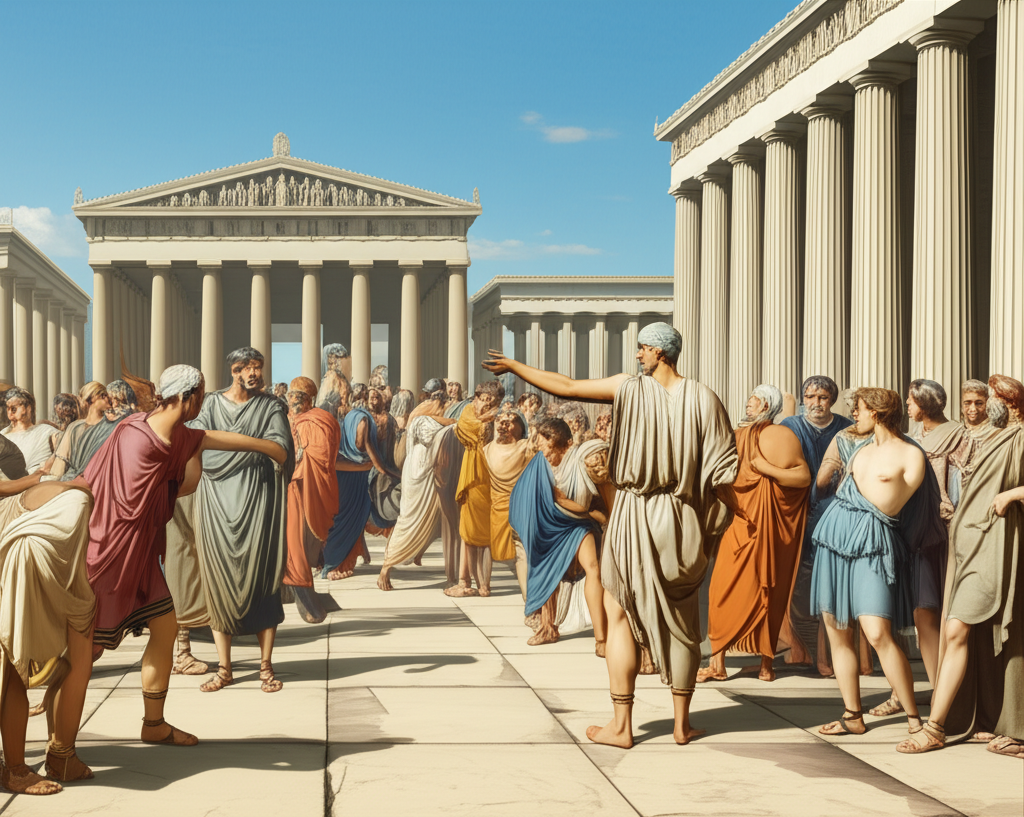
Ancient Greece, the cradle of democracy, also saw the flourishing of rhetoric. Thinkers like Plato, however, viewed rhetoric with deep suspicion, particularly in his Gorgias, where he portrays it as a dangerous art that prioritizes persuasion over truth, capable of manipulating the ignorant masses. For Plato, the nature of true governance should be guided by reason and philosophical wisdom, not the shifting sands of popular opinion swayed by clever speakers.
Yet, democracy thrives on the free exchange of diverse opinions. It's a system that, by design, allows for multiple truths and competing visions. This inherent pluralism makes rhetoric indispensable. Every citizen's voice, every group's agenda, requires articulation. The challenge, then, lies in distinguishing between rhetoric that informs and elevates, and rhetoric that deceives and degrades.
Rhetoric's Dual Nature: The Builder and the Destroyer
The power of rhetoric is its neutrality; it can be wielded for noble ends or for self-serving manipulation. This duality is critical to understanding its impact on democracy.
The Constructive Force of Rhetoric:
- Enlightenment: Effective rhetoric can clarify complex issues, making them accessible to a broader public.
- Inspiration: It can inspire collective action, foster civic virtue, and unite people around shared goals.
- Checks and Balances: Strong rhetorical challenges from an opposition are vital for holding power accountable.
- Education: It teaches citizens how to analyze arguments, identify fallacies, and form reasoned judgments.
The Destructive Potential of Rhetoric:
- Demagoguery: The use of emotional appeals, prejudices, and oversimplifications to gain power, often at the expense of truth.
- Misinformation: The deliberate spread of false or misleading information, eroding trust and distorting public discourse.
- Polarization: Rhetoric can be used to deepen divisions, demonize opponents, and prevent constructive compromise.
- Erosion of Reason: When emotion consistently trumps logic, the deliberative nature of democracy suffers.
Aristotle, in his Rhetoric, acknowledges these dangers but argues that a proper understanding of rhetorical principles allows one to discern and counter specious arguments. The responsibility, therefore, falls not only on the speaker but also on the discerning listener.
From Agora to Algorithm: The Evolving Landscape of Persuasion
The fundamental relationship between democracy and rhetoric has remained constant, but the arenas and tools of persuasion have dramatically evolved.
| Era | Primary Rhetorical Mediums | Impact on Democracy |
|---|---|---|
| Ancient Greece | Oratory in the Agora, Public Debates | Direct, immediate, reliant on presence and voice. |
| Roman Republic | Oratory in the Forum, Legal Speeches | Structured, legalistic, emphasized civic duty. |
| Enlightenment | Pamphlets, Newspapers, Public Lectures | Rise of print media; broader, more abstract public sphere. |
| 20th Century | Radio, Television, Mass Advertising | Centralized, one-to-many communication; rise of propaganda. |
| 21st Century | Social Media, Internet Forums, Blogs | Decentralized, rapid, personalized; echo chambers, viral misinformation. |
The digital age, with its algorithms and instant gratification, presents a new set of challenges. The sheer volume of information, coupled with the tendency for individuals to inhabit "filter bubbles," means that the nature of public opinion is shaped by forces far more intricate and often less transparent than the orations of old. The ability to distinguish reliable sources from persuasive but false narratives is now a critical civic skill.
Navigating the Rhetorical Landscape: A Call for Critical Engagement
For democracy to thrive, citizens must be equipped to critically engage with the rhetoric they encounter daily. This isn't about eliminating rhetoric—an impossible and undesirable goal—but about fostering an environment where ethical persuasion can flourish and manipulative tactics can be identified and rejected.
Here are a few ways to cultivate a more resilient democratic discourse:
- Media Literacy: Understanding how information is produced, distributed, and consumed.
- Critical Thinking Skills: The ability to analyze arguments, identify biases, and evaluate evidence.
- Encouraging Deliberation: Creating spaces, both online and offline, for thoughtful discussion rather than mere shouting matches.
- Promoting Intellectual Humility: Recognizing the limits of one's own opinion and being open to changing one's mind in the face of compelling evidence.
The ongoing tension between the ideal of reasoned debate and the reality of passionate persuasion is fundamental to the nature of democracy. It demands constant vigilance and a commitment from all participants to uphold the principles of honest discourse.
Conclusion: An Enduring Interdependence
The relationship between democracy and rhetoric is not a choice but an inescapable reality. Rhetoric is the language of democratic action, the means by which citizens articulate their visions, debate their differences, and forge a collective path forward. While its power can be abused, leading to the manipulation of opinion and the degradation of public discourse, it is also the essential tool for education, inspiration, and the very articulation of democratic ideals. To understand democracy, we must understand rhetoric; to safeguard democracy, we must master its ethical application and equip ourselves to discern its true nature.
YouTube Video Suggestions:
-
📹 Related Video: PLATO ON: The Allegory of the Cave
Video by: The School of Life
💡 Want different videos? Search YouTube for: ""Plato Gorgias rhetoric democracy summary""
2. ## 📹 Related Video: ARISTOTLE ON: The Nicomachean Ethics
Video by: The School of Life
💡 Want different videos? Search YouTube for: ""Aristotle Rhetoric explained public speaking""