

The Enigma of Animal Matter: A Philosophical Journey
The question of what constitutes animal matter—its fundamental nature and the physics that govern it—has captivated philosophers from antiquity to the present day. Far from being a mere biological inquiry, this investigation delves into the very essence of life, consciousness, and our place within the natural order. This article explores the rich philosophical heritage from the Great Books of the Western World that grapples with how living animal bodies differ from inanimate objects, examining perspectives that range from the ensouled organism to the intricate machine.
Ancient Inquiries into the Living Substance
From the earliest philosophical traditions, thinkers sought to distinguish between the vibrant, active substance of an animal and inert matter. This distinction was crucial for understanding movement, sensation, and the very spark of life.
Plato's Forms and the Embodied Soul
For Plato, as explored in dialogues like Phaedo and Timaeus, the physical world, including animal matter, is but an imperfect reflection of eternal, unchanging Forms. While the soul, for Plato, is immortal and distinct from the body, it is nonetheless embodied in matter, giving it animation and purpose. The physical body is a temporary vessel, subject to the laws of the material world, yet imbued with a soul that yearns for higher truths. The nature of the animal, then, is a complex interplay between its material constitution and its animating principle.
Aristotle's Hylomorphism: Form as the Soul
Aristotle, particularly in De Anima and his extensive biological works (Parts of Animals, History of Animals), offered a more integrated view. He proposed hylomorphism, the idea that every substance is a compound of form and matter. For Aristotle, the soul (psyche) is not a separate entity imprisoned within the body but rather the form of a natural body possessing the potentiality for life.
Aristotle's Four Causes Applied to Animal Matter:
| Cause | Description | Application to an Animal |
|---|---|---|
| Material | That out of which something is made. | The flesh, bones, blood, organs – the physical matter. |
| Formal | The essence, structure, or pattern of a thing; its "whatness." | The soul (psyche) as the organizing principle, the life-giving form. |
| Efficient | The primary source of the change or rest. | The parent animal that begot it. |
| Final | The purpose or end for which a thing exists; its "for the sake of which." | To live, grow, reproduce, and fulfill its species-specific nature. |
In this framework, animal matter is not merely passive substance but matter organized by a specific form (the soul) which enables its characteristic functions: nutrition, growth, sensation, and locomotion. The physics governing its material components are subsumed within the broader teleological (purpose-driven) nature of the living organism.
The Materialist Challenge: Atoms and Mechanisms
Not all ancient thinkers saw a distinct, non-material principle animating animal matter. The Epicurean tradition, as eloquently articulated by Lucretius in On the Nature of Things, presented a powerful counter-narrative.
Lucretius and the Atomic Animal
For Lucretius, the entire universe, including living beings, is composed solely of atoms and void. The soul itself is a fine aggregation of atoms, distributed throughout the body, responsible for sensation and thought. When the body dies, these atoms disperse, and the soul ceases to exist.
This perspective offers a radical reduction of animal matter to its most fundamental physical constituents. The nature of the animal is, in essence, the complex arrangement and interaction of these atoms. The physics of collision, motion, and aggregation fully explain life, without recourse to immaterial forms or souls. This early materialist view foreshadowed later mechanistic philosophies.
The Mechanistic Turn: Descartes and Animal Automata
Centuries later, René Descartes, a pivotal figure in the Great Books tradition, dramatically reshaped the understanding of animal matter through his radical dualism. In works like Discourse on Method and Meditations, Descartes posited a fundamental division between mind (thinking substance, res cogitans) and body (extended substance, res extensa).
Animals as Complex Machines
For Descartes, humans possess both a rational soul and a physical body, with the soul interacting with the body primarily through the pineal gland. However, animals, lacking a rational soul, were considered by Descartes to be mere machines, albeit incredibly complex ones. Their movements, sensations, and behaviors could be entirely explained by the laws of physics and mechanics, much like a clock or an elaborate automaton.
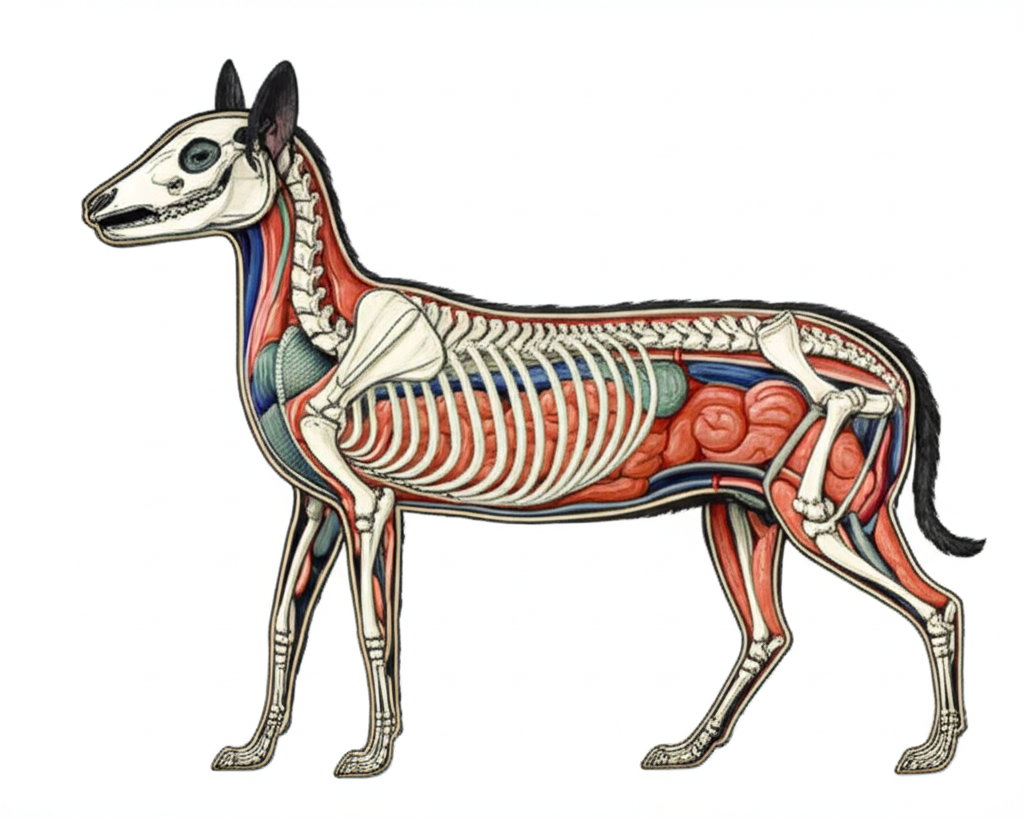
This view profoundly influenced subsequent thought, leading to a scientific paradigm that sought to understand biological processes through mechanical analogies. The nature of animal matter was stripped of any inherent vital principle; it was simply matter obeying the universal laws of physics.
Modern Echoes and the Enduring Question
The philosophical debates concerning the nature of animal matter continue to resonate today. While modern biology has moved beyond crude mechanistic analogies, it still operates largely within a physicalist framework, seeking to explain life through the complex interactions of molecules, cells, and systems, all governed by the laws of physics.
Yet, the questions raised by ancient philosophers persist:
- Is there an emergent quality to animal matter that transcends its constituent parts?
- How do physical processes give rise to sensation, consciousness, and subjective experience in animals?
- Does the unique nature of living matter require a different philosophical lens than inanimate objects?
The journey through the Great Books reveals that the seemingly simple question of "what is animal matter?" quickly unfolds into profound inquiries about life, mind, and the fundamental structure of reality itself. Understanding animal matter is not just a scientific endeavor; it is a quintessential philosophical challenge that continues to shape our understanding of the living world.
YouTube Video Suggestions:
-
📹 Related Video: ARISTOTLE ON: The Nicomachean Ethics
Video by: The School of Life
💡 Want different videos? Search YouTube for: "Aristotle De Anima Summary"
2. ## 📹 Related Video: KANT ON: What is Enlightenment?
Video by: The School of Life
💡 Want different videos? Search YouTube for: "Descartes Animals as Machines"