

The Enigma of Animal Matter: A Philosophical Expedition
Summary: What exactly constitutes "animal matter"? This isn't merely a biological question for a lab coat, but a profound philosophical inquiry that stretches back to antiquity. From the Great Books of the Western World, we glean that understanding the Nature of Animal Matter requires us to move beyond its physical composition to explore the principles of life, sensation, and self-motion that distinguish it from inert Matter. We'll delve into how classical thinkers grappled with the unique organization of living substance, touching upon the intersection of metaphysics and Physics as they sought to unravel the essence of animal existence.
The Substance of Life: Beyond Mere Dust and Atoms
Hello, fellow travelers on the philosophical path! Have you ever paused to truly consider what makes an animal, well, animal? It's a question that might seem straightforward at first glance, a matter for biology textbooks. But for centuries, the greatest minds have grappled with the profound implications of The Nature of Animal Matter, seeking to understand not just what it is, but how it is, and why it is so fundamentally different from a rock or a river. Our journey today takes us deep into the heart of this ancient inquiry, guided by the wisdom enshrined in the Great Books of the Western World.
From Plato's forms to Aristotle's treatises on the soul, the distinction between living and non-living Matter has always been a cornerstone of philosophical thought. It's not enough to say that an animal is made of cells and organic compounds; for philosophers, the true challenge lies in understanding the animating principle, the dynamic organization that transforms mere Matter into a vibrant, sensing being.
Aristotle's Hylomorphism: Form Infusing Matter
When we speak of Animal Matter, it's almost impossible not to invoke the towering figure of Aristotle. His concept of hylomorphism provides a foundational framework for understanding the Nature of living things. For Aristotle, any physical substance is a composite of two fundamental principles:
- Matter (hyle): The raw potential, the stuff out of which something is made. Think of the clay before it's molded.
- Form (morphe): The actuality, the organizing principle that gives shape, structure, and purpose to the matter. This is the sculptor's vision brought to life in the clay.
In the context of an animal, the "form" isn't just its shape; it's its soul (psyche). This isn't a disembodied spirit in the modern sense, but the very principle of life, sensation, and self-motion that organizes the physical Matter.
Consider the implications:
- An animal's flesh and bones are its Matter.
- But what makes that flesh living flesh, rather than decaying carrion, is its Form – the animating soul that directs its growth, metabolism, and sensory experience.
This perspective radically shifts our understanding of Physics as well. For the ancients, Physics was the study of Nature itself – the inherent principles of change and motion in the world. Animal bodies, with their capacity for self-generated movement and purposeful action, presented a unique challenge to this understanding, demanding an explanation beyond simple mechanical forces.
Distinguishing Features of Animal Matter
What sets Animal Matter apart from other forms of existence? The Great Books offer several key characteristics that illuminate this philosophical distinction:
| Feature | Description | Philosophical Significance |
|---|---|---|
| Self-Motion | Animals possess an internal principle of motion, allowing them to move themselves from place to place, unlike inanimate objects which only move when acted upon by an external force. | Implies an internal "driver" or will, distinguishing living beings from mere mechanisms. |
| Sensation | The capacity to perceive the world through senses (sight, hearing, touch, taste, smell). This is a hallmark of animal life, absent in plants and inert Matter. | Establishes a relationship between the animal and its environment, forming the basis for experience and knowledge. |
| Perception | Beyond raw sensation, the ability to interpret and respond to sensory input. An animal doesn't just "see" light; it "sees" a predator or prey. | Points to a rudimentary form of cognition and an engagement with the world that is purposeful and adaptive. |
| Nutrition & Growth | The ability to take in external Matter, transform it into its own substance, and grow. This metabolic process is fundamental to all life, but animals exhibit unique patterns of consumption and energy expenditure. | Demonstrates an active, self-sustaining process that maintains the organism's form against entropy. |
| Reproduction | The capacity to produce offspring "after its own kind," ensuring the continuation of its species. | Highlights the inherent drive within Nature for perpetuation and the transmission of form. |
These features are not merely biological functions; they are expressions of the animal's inherent Nature, the very Form that organizes its Matter.
The Philosophical Echoes: From Ancient Greece to Modern Physics
The questions posed by the ancients regarding The Nature of Animal Matter continue to resonate today. While modern Physics and biology provide incredibly detailed accounts of the chemical and physical processes within living organisms, the philosophical mystery of why and how these processes coalesce into a sentient, self-moving Animal remains.
Descartes, for instance, famously viewed animals as complex machines, albeit divinely constructed. This mechanistic perspective, while influential, still grappled with the unique organizational complexity that distinguishes an animal from a clock. Later vitalists would argue for an irreducible "life force," a nod back to the ancient concept of the animating soul, even if couched in different terms.
Today, fields like systems biology and complexity theory explore how emergent properties arise from the interactions of simpler components, echoing Aristotle's idea that the whole is greater than the sum of its parts, and that Form dictates function. The inherent order and purposefulness observed in living systems still challenge a purely reductionist view of Matter. The Nature of an Animal is not simply its constituent atoms, but the intricate dance of those atoms, governed by an organizing principle that allows it to live, feel, and interact with its world.
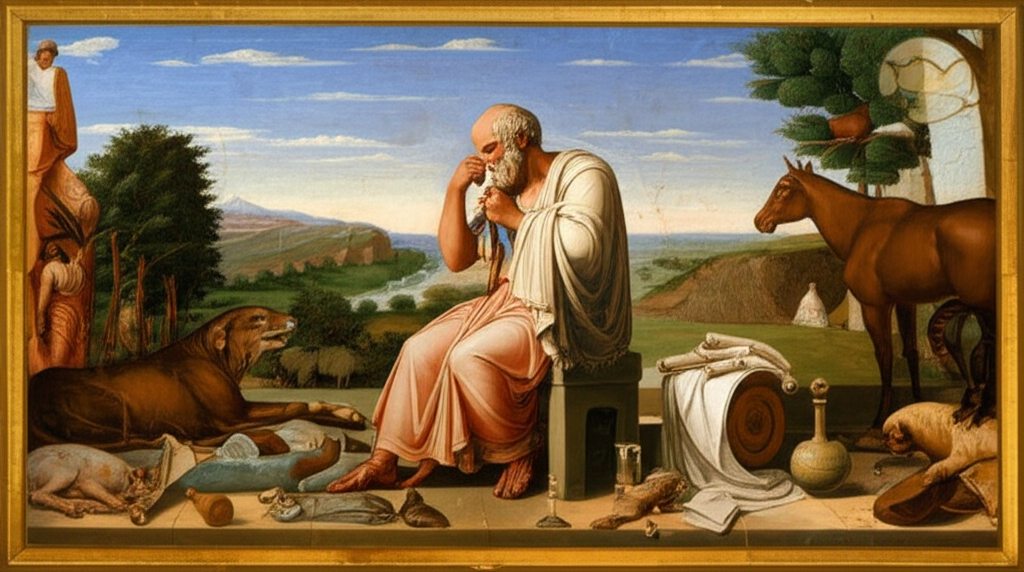
Ultimately, understanding The Nature of Animal Matter is an ongoing conversation, a bridge between the enduring wisdom of the Great Books of the Western World and our contemporary scientific explorations. It reminds us that philosophy isn't just about abstract ideas, but about making sense of the world right before our very eyes – from the smallest amoeba to the most complex human being.
YouTube Video Suggestions:
- Specific Search: "Aristotle On The Soul De Anima Explained"
- Specific Search: "Great Books Western World Philosophy Nature Life"
📹 Related Video: What is Philosophy?
Video by: The School of Life
💡 Want different videos? Search YouTube for: "The Nature of Animal Matter philosophy"