

The Ever-Unfolding Tapestry: A Philosophical Look at the Nature of Animal Evolution
The concept of animal evolution is more than just a biological theory; it represents one of humanity's most profound philosophical challenges to our understanding of the Nature of life, species, and ourselves. From the ancient Greek inquiries into Change and being to the revolutionary insights of modern science, the journey to comprehend how Animals came to be, and continue to transform, compels us to re-evaluate fundamental assumptions about essence, purpose, and our place in the cosmic order. This article delves into the philosophical underpinnings of Animal Evolution, drawing upon the wisdom of the Great Books of the Western World to illuminate the profound shifts in our understanding of life's dynamic journey.
I. The Ancient Gaze on Nature and Change
Before the advent of evolutionary theory, philosophers grappled with the fundamental tension between permanence and flux. How could something be itself if it was constantly changing?
- Heraclitus' Flux and Parmenides' Stasis: In early Greek thought, Heraclitus famously declared, "You cannot step into the same river twice," emphasizing the ceaseless Change inherent in Nature. Conversely, Parmenides argued for an unchanging, unified reality, where Change was an illusion. This foundational debate set the stage for centuries of philosophical inquiry into the essence of being.
- Aristotle's Potentiality and Actuality: Aristotle, a towering figure in the Great Books, offered a nuanced perspective. He understood Change not as a mere illusion, but as the actualization of potential. An acorn's Nature is to become an oak, representing a specific trajectory of Change. For Aristotle, the Nature of things, then, was often seen as an inherent essence, a fixed blueprint, guiding its development and defining its kind. This teleological view – that things develop towards an inherent purpose – deeply influenced Western thought for millennia.
II. Defining the Animal Before Darwin
The classification and understanding of Animals were, for a long time, rooted in these classical philosophical frameworks, often emphasizing fixed forms and hierarchical order.
- Aristotle's De Anima: In this seminal work, Aristotle meticulously described the "animal soul," distinguishing it from plant and human souls by its faculties of sensation and locomotion, in addition to nutrition and reproduction. An Animal was defined by these specific, observable capacities, leading to a categorization based on essential attributes.
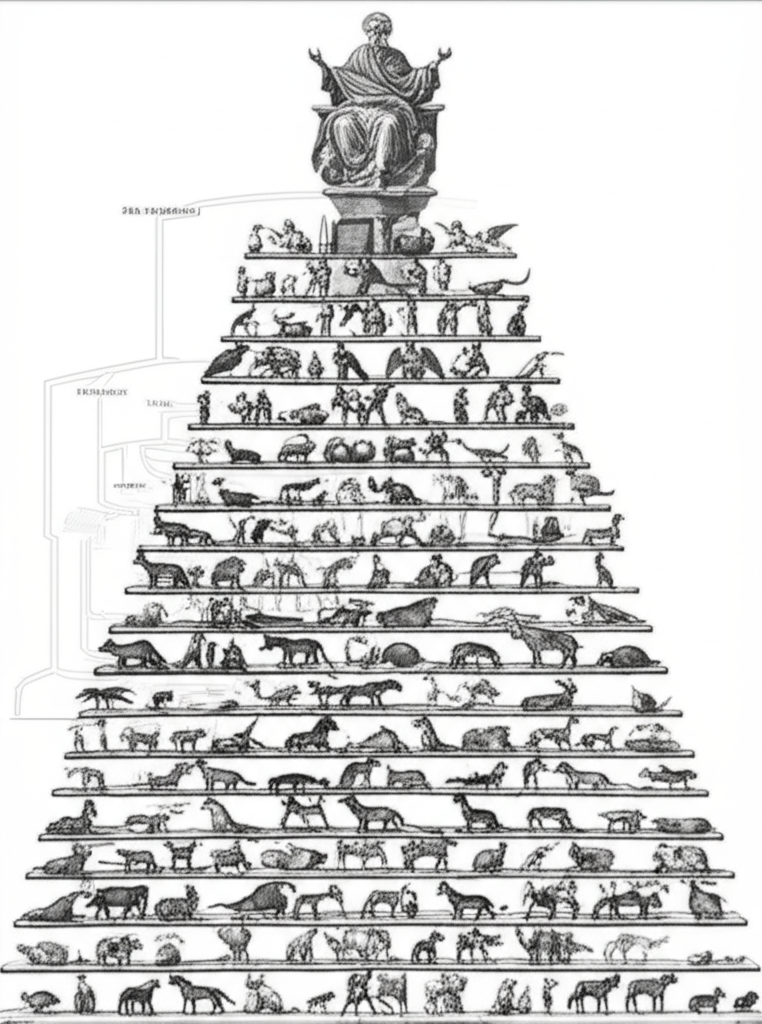
- The Great Chain of Being: Influenced by Platonic forms and Aristotelian essences, the concept of the scala naturae, or Great Chain of Being, became a pervasive model. This hierarchical structure posited a fixed order of existence, from God at the apex, through angels, humans, Animals, plants, and minerals, each occupying an immutable rung. The idea of an immutable Animal form persisted for centuries, with species seen as distinct and unchanging creations.
Here are some classical attributes commonly used to define an animal:
- Possession of a Sensitive Soul: Enabling sensation and perception.
- Capacity for Self-Motion: The ability to move from place to place (locomotion).
- Sensation: Experience of the world through senses (sight, hearing, touch, etc.).
- Nutrition and Reproduction: Fundamental biological processes shared with plants.
III. The Evolutionary Revolution: A Profound Change in Perspective
The 19th century brought a seismic shift in understanding, fundamentally altering how we perceive the Nature of Animals and the dynamic processes of Change.
- Challenging Fixed Forms: Charles Darwin's On the Origin of Species (though not part of the original Great Books collection, its philosophical impact resonates with the intellectual tradition it critiques and extends) synthesized earlier ideas about species variation and geological Change, presenting a compelling mechanism for the transformation of life. The notion of fixed species, so central to classical thought, was replaced by a dynamic, ever-changing tapestry of life.
- Natural Selection and the Indifferent Nature: Darwin proposed that organisms with traits better suited to their environment are more likely to survive and reproduce, passing those advantageous traits to their offspring. This process, Natural Selection, introduced a non-teleological mechanism for biological Change. This shift moved from a teleological Nature (one with inherent purpose or design) to one governed by contingent survival and reproduction, dramatically altering philosophical inquiries into purpose and design in the universe.
IV. The Philosophical Nature of Animal Evolution
Understanding Animal Evolution forces us to confront deep philosophical questions about identity, purpose, and our relationship to the rest of the natural world.
- From Essence to Process: Evolution redefines what an Animal is. It's not a fixed essence, but rather a dynamic, ever-changing node in a continuous, branching lineage. The Nature of an Animal becomes less about an immutable form and more about its history, its adaptations, and its ongoing potential for Change.
- The Question of Purpose (Teleology): If Nature selects through blind processes of mutation and survival, does it have a goal? Or is it merely a blind, indifferent process devoid of inherent purpose? This remains a core philosophical debate, challenging our intuitive search for meaning in the biological world.
- Our Place in the Tapestry: By demonstrating our shared ancestry with all life, Animal Evolution fundamentally impacts human self-perception and ethics. Are we distinct and superior, or simply one branch on a vast, interconnected tree of life? This understanding compels us to reconsider our moral obligations to other species and the environment, recognizing our profound interrelationship within the natural world.
V. Bridging Ancient Wisdom and Modern Understanding
The dialogue between classical philosophy and evolutionary science reveals how our understanding of core concepts has undergone a profound transformation.
| Philosophical Concept | Pre-Evolutionary View (e.g., Aristotle, Plato) | Evolutionary View (e.g., Darwin, Modern Synthesis) |
|---|---|---|
| Species | Fixed, essential forms; immutable | Dynamic populations; mutable; defined by common ancestry and reproductive isolation |
| The Animal | Defined by specific, inherent faculties; distinct categories | A continuum of life forms; shared genetic heritage; adaptation to environment |
| Change | Accidental; within limits of species form; cyclical | Fundamental and directional; driving diversification and speciation |
| Nature's Role | Teleological; imbued with purpose or design | Non-teleological; processes of selection and mutation; indifferent to outcomes |
The enduring philosophical challenge is to reconcile our intuitive search for meaning with the scientific understanding of a universe in constant Change. This synthesis allows us to appreciate the intricate beauty of Nature not as a static masterpiece, but as a dynamic, ever-unfolding tapestry woven through billions of years of Animal Evolution.
The Ongoing Inquiry
The Nature of Animal Evolution is not merely a scientific fact but a profound philosophical statement about the essence of life itself. It has forced us to reconsider our most cherished beliefs about identity, purpose, and the very fabric of existence. The Change it brought to our worldview continues to resonate, inviting us to engage in an ongoing inquiry into the dynamic, interconnected, and awe-inspiring complexity of the natural world. In understanding evolution, we gain not just knowledge of biology, but a deeper appreciation for the enduring philosophical questions that define our humanity.
📹 Related Video: ARISTOTLE ON: The Nicomachean Ethics
Video by: The School of Life
💡 Want different videos? Search YouTube for: ""Great Books of the Western World Aristotle De Anima explained""
📹 Related Video: ARISTOTLE ON: The Nicomachean Ethics
Video by: The School of Life
💡 Want different videos? Search YouTube for: ""Philosophical implications of Darwin's On the Origin of Species""