

The Enigmatic Depths: Exploring the Nature of Animal Consciousness
The question of whether animals possess consciousness is one of philosophy's most enduring and profound inquiries, touching upon the very essence of what it means to experience the world. This pillar page delves into the multifaceted nature of animal consciousness, tracing its philosophical journey from ancient thought to contemporary scientific exploration. We will examine historical perspectives on the animal mind, grapple with the complexities of defining consciousness beyond human experience, and consider the profound ethical implications of recognizing sentient life across species. By exploring how philosophers and scientists have grappled with the mind of the animal, we aim to illuminate our understanding of consciousness itself and our place within the vast tapestry of life.
Unveiling the Animal Mind: What is Consciousness?
Before we can ask if animals are conscious, we must first grapple with the elusive concept of consciousness itself. At its core, consciousness refers to the state of being aware of one's own existence and surroundings. It encompasses sensation, perception, thought, emotion, and, for some, self-awareness. For centuries, this capacity was largely reserved for humans, often tied to rationality or the possession of an immortal soul. However, as our understanding of the biological world expands and philosophical inquiry deepens, the boundaries of the conscious mind are increasingly being re-evaluated.
The challenge lies in defining consciousness in a way that is neither overly anthropocentric nor so broad as to be meaningless. We must consider:
- Sentience: The capacity to feel, perceive, or experience subjectivity. This includes the ability to feel pain and pleasure.
- Awareness: Being cognizant of one's internal and external states.
- Cognition: The mental processes involved in acquiring knowledge and understanding through thought, experience, and the senses. This includes problem-solving, memory, and learning.
- Self-awareness: The ability to recognize oneself as an individual entity separate from others and the environment.
Understanding the nature of animal consciousness requires moving beyond mere behavioral observations to infer the underlying subjective experience.
Echoes from Antiquity: Classical Perspectives on the Animal Mind
The question of the animal mind is far from new; it has occupied thinkers since the dawn of philosophy, often shaping the early understanding of the human place in the natural order.
The Great Chain of Being: Aristotle's Scala Naturae
Among the earliest and most influential views came from Aristotle, whose concept of the scala naturae (ladder of nature) or Great Chain of Being posited a hierarchical arrangement of life. In his works, particularly De Anima (On the Soul), Aristotle distinguished three types of souls:
- Nutritive Soul: Possessed by plants, responsible for growth, reproduction, and sustenance.
- Sensitive Soul: Found in animals, encompassing the nutritive functions plus sensation (sight, hearing, touch, taste, smell), desire, and movement.
- Rational Soul: Unique to humans, incorporating all lower functions plus reason, intellect, and moral choice.
For Aristotle, animals clearly possessed sensation and a form of mind that allowed them to perceive and react to their environment, but they lacked the higher reasoning capacity of humans. Their consciousness was limited to sensory experience and instinct.
Other Ancient Voices
While Plato focused more on the human soul's eternal nature and its connection to the Forms, his writings occasionally hint at the mind of animals through fables and allegories. Later Stoic philosophers, while emphasizing human reason, acknowledged that animals possessed impressions and impulses, albeit not "reason" in the human sense. Epicureans, too, recognized animal sensation and the pursuit of pleasure, suggesting a basic form of consciousness driven by natural impulses.
| Philosopher | Key Concept Regarding Animal Mind | Implied Level of Consciousness |
|---|---|---|
| Aristotle | Sensitive Soul, Scala Naturae | Sensation, desire, movement |
| Plato | (Less direct focus on animals) | Basic sensation (implied) |
| Stoics | Impressions, impulses | Sensory awareness, instinct |
| Epicureans | Sensation, pleasure/pain | Subjective experience of stimuli |
The Cartesian Divide: Animals as Automata
The 17th century brought a radical shift in Western thought, largely spearheaded by René Descartes. In his Discourse on Method and Meditations on First Philosophy, Descartes introduced a strict mind-body dualism. He argued that humans possess both an extended physical body (res extensa) and an unextended thinking substance (res cogitans) – the mind or soul.
For Descartes, animals were fundamentally different. He famously posited that animals were mere "automata" or complex machines, devoid of a conscious mind, soul, or genuine subjective experience. Their cries of pain were akin to the creaking of a machine, not indicators of suffering. This view had profound implications, legitimizing the often cruel treatment of animals by effectively denying their capacity for consciousness and pain. While controversial even in his time, Descartes's influence profoundly shaped scientific and philosophical discourse for centuries, creating a stark divide between human and animal nature.
Enlightenment and Evolution: Re-evaluating the Animal Mind
The strict Cartesian view did not go unchallenged. The Enlightenment brought a renewed focus on empiricism and observation, gradually eroding the certainty of the animal automaton theory.
Sensation and Experience: Locke and Hume
John Locke, in his Essay Concerning Human Understanding, explored how ideas are formed through sensation and reflection. While he primarily focused on the human mind, his emphasis on experience as the source of knowledge opened the door to considering animal sensation as a legitimate source of their own, albeit different, forms of consciousness.
David Hume, a Scottish empiricist, went further. In A Treatise of Human Nature, he argued for a fundamental continuity between human and animal minds. He observed that animals learn from experience, form expectations, and demonstrate a rudimentary form of reasoning based on cause and effect, much like humans. For Hume, the difference was one of degree, not kind, challenging the notion of an unbridgeable gap in consciousness.
Darwin's Revolution: Continuity of Mind
Perhaps the most significant shift came with Charles Darwin and his theory of evolution. In On the Origin of Species and later The Expression of the Emotions in Man and Animals, Darwin argued for a continuity of mental and emotional states across species. He observed that animals exhibit emotions like fear, joy, and affection, and possess problem-solving abilities. For Darwin, the human mind was not a unique creation but rather an evolved form of the animal mind, suggesting that consciousness itself is a product of natural selection and exists along a spectrum. This evolutionary perspective provided a powerful scientific framework for recognizing the shared nature of life and mind.
Modern Explorations: Science, Philosophy, and the Animal Mind
Today, the study of animal consciousness is a vibrant interdisciplinary field, drawing on philosophy, cognitive ethology, neuroscience, and comparative psychology. Mounting scientific evidence increasingly supports the idea that many animals possess rich inner lives.
Indicators of Animal Consciousness
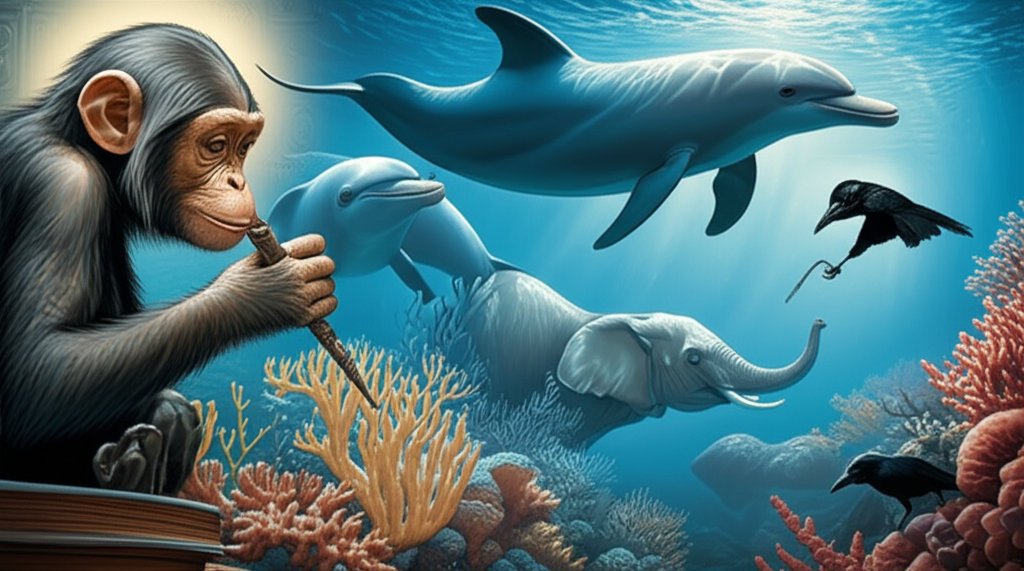
Researchers employ various methods to infer animal consciousness, looking for indicators such as:
- Pain Response: Not just reflex, but learned avoidance, protective behaviors, and physiological stress responses.
- Learning and Memory: Complex learning, long-term memory, and the ability to adapt behavior based on past experiences.
- Problem-Solving and Tool Use: Demonstrated by primates, birds, octopuses, and others, indicating cognitive flexibility.
- Social Complexity: Formation of complex social structures, cooperation, communication, and empathy.
- Self-Recognition: Demonstrated by some species (e.g., great apes, dolphins, elephants, magpies) passing the mirror test.
- Future Planning: Evidence of planning for future events, such as caching food or migrating.
- Theory of Mind: The ability to attribute mental states (beliefs, intentions, desires) to oneself and others, though this remains highly debated in animals.
- Emotional Expression: Behaviors indicative of fear, joy, grief, and other complex emotions.
Contemporary Philosophical Theories
Philosophers continue to debate the nature of animal consciousness and its implications. Some theories applied to humans are also considered for animals:
- Integrated Information Theory (IIT): Proposes that consciousness is a measure of integrated information in a system, suggesting it can exist in varying degrees.
- Global Workspace Theory: Suggests consciousness arises from a "global workspace" in the brain where information from various modules is integrated and broadcast.
- Predictive Processing: Views the brain as constantly making predictions about the world and updating them, which could account for sensory consciousness in animals.
The consensus among many scientists and philosophers is that consciousness is not an all-or-nothing phenomenon but likely exists on a spectrum, with different species exhibiting different forms and degrees of awareness.
The Ethical Imperative: Why Animal Consciousness Matters
The recognition of animal consciousness carries profound ethical weight, compelling us to reconsider our relationship with other species and our moral responsibilities. If animals can feel, perceive, and experience, then their well-being becomes a moral concern.
This understanding impacts various domains:
- Animal Welfare and Rights: The capacity for suffering necessitates a duty to minimize harm and ensure humane treatment. This forms the basis for animal welfare laws and the growing animal rights movement.
- Agriculture: Industrial farming practices, which often subject animals to extreme confinement and suffering, are increasingly scrutinized.
- Scientific Research: The use of animals in experiments raises ethical questions about balancing potential human benefits with animal suffering.
- Conservation: Recognizing the intrinsic value and subjective experience of wild animals strengthens arguments for protecting biodiversity and natural habitats.
- Personal Choices: Our dietary habits, choices of entertainment, and even pet ownership are re-evaluated through the lens of animal consciousness.
The question is no longer if animals are conscious, but how they are conscious, and what that knowledge demands of us. Our evolving understanding of the animal mind challenges us to expand our circle of moral concern and re-imagine our place within the interconnected web of life.
Conclusion: An Ongoing Journey of Discovery
The journey to understand the nature of animal consciousness is an ongoing philosophical and scientific odyssey. From Aristotle's careful categorizations to Descartes's stark division, and from Darwin's revolutionary insights to the cutting-edge neuroscience of today, our perception of the animal mind has continually evolved. We have moved from viewing animals as mere biological machines to acknowledging their complex inner worlds, their capacity for sensation, emotion, and even forms of cognition once thought exclusive to humans.
This shift in understanding is not merely an academic exercise; it carries profound implications for how we interact with the natural world and the ethical responsibilities we bear. As we continue to probe the depths of animal consciousness, we are not only learning more about other species but also gaining invaluable insights into the fundamental nature of consciousness itself and the intricate workings of the mind. The mystery of the animal mind remains, inviting us to approach the living world with humility, curiosity, and a deepened sense of moral obligation.
📹 Related Video: What is Philosophy?
Video by: The School of Life
💡 Want different videos? Search YouTube for: ""Animal Consciousness Philosophy Documentary""
📹 Related Video: PLATO ON: The Allegory of the Cave
Video by: The School of Life
💡 Want different videos? Search YouTube for: ""The Science of Animal Minds and Emotions""