

The Unseen Depths: Exploring the Nature of Animal Consciousness
The question of animal consciousness is not merely a scientific inquiry; it is a profound philosophical journey that challenges our anthropocentric biases and reshapes our understanding of the Mind itself. From ancient philosophers grappling with the concept of the soul to modern neuroscientists mapping neural pathways, the Nature of animal experience remains one of the most compelling and ethically charged frontiers of thought. This pillar page delves into the multifaceted dimensions of Animal Consciousness, exploring its historical roots, contemporary evidence, and the profound implications it holds for our moral responsibilities. We will navigate the rich tapestry of ideas that have sought to define, understand, and sometimes deny, the inner lives of our fellow creatures.
What is Animal Consciousness? Defining the Terrain of the Mind
At its core, consciousness refers to the state of being aware of one's own existence and surroundings. For animals, this often translates into the capacity for subjective experience, sentience, and perhaps even a form of self-awareness. But what does it truly mean for an animal to be conscious? Is it merely the ability to react to stimuli, or does it encompass a richer inner life of thoughts, feelings, and intentions?
Historically, philosophers have grappled with the very definition of consciousness. In the Great Books of the Western World, figures like Aristotle, in his De Anima, extensively discussed the soul (psyche) as the animating principle of living beings. He posited a hierarchy of souls: the nutritive soul (plants), the sensitive soul (animals, capable of sensation, desire, and movement), and the rational soul (humans, capable of thought and reason). For Aristotle, animals clearly possessed a sensitive soul, implying a fundamental capacity for perception and feeling, albeit distinct from human rationality.
The Spectrum of Awareness: Beyond Simple Reflexes
Understanding Animal Consciousness requires us to move beyond simplistic definitions. It's not a binary state but a spectrum, encompassing various levels of awareness and cognitive complexity. We consider:
- Sentience: The capacity to feel, perceive, or experience subjectively. This includes the ability to feel pain, pleasure, fear, and comfort.
- Perception: The ability to interpret sensory information from the environment.
- Emotion: The experience of feelings like joy, sorrow, anger, or empathy.
- Cognition: Mental processes such as problem-solving, memory, learning, and decision-making.
- Self-awareness: The capacity to recognize oneself as an individual distinct from others and the environment.
- Theory of Mind: The ability to attribute mental states (beliefs, desires, intentions) to oneself and others.
The Philosophical Roots: Ancient Wisdom to Modern Inquiries
The philosophical discourse on Animal Consciousness is as old as philosophy itself, evolving dramatically over centuries.
Early Inquiries: Aristotle's Souls and the Stoic View
As mentioned, Aristotle provided one of the earliest systematic accounts, granting animals a sensitive soul. This acknowledged their capacity for sensation and desire, placing them firmly within the realm of conscious beings, even if subordinate to humans. The Stoics, however, often emphasized human rationality as the sole basis for moral consideration, viewing animals as lacking reason and thus not deserving of the same ethical concern.
The Cartesian Divide: Animals as Automata
Perhaps one of the most influential, and controversial, perspectives came from René Descartes in the 17th century. In his Discourse on Method and Meditations, Descartes famously argued for a strict mind-body dualism. For him, Mind was synonymous with thought and exclusive to humans, who possessed an immortal, rational soul. Animals, lacking this soul, were considered mere automata—complex biological machines driven by mechanistic principles, devoid of true sensation, pain, or consciousness. This view, while largely rejected today, profoundly influenced Western thought and scientific practice for centuries, effectively justifying the exploitation and disregard for animal suffering.
Enlightenment and Beyond: Challenging the Mechanistic View
The Enlightenment brought renewed scrutiny to Descartes' position. John Locke, in his Essay Concerning Human Understanding, while primarily focused on human cognition, laid groundwork for considering experience as the source of knowledge, which could be extended to animals. Later, David Hume explicitly argued for a continuity of Mind between humans and animals, observing that animals demonstrate reason and intelligence analogous to human faculties, albeit in a lesser degree. He noted, "No truth appears to me more evident, than that beasts are endowed with thought and reason as well as men."
The 19th century saw Charles Darwin revolutionize our understanding of the Nature of life. In The Descent of Man, he posited a continuity of mental faculties between humans and other animals, suggesting that differences were of degree, not kind. This evolutionary perspective provided a powerful scientific framework for understanding Animal Consciousness as a product of natural selection, evolving to aid survival and reproduction.
Table: Shifting Philosophical Views on Animal Consciousness
| Philosopher/Era | Key Idea on Animal Consciousness | Impact |
|---|---|---|
| Aristotle | Possess a "sensitive soul"; capable of sensation and desire. | Acknowledged animal experience, but hierarchical. |
| Descartes | Animals are "automata"; lack mind, thought, or true sensation. | Justified scientific experimentation without ethical concern for animals. |
| Hume | Continuity of mind between humans and animals; animals possess reason. | Challenged anthropocentrism; laid groundwork for ethical consideration. |
| Darwin | Mental faculties evolved; differences are of degree, not kind. | Provided scientific basis for shared cognitive and emotional capacities. |
Manifestations of Animal Consciousness: Evidence and Observation
Modern science, informed by philosophical insights, has amassed a compelling body of evidence for sophisticated Animal Consciousness.
The Experience of Pain and Pleasure
The capacity to feel pain and pleasure, central to sentience, is widely accepted across a vast range of animal species. Neuroscientific studies show that many animals possess nociceptors, neural pathways, and brain regions analogous to those involved in pain processing in humans. Behavioral observations—such as avoidance learning, protective behaviors, and vocalizations—further support the subjective experience of pain.
Emotional Lives: Joy, Fear, and Empathy
Animals display a wide array of emotions. From the joyous play of puppies and dolphins to the grief observed in elephants mourning their dead, the emotional lives of animals are increasingly recognized. Studies on social bonding, stress responses, and even altruistic behaviors in species like primates and rats suggest complex emotional landscapes. The presence of mirror neurons in some animals, similar to those linked to empathy in humans, hints at an ability to understand and share the feelings of others.
Cognitive Prowess: Problem-Solving and Tool Use
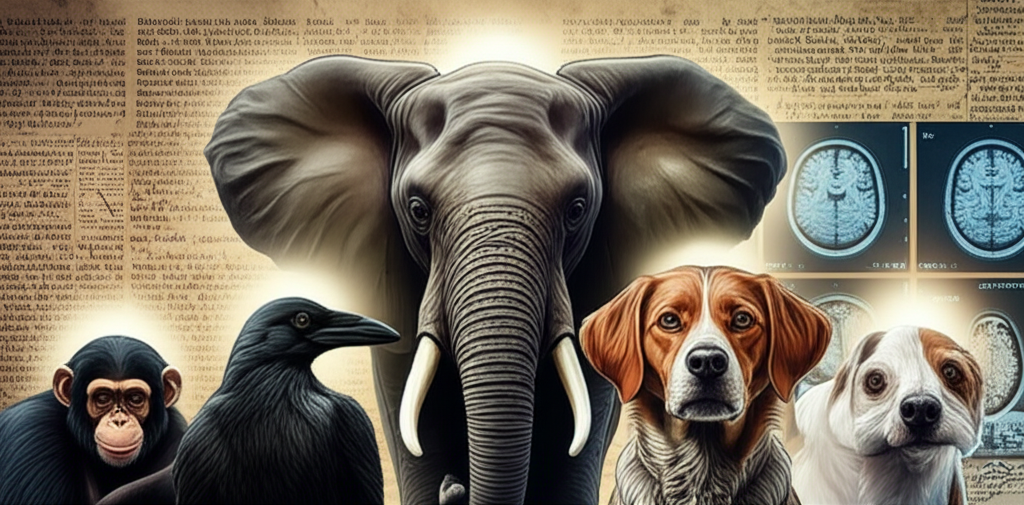
The cognitive abilities of animals often astound us. Crows can fashion tools to retrieve food, chimpanzees can use sign language, and octopuses can solve complex puzzles to escape enclosures. These examples, and many others, demonstrate advanced problem-solving skills, memory, planning, and learning—all hallmarks of a conscious, thinking Mind.
Self-Awareness: The Mirror Test and Beyond
Self-awareness, often tested by the "mirror self-recognition test," has been observed in species beyond humans, including great apes, dolphins, elephants, and some birds. Animals that pass this test demonstrate an understanding that the reflection is themselves, not another individual. While not definitive proof of a human-like self-concept, it strongly suggests a degree of self-referential consciousness.
Ethical Implications: Our Moral Obligations
Recognizing the Nature of Animal Consciousness carries profound ethical implications. If animals can feel pain, experience joy, and possess a degree of cognitive awareness, then our moral obligations towards them shift dramatically.
Sentience and Suffering: The Foundation of Animal Rights
The cornerstone of modern animal ethics is sentience. If an animal can suffer, then we have a moral duty to avoid causing unnecessary suffering. This principle underpins arguments for animal welfare, advocating for conditions that allow animals to live free from hunger, discomfort, pain, fear, and distress, and to express normal behaviors.
Challenging Anthropocentrism: Reconsidering Our Place
Acknowledging sophisticated Animal Consciousness forces us to reconsider our anthropocentric view of the world—the belief that humans are the central or most significant entities. It encourages a more humble and interconnected understanding of life on Earth, where human exceptionalism is tempered by a recognition of shared capacities and vulnerabilities. This challenges the traditional Nature of our relationship with other species, moving from one of dominion to one of stewardship and respect.
Challenges and Future Directions
Despite significant progress, understanding Animal Consciousness remains a challenging endeavor.
The "Hard Problem" Extended
The "hard problem of consciousness"—how physical processes in the brain give rise to subjective experience—applies equally, if not more intensely, to animals. We can observe behavior and study brain activity, but accessing the subjective qualia (the "what it's like" to be a bat, as Thomas Nagel famously put it) of an animal remains an epistemic barrier.
Methodological Limitations
Studying Animal Consciousness is constrained by our inability to directly communicate with animals in human language. Researchers rely on behavioral observations, physiological measurements, and comparative cognition studies, which are always open to interpretation.
Emerging Research
Future research will likely continue to leverage advancements in neuroscience, cognitive ethology, and behavioral genetics. The development of new non-invasive imaging techniques and sophisticated behavioral experiments will undoubtedly deepen our understanding of the intricate Nature of the animal mind. The ethical implications of this ongoing research will continue to shape our moral compass and our policies regarding animal treatment.
Conclusion: Reconsidering the Animal Mind
The journey to understand The Nature of Animal Consciousness is far from over. From Aristotle's ancient classifications to Darwin's revolutionary insights and the cutting-edge neuroscience of today, the evidence increasingly points to a rich, complex, and diverse tapestry of Mind across the animal kingdom. As we peel back the layers of species-specific behaviors and neural architectures, we are continually reminded that consciousness is not a uniquely human phenomenon but a fundamental aspect of life's intricate design. This realization compels us to re-evaluate our ethical frameworks, fostering a deeper respect and greater responsibility towards the myriad conscious beings with whom we share this planet. The Nature of their Mind is, in many ways, a reflection of our own.
📹 Related Video: PLATO ON: The Allegory of the Cave
Video by: The School of Life
💡 Want different videos? Search YouTube for: ""Animal Consciousness Documentary""
📹 Related Video: ARISTOTLE ON: The Nicomachean Ethics
Video by: The School of Life
💡 Want different videos? Search YouTube for: ""Philosophical Debates on Animal Minds""