

The Unseen Depths: Exploring the Nature of Animal Consciousness
The rustle in the leaves, the watchful gaze of a deer, the intricate dance of a bee – these are not merely mechanical movements but, for many of us, glimpses into a profound mystery: animal consciousness. Do animals possess minds akin to our own, capable of thought, feeling, and even self-awareness? This question, far from being a mere curiosity, strikes at the very heart of what it means to be a conscious being and reshapes our understanding of the natural world and our place within it.
This pillar page embarks on a philosophical journey to explore the nature of animal consciousness. We'll delve into historical perspectives that shaped our understanding of animal minds, examine modern scientific and philosophical insights, and confront the ethical implications of recognizing sentience beyond the human realm. Prepare to challenge assumptions, ponder the unanswerable, and perhaps, look at the creatures around you with a renewed sense of wonder and inquiry.
Defining the Elusive: What Do We Mean by Consciousness?
Before we can even begin to ponder animal consciousness, we must first grapple with the notoriously slippery concept of consciousness itself. What exactly are we searching for when we look into the eyes of a creature and wonder if "anyone's home"? Is it simply responsiveness to stimuli, or something far deeper – a subjective, inner experience, a mind that feels and perceives?
Historical Echoes: From Soul to Sensation
Throughout the Great Books of the Western World, philosophers have wrestled with the concept of the soul, the psyche, and the mind. Aristotle, in his De Anima, proposed a hierarchy of souls: the vegetative soul (nutrition, growth), the sensitive soul (sensation, movement), and the rational soul (thought, reason). Animals, he argued, possessed sensitive souls, allowing for perception and desire, but not the higher faculty of reason unique to humans. This framework profoundly influenced Western thought for centuries, placing animal minds in a distinct, often inferior, category.
Centuries later, René Descartes, a pivotal figure in modern philosophy, presented an even starker distinction. For Descartes, consciousness was inextricably linked to the capacity for thought and language, which he believed animals lacked. He famously posited that animals were mere automata, complex biological machines devoid of an inner mind or subjective experience. Their cries of pain, in this view, were no more indicative of suffering than the creak of a broken machine. This Cartesian dualism – the sharp separation of mind from body, and the exclusion of animals from the former – cast a long shadow over the discourse on animal consciousness.
Modern Perspectives: Spectrum, Not Binary
Today, the philosophical and scientific understanding of consciousness is far more nuanced. We've moved beyond the rigid binary of "conscious or not" towards a recognition of a spectrum of conscious experience. Modern theories suggest that consciousness might involve various components, such as:
- Awareness: The ability to perceive and respond to one's environment.
- Sentience: The capacity to feel, perceive, and experience subjectivity (e.g., pain, pleasure, fear).
- Self-awareness: The ability to recognize oneself as a distinct individual, separate from others and the environment.
- Higher-order thinking: Complex cognitive abilities like planning, problem-solving, and abstract thought.
When we consider animal consciousness, we're often asking which of these components, and to what degree, might be present in a non-human mind. The focus has shifted from an all-or-nothing proposition to an exploration of the rich tapestry of animal inner lives.
The Animal Mind: A Spectrum of Experience
If consciousness is a spectrum, where do animal minds fall? The evidence for complex animal consciousness is mounting, challenging long-held assumptions and inviting us to reconsider the very nature of intelligence and feeling.
Evidence and Inference: Behavior, Brains, and Empathy
How do we infer the presence of a mind in creatures that cannot articulate their inner worlds? We rely on a combination of behavioral observations, neurological studies, and philosophical reasoning.
Behavioral Indicators:
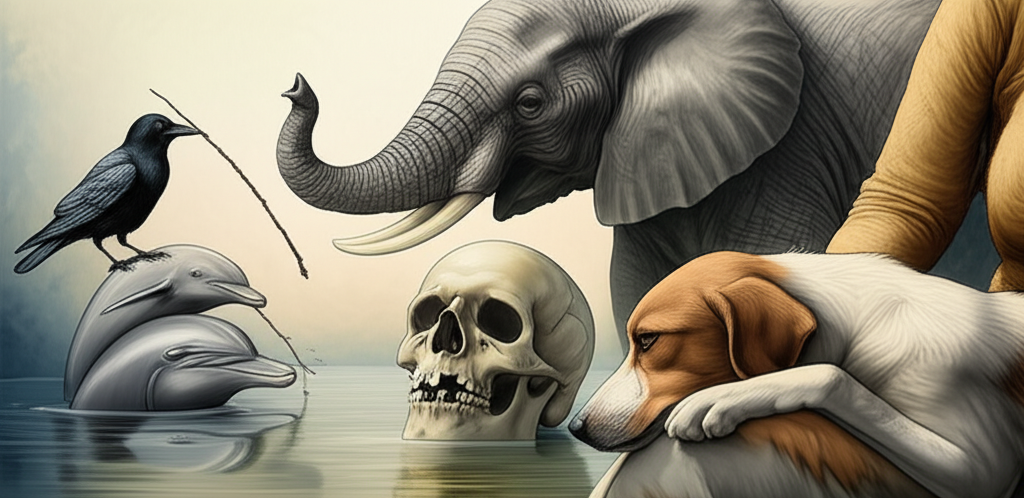
- Problem-solving: Animals demonstrating innovative solutions to novel challenges (e.g., tool use in crows, chimpanzees).
- Emotional displays: Behaviors consistent with joy, grief, fear, or empathy (e.g., elephants mourning their dead, dogs exhibiting separation anxiety).
- Play: Seemingly purposeless activities that suggest enjoyment and social bonding.
- Deception: Animals intentionally misleading others, implying a "theory of mind" – the ability to attribute mental states to others.
Neurological Insights:
- Brain structures: The presence of homologous brain regions to those associated with consciousness in humans (e.g., neocortex in mammals, pallium in birds).
- Neurotransmitters: Shared neurochemical pathways for pain and pleasure, suggesting similar physiological responses.
- Sleep patterns: The observation of REM sleep in many animals, often associated with dreaming and complex cognitive processing.
The Cambridge Declaration on Consciousness (2012): This landmark declaration, signed by a prominent group of neuroscientists, explicitly stated that "nonhuman animals, including all mammals and birds, and many other creatures, including octopuses, also possess the neurological substrates of consciousness."
Beyond Instinct: Problem-Solving, Emotion, and Self-Awareness
The more we observe animals, the more we uncover abilities that transcend mere instinct.
| Cognitive Trait | Observed in Animals | Implications for Consciousness |
|---|---|---|
| Tool Use | Chimpanzees fishing for termites; Crows bending wire to retrieve food; Sea otters using rocks to crack shells. | Suggests planning, innovation, and understanding of cause-and-effect. |
| Emotional Complexity | Elephants exhibiting grief for deceased kin; Dogs showing loyalty and affection; Rats demonstrating empathy by freeing trapped cage mates. | Points to rich inner emotional lives, social bonds, and possibly moral sentiments. |
| Self-Recognition | Dolphins and magpies passing the mirror test (recognizing their reflection as themselves). | Strong evidence for self-awareness, a fundamental aspect of higher consciousness. |
| Communication | Complex vocalizations in whales and dolphins; Alarm calls with specific meanings in vervet monkeys; Dance language in bees indicating food source. | Suggests intentional communication, information transfer, and potentially shared understanding. |
| Future Planning | Scrub-jays re-caching food based on future needs and memory of past events. | Implies foresight, memory, and the ability to project oneself into future scenarios. |
The Philosophical Quandary: Bridging the Human-Animal Divide
Acknowledging animal consciousness is not merely a scientific endeavor; it's a profound philosophical and ethical challenge. It forces us to re-evaluate our long-held assumptions about human exceptionalism and our relationship with the rest of the natural world.
Cartesian Dualism and its Legacy
As discussed, Descartes's view of animals as unthinking machines profoundly shaped Western thought. This perspective, while perhaps unintended by Descartes himself, provided a powerful philosophical justification for the instrumental use of animals – for food, labor, and scientific experimentation – without significant ethical qualms. If animals had no mind, no subjective experience of pain or pleasure, then our actions towards them were morally neutral.
The legacy of this dualism continues to influence debates today. Even as scientific evidence for animal consciousness mounts, there's often a lingering resistance to fully embrace the implications, perhaps due to the discomfort it creates regarding our practices.
The Ethical Imperative: Our Responsibilities to Conscious Beings
If animals are indeed conscious beings, capable of feeling pain, experiencing joy, and perhaps even possessing a form of self-awareness, then our ethical obligations towards them fundamentally change. This is where philosophy moves from description to prescription.
Key Ethical Questions Arising from Animal Consciousness:
- Moral Status: Do conscious animals possess inherent moral status, meaning their interests should be considered for their own sake, not just for human benefit?
- Suffering: If animals can suffer, what are our responsibilities to minimize their pain in agriculture, research, and entertainment?
- Rights: Do animals have rights, such as the right to life, liberty, or freedom from cruelty? Philosophers like Peter Singer (utilitarianism) and Tom Regan (deontology) have extensively explored these questions, arguing for radical shifts in our treatment of animals based on their capacity for consciousness and sentience.
- Environmental Stewardship: Recognizing the complex minds and rich inner lives of animals deepens our appreciation for biodiversity and strengthens arguments for conservation and environmental protection.
YouTube: "Peter Singer Animal Liberation Explained"
YouTube: "What is Animal Ethics? Crash Course Philosophy"
The Future of Understanding: Towards a Deeper Empathy
The exploration of animal consciousness is an ongoing journey, fraught with philosophical puzzles and scientific frontiers. Yet, each new discovery, each nuanced observation, brings us closer to a more complete and compassionate understanding of the nature of life on Earth.
Ongoing Research and Unanswered Questions
Scientists continue to probe the complexities of animal brains, using advanced imaging techniques and behavioral experiments to uncover the neural correlates of consciousness. Philosophers continue to refine theories of mind, seeking frameworks that can accommodate the rich diversity of animal experience without anthropomorphizing or reducing it.
Many questions remain:
- Do insects feel pain?
- What is the nature of a fish's mind?
- Can plants exhibit consciousness in some rudimentary form?
- How does the subjective experience of consciousness differ across species?
These are not trivial questions. The answers, or even the persistent pursuit of them, force us to expand our empathy and re-evaluate our position within the vast tapestry of the natural world.
Rethinking Our Place in the Nature of Things
Ultimately, the study of animal consciousness is a mirror reflecting our own understanding of consciousness and our place in the cosmos. By acknowledging the intricate minds of other creatures, we challenge our anthropocentric biases and open ourselves to a more profound connection with all life. It’s a call to humility, to wonder, and to a deeper ethical engagement with the vibrant, conscious world that surrounds us. The nature of animal consciousness is not just about them; it's about us, and the kind of world we choose to inhabit.
📹 Related Video: What is Philosophy?
Video by: The School of Life
💡 Want different videos? Search YouTube for: "The Nature of Animal Consciousness philosophy"