

The Nature of Animal Consciousness: Unveiling the Inner Lives of Non-Human Beings
The question of animal consciousness is one of philosophy's most enduring and perplexing inquiries. It invites us to peer beyond the observable behaviors of non-human creatures and contemplate the possibility of an inner Mind, a subjective experience of the world akin to our own. This pillar page delves into the historical philosophical perspectives, contemporary scientific insights, and profound ethical implications surrounding the nature of animal awareness, exploring what it means for a creature to truly experience life. From the intricate dances of insects to the complex social structures of primates, understanding animal consciousness challenges our anthropocentric biases and expands our conception of what it means to be a conscious entity in the vast tapestry of existence.
I. Defining the Enigma: What Do We Mean by Consciousness?
Before we can ask if animals are conscious, we must first grapple with the notoriously elusive concept of consciousness itself. In philosophical discourse, consciousness refers to the state of being aware of one's own existence and surroundings, characterized by subjective experiences, feelings, and perceptions—often termed qualia. This is distinct from mere responsivity or complex behavior.
Key Distinctions in Consciousness:
- Sentience: The capacity to feel, perceive, or experience subjectively. This is often considered the most basic form of consciousness, encompassing pleasure, pain, and basic sensory input.
- Awareness: A broader term, often implying some level of cognitive processing beyond mere sensation, such as recognizing objects or understanding simple commands.
- Self-awareness: The ability to recognize oneself as an individual entity separate from others and the environment. This is often tested with mirror self-recognition.
- Higher-Order Consciousness: Involving complex cognitive functions like metacognition (thinking about thinking), planning, reasoning, and reflective thought.
The debate largely hinges on whether animals possess sentience, and if so, to what extent they exhibit higher forms of Mind.
II. A Historical Trajectory: From Automatons to Fellow Travelers
Philosophical thought on animal consciousness has undergone significant shifts throughout history, often reflecting prevailing scientific and theological paradigms. The Great Books of the Western World offer a rich lineage of perspectives.
A. Ancient Roots: Aristotelian Souls
- Aristotle, in works like De Anima (On the Soul), proposed a hierarchical classification of souls. He posited three types:
- Vegetative Soul: Possessed by plants, responsible for nutrition and reproduction.
- Sensitive Soul: Found in animals, encompassing sensation, desire, and locomotion, in addition to vegetative functions.
- Rational Soul: Unique to humans, adding reason and intellect to the sensitive and vegetative capacities.
- While animals clearly had a "sensitive soul" capable of perception and basic feeling, Aristotle did not attribute to them the capacity for abstract thought or moral reasoning, which were hallmarks of the human Mind.
B. The Cartesian Divide: Animals as Machines
- The 17th century saw a profound shift with René Descartes. In his Discourse on Method and Meditations on First Philosophy, Descartes argued for a strict dualism between mind (res cogitans) and body (res extensa). For Descartes, consciousness and thought were attributes of the immaterial soul, which he believed only humans possessed.
- Descartes famously posited that animals were mere automata—complex biological machines, devoid of a soul, reason, or genuine feeling. Their cries of pain were, to him, no different from the creaking of a faulty mechanism. This view, though controversial even in his time, profoundly influenced Western thought for centuries, justifying the exploitation and often cruel treatment of animals by denying them any inner life or Mind.
C. Enlightenment Echoes: Sensation, Experience, and Empathy
- Later empiricists like John Locke and David Hume, while not directly addressing animal consciousness in the same systematic way as Descartes, laid groundwork that would eventually challenge his rigid dualism. Their focus on experience, sensation, and the formation of ideas from sensory input opened the door to considering whether animals, demonstrably capable of sensation, might also form rudimentary ideas or associations.
- Immanuel Kant, while emphasizing human rationality as the basis for moral worth, nevertheless acknowledged animal suffering, even if he did not grant them direct moral rights in the same way he did for rational beings. He saw cruelty to animals as detrimental to human moral character, hinting at a recognition of their capacity for pain.
Table 1: Historical Perspectives on Animal Consciousness
| Philosopher/Era | Key Idea on Animal Consciousness | Impact |
|---|---|---|
| Aristotle | Sensitive soul; sensation, desire, locomotion. No reason. | Foundation for hierarchical understanding of life. |
| Descartes | Animals as automata; no soul, no mind, no true feeling. | Justified scientific experimentation and exploitation. |
| Enlightenment | Emphasis on sensation and experience (Locke, Hume); indirect moral consideration (Kant). | Began to chip away at Cartesian dualism; laid groundwork for empathy. |
III. Contemporary Inquiries: Science Meets Philosophy
The 20th and 21st centuries have witnessed an explosion of scientific research into animal consciousness, driven by advances in neuroscience, ethology, and cognitive science. This empirical data provides compelling evidence that challenges the Cartesian view.
A. The Behavioral Tapestry: Evidence from Observation
Ethologists have meticulously documented a vast array of complex behaviors in the animal kingdom suggesting more than mere instinctual responses:
- Tool Use: Chimpanzees fashioning tools to extract termites, crows bending wire to retrieve food, otters using rocks to crack shells.
- Problem-Solving: Octopuses navigating complex mazes, parrots solving multi-step puzzles, dogs learning intricate commands.
- Communication: Whales singing complex songs, vervet monkeys using specific alarm calls for different predators, bees performing waggle dances to indicate food sources.
- Emotional Responses: Evidence of grief in elephants mourning their dead, empathy in primates comforting distressed individuals, joy in playful behaviors.
- Self-Recognition: Some species (e.g., great apes, dolphins, elephants, magpies) pass the mirror self-recognition test, suggesting a form of self-awareness.
B. The Neurological Landscape: Brains and Minds
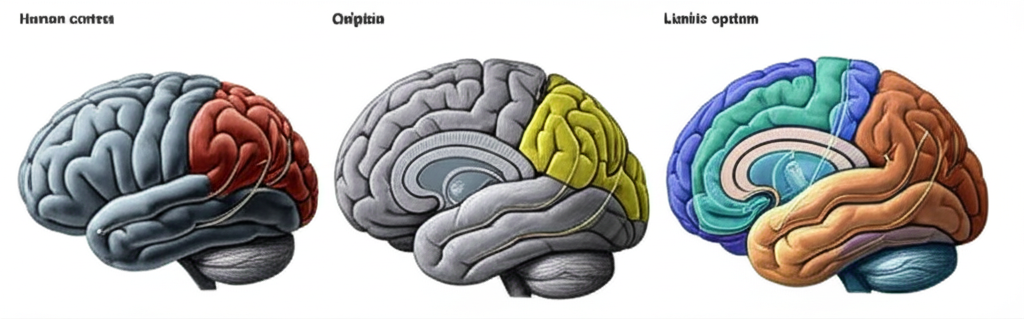
Neuroscience offers a powerful lens into the physical basis of consciousness. The discovery of structural and functional similarities between human and animal brains provides strong support for shared conscious experiences.
- Similar Brain Structures: Many animals, particularly mammals and birds, possess brain structures (e.g., neocortex, limbic system) homologous to those in humans associated with emotions, memory, and cognitive processing.
- Neural Correlates of Consciousness (NCCs): Research identifies specific patterns of brain activity linked to conscious experience in humans. Similar patterns are increasingly being found in animals, suggesting analogous subjective states.
- Pain Pathways: The presence of nociceptors (pain receptors), neural pathways for pain transmission, and brain regions associated with pain processing are widespread across diverse animal taxa. The Cambridge Declaration on Consciousness (2012), signed by prominent neuroscientists, explicitly states that "nonhuman animals, including all mammals and birds, and many other creatures, including octopuses, also possess these neurological substrates" for consciousness.
C. Evolutionary Continuity: A Gradual Ascent
The theory of evolution suggests a gradual development of traits over time. It is highly improbable that consciousness, especially in its fundamental forms like sentience, suddenly appeared fully formed in humans. Instead, an evolutionary perspective posits a continuum of Mind, with varying degrees of complexity across species.
- From simple nervous systems capable of basic sensation to highly complex brains capable of abstract thought, consciousness likely evolved as an adaptive trait, enhancing survival and reproduction.
- This perspective suggests that the differences between human and animal consciousness are more a matter of degree and complexity rather than a categorical absence in non-human species.
IV. The Hard Problem, Animal Style: Philosophical Challenges
Despite compelling evidence, the "hard problem" of consciousness—explaining how physical processes give rise to subjective experience—remains for animals as it does for humans.
- The "Other Minds" Problem: We can never directly experience another being's consciousness. Our inference is always based on analogy to our own experience and observable behavior. This problem is amplified for animals, where communication is often non-verbal and vastly different.
- Anthropomorphism vs. Objectivity: A constant challenge is to avoid projecting human emotions and cognitive capacities onto animals (anthropomorphism) while also not dismissing genuine evidence of animal consciousness due to a fear of anthropomorphism.
- Defining the Threshold: If consciousness is a continuum, where do we draw the line? Is a snail conscious? A bacterium? The question becomes increasingly difficult as we move down the phylogenetic tree.
V. Ethical Imperatives: Living with Conscious Beings
The profound implications of animal consciousness extend directly into our ethical responsibilities towards the natural world. If animals possess a Mind capable of experiencing pain, pleasure, and perhaps even complex emotions, then our treatment of them demands rigorous moral scrutiny.
A. Animal Welfare vs. Animal Rights
- Animal Welfare: Focuses on ensuring animals are treated humanely and that their basic needs (food, water, shelter, freedom from pain) are met. It acknowledges their capacity to suffer.
- Animal Rights: Argues that certain animals, particularly those with demonstrable consciousness and sentience, have inherent rights not to be exploited, harmed, or used by humans. Philosophers like Peter Singer (utilitarian perspective) and Tom Regan (deontological perspective) have been instrumental in advocating for animal rights, arguing that speciesism (discrimination based on species) is as morally indefensible as racism or sexism.
B. Impact on Human Practices
The recognition of animal consciousness profoundly impacts:
- Factory Farming: Raises serious ethical questions about the suffering endured by billions of animals annually.
- Animal Experimentation: Forces a re-evaluation of the necessity and justification of using animals in scientific research.
- Pet Ownership: Elevates the responsibility of care beyond mere provision to nurturing the well-being of a sentient companion.
- Conservation: Shifts the focus from preserving species to preserving individual lives and their capacity for experience.
VI. Future Directions and Unanswered Questions
The exploration of animal consciousness is a dynamic and evolving field. Future research will likely continue to integrate philosophical inquiry with cutting-edge scientific methodologies.
- Advanced Neuroimaging: Non-invasive techniques will provide deeper insights into animal brain activity and its correlation with behavior.
- Comparative Cognition: Further studies across diverse species will help map the continuum of cognitive abilities and their relationship to consciousness.
- AI and Machine Consciousness: The development of artificial intelligence capable of complex learning and decision-making may offer new theoretical frameworks for understanding the mechanisms of biological Mind.
- Redefining Our Place in Nature: A deeper understanding of animal consciousness compels us to re-evaluate our role as humans in the biosphere, fostering greater empathy and a more sustainable relationship with the natural world.
The journey to understand the nature of animal consciousness is not merely an academic exercise; it is a profound ethical challenge that invites us to expand our moral circle and reconsider our place among the myriad conscious beings that share our planet.
YouTube Video Suggestions:
-
📹 Related Video: KANT ON: What is Enlightenment?
Video by: The School of Life
💡 Want different videos? Search YouTube for: "Peter Singer Animal Liberation explained"
2. ## 📹 Related Video: KANT ON: What is Enlightenment?
Video by: The School of Life
💡 Want different videos? Search YouTube for: "The Cambridge Declaration on Consciousness explained"