

The Enigmatic Depths: Exploring the Nature of Animal Consciousness
Summary
The question of animal consciousness stands as one of philosophy's most profound and persistent inquiries, challenging our understanding of mind, self, and the very fabric of existence beyond the human realm. This pillar page delves into the multifaceted nature of animal consciousness, tracing its historical philosophical roots from ancient contemplations to contemporary scientific and ethical debates. We will explore what it means for an animal to possess a mind, examine the various facets of consciousness—from sentience and phenomenal experience to self-awareness—and consider the profound implications of these discussions for how we perceive and interact with the non-human world. Our journey will reveal not a simple answer, but a rich tapestry of thought that continually redefines the boundaries of intelligence and subjective experience.
Introduction: Peering into the Non-Human Mind
For centuries, humanity has grappled with its unique place in the cosmos. Central to this introspection is the question of what distinguishes us from other living beings. While biological differences are readily apparent, the true philosophical frontier lies in the realm of the mind. Do animals merely react, or do they experience? Do they possess an inner world, a subjective reality, a form of consciousness that mirrors, however faintly, our own?
The nature of animal consciousness is not merely an academic exercise; it underpins our ethical responsibilities, shapes our scientific methodologies, and profoundly influences our metaphysical worldview. To contemplate animal consciousness is to confront the limits of our own understanding and to expand the very definition of what it means to be alive and aware.
Historical Perspectives: Great Minds on Animal Minds
The notion of an animal mind has been a subject of philosophical contention since antiquity. Examining the Great Books of the Western World reveals a fascinating evolution in thought, from recognizing certain capacities in animals to outright denying their inner lives.
Aristotle: The Graded Soul
In his seminal work, De Anima (On the Soul), Aristotle presented a hierarchical understanding of the soul. He posited three types of souls:
- Vegetative Soul: Responsible for nutrition and reproduction (found in plants, animals, and humans).
- Sensitive Soul: Encompasses sensation, desire, and locomotion (found in animals and humans).
- Rational Soul: Unique to humans, enabling thought, reason, and moral choice.
For Aristotle, animals clearly possessed a sensitive soul, capable of sensation (perception through senses) and basic forms of memory and imagination. They could experience pleasure and pain, and act on desires. However, they lacked the capacity for abstract thought or true reason, thereby distinguishing their mind from the human intellect. This perspective granted animals a significant degree of inner life, albeit one fundamentally different from ours.
René Descartes: The Animal-Machine
Centuries later, René Descartes, a pivotal figure in modern philosophy, presented a radically different view. In works like Discourse on Method and Meditations on First Philosophy, Descartes argued for a strict dualism between mind (res cogitans – thinking substance) and matter (res extensa – extended substance).
Descartes famously concluded that only humans possessed a non-physical mind or soul, capable of thought, self-awareness, and true consciousness. Animals, in his view, were complex automata or machines, devoid of mind, feelings, or genuine consciousness. Their cries of pain were merely mechanical reactions, akin to a clock striking an hour. This mechanistic view profoundly influenced subsequent Western thought, portraying animals as sophisticated biological robots, acting purely on instinct and physical causation.
Defining the Indefinable: What is Animal Consciousness?
Before we can ask if animals are conscious, we must first grapple with what we mean by consciousness itself. This is no easy task, even for humans, but it becomes particularly complex when applied to non-verbal species.
Key Facets of Consciousness
When discussing animal consciousness, philosophers and scientists often refer to several distinct, though interrelated, concepts:
- Sentience: The capacity to feel, perceive, or experience subjectively. This includes experiencing pleasure and pain, hunger, fear, and comfort. It is the most basic form of consciousness.
- Phenomenal Consciousness (Qualia): The "what it's like" aspect of experience. What is it like to be a bat, a bird, or a bee? This refers to the subjective, qualitative feel of sensations and perceptions (e.g., the redness of red, the taste of chocolate).
- Access Consciousness: The ability to represent and manipulate information in the mind, making it available for reasoning, planning, and verbal report (though verbal report is not a prerequisite for animals).
- Self-Awareness: The capacity to recognize oneself as an individual entity distinct from others and the environment. This can manifest in mirror self-recognition, understanding one's own body, or having a theory of mind (attributing mental states to others).
- Intentionality: The property of mental states (beliefs, desires) being "about" something. Does an animal act with purpose or intention?
The debate often centers on which of these facets animals possess, and to what degree. While few dispute animal sentience today, the extent of their phenomenal experience, access consciousness, and self-awareness remains a rich area of inquiry.
The Hard Problem and the Animal Mind
The "hard problem of consciousness," coined by philosopher David Chalmers, asks why and how physical processes in the brain give rise to subjective experience (qualia). This problem is amplified when we consider animal consciousness. If we struggle to explain how human brains produce phenomenal experience, how can we possibly infer it in species whose brains are structured so differently from our own?
This philosophical hurdle doesn't negate the possibility of animal consciousness, but it underscores the challenge of moving beyond mere observation of behavior to understanding the inner life of another species.
Evidence and Inferences: How Do We Know?
Given that animals cannot articulate their inner states in human language, our understanding of their consciousness relies on a combination of behavioral observations, neuroscientific findings, and evolutionary reasoning.
Indicators of Animal Consciousness
| Category | Indicators | Examples |
|---|---|---|
| Behavioral | Complex Problem-Solving: Using tools, planning ahead, strategic hunting. | Chimpanzees using sticks to extract termites; Crows bending wire to retrieve food; Octopuses navigating mazes. |
| Emotional Responses: Displaying joy, fear, grief, empathy. | Dogs greeting owners; Elephants mourning their dead; Primates comforting distressed individuals. | |
| Learning & Memory: Classical and operant conditioning, episodic-like memory. | Pavlov's dogs; Birds remembering food caches; Rats learning complex routes. | |
| Communication: Sophisticated vocalizations, body language, symbolic communication. | Dolphin clicks and whistles; Bee waggle dance; Vervet monkey alarm calls for different predators. | |
| Self-Recognition: Reacting to one's own reflection. | Great apes, dolphins, elephants, and some birds (magpies) recognizing themselves in mirrors. | |
| Neurological | Brain Structure: Presence of homologous brain regions (e.g., limbic system for emotions). | Mammalian brains share structures associated with emotion and memory; Avian pallium shows functional similarities to mammalian cortex. |
| Neurotransmitters: Presence of chemicals associated with pain, pleasure, stress. | Endorphins, dopamine, serotonin found across diverse animal taxa. | |
| Electrical Activity: Brainwave patterns indicative of sleep, wakefulness, attention. | EEG patterns in various animals similar to human sleep stages and attentive states. | |
| Evolutionary | Continuity Hypothesis: Shared ancestry suggests shared fundamental biological processes, including consciousness. | If humans evolved consciousness, it's plausible that simpler forms or precursors exist in closely related species and even more distant ones, adapted to their specific nature. |
| Adaptive Value: Consciousness as an evolutionary advantage for survival and reproduction. | The ability to feel pain and avoid danger, or to experience pleasure from essential activities (eating, mating), confers survival benefits. |
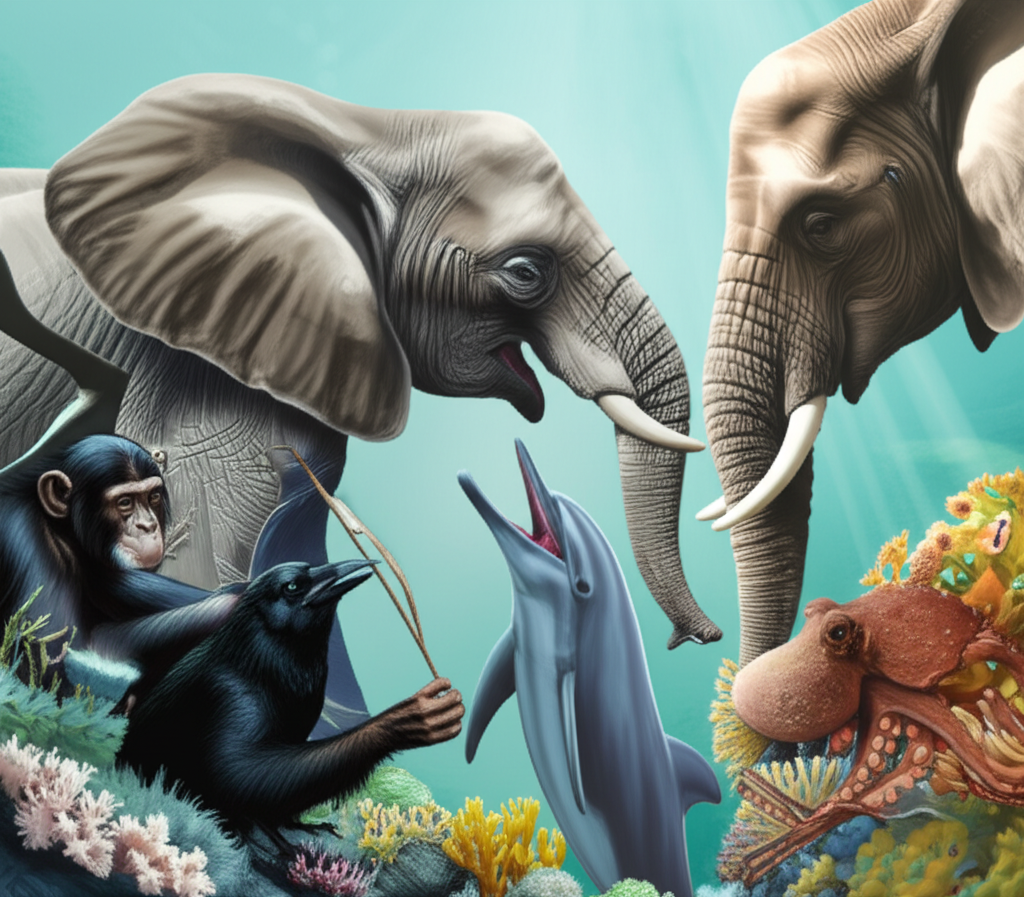 . The background is a subtle, abstract representation of neural networks, symbolizing the underlying biological basis of consciousness.)
Ethical Implications: Why Does it Matter?
The philosophical inquiry into animal consciousness is not an abstract exercise; it carries profound ethical weight. If animals possess subjective experiences, if they can feel pain and pleasure, fear and joy, then our moral obligations towards them fundamentally change.
- Animal Welfare: Acknowledging animal consciousness strengthens arguments for reducing suffering in agriculture, research, and entertainment.
- Animal Rights: Some philosophers argue that if animals possess certain levels of consciousness (e.g., self-awareness), they may have a right to life, liberty, and freedom from exploitation.
- Conservation: Understanding the complex inner lives of animals can foster greater empathy and commitment to preserving biodiversity and their natural habitats.
The nature of animal consciousness compels us to re-evaluate our anthropocentric biases and consider a more inclusive moral framework that extends beyond our own species.
Contemporary Views and the Future of Inquiry
Modern philosophy and science have largely moved beyond Descartes' animal-machine hypothesis. The prevailing view among many neuroscientists and cognitive ethologists is that some form of consciousness is widespread in the animal kingdom, varying in complexity.
The Cambridge Declaration on Consciousness (2012), signed by prominent neuroscientists, explicitly states that "nonhuman animals, including all mammals and birds, and many other creatures, including octopuses, also possess the neurological substrates of consciousness." This landmark declaration underscores a growing scientific consensus that the nature of mind is not exclusive to humans.
Future research will likely continue to explore:
- The neural correlates of consciousness in diverse species.
- The evolutionary origins and adaptive functions of different forms of consciousness.
- The development of more sophisticated methods for inferring subjective experience in animals.
Conclusion: A Wider Circle of Concern
The journey into the nature of animal consciousness is a journey into the heart of what it means to be a conscious being. From Aristotle's graded souls to Descartes' automata, and now to the nuanced understanding of modern science, our perception of the animal mind has evolved dramatically.
While the "hard problem" of consciousness ensures that a complete understanding may forever elude us, the overwhelming evidence points towards a vibrant, diverse spectrum of subjective experience across the animal kingdom. This realization challenges us not only to expand our philosophical horizons but also to re-examine our ethical responsibilities, fostering a deeper respect and empathy for the myriad forms of life that share our planet. The nature of animal consciousness is not just about them; it is ultimately about us, and the kind of world we choose to inhabit.
YouTube:
- The Consciousness of Animals: A Philosophical Debate
- Are Animals Conscious? Crash Course Philosophy #29
📹 Related Video: What is Philosophy?
Video by: The School of Life
💡 Want different videos? Search YouTube for: "The Nature of Animal Consciousness philosophy"