

The Enigma of Animal Consciousness: Probing the Non-Human Mind
The piercing gaze of a predator, the intricate dance of a bee, the mournful cry of an elephant – these moments stir in us a profound question: What lies behind those eyes? Do animals merely react to stimuli, or do they experience the world with an inner life, a subjective awareness akin to our own? This pillar page delves into the multifaceted philosophical and scientific inquiry into the nature of animal consciousness, exploring the historical progression of thought, the challenges of defining and detecting consciousness in non-human species, and the profound ethical implications of our evolving understanding of the animal mind. We will journey through centuries of philosophical debate, from ancient Greek classifications of souls to modern neuroscience, aiming to illuminate the complex and often humbling frontier of animal sentience.
Defining Consciousness: A Human Predicament, An Animal Question
Before we can even begin to probe the animal mind, we must first grapple with the elusive concept of consciousness itself. What, precisely, do we mean when we speak of consciousness? Is it merely wakefulness, the ability to respond to stimuli, or something far deeper – the subjective experience of "what it is like" to be a particular organism? Philosophers often differentiate between:
- Phenomenal Consciousness: The raw, subjective experience of sensations, feelings, and perceptions (e.g., the redness of red, the taste of sweetness). This is often referred to as the "hard problem" of consciousness.
- Access Consciousness: The ability to process information, report on it, and use it for reasoning and guiding action.
- Self-Awareness: The capacity to recognize oneself as a distinct individual, separate from others and the environment.
For centuries, human consciousness has been the benchmark, often leading to an anthropocentric bias in our understanding. The challenge with animals lies in our inability to directly access their inner worlds. We cannot ask a bat what it feels like to echolocate, nor a dog what it truly experiences when it dreams. This epistemological barrier makes the study of animal consciousness a unique and deeply philosophical endeavor, forcing us to rely on inference, analogy, and increasingly sophisticated scientific methods to infer the presence and nature of their minds.
Historical Perspectives on the Animal Mind
The question of whether animals possess consciousness is not a modern one; it has echoed through the corridors of philosophy for millennia. The "Great Books of the Western World" offer a rich tapestry of perspectives that have shaped our understanding, or misunderstanding, of the animal mind.
Aristotle's Hierarchical Souls: The Sensitive Animal
In his seminal work, De Anima (On the Soul), Aristotle proposed a tiered classification of souls. While he granted humans a "rational soul" (logos), animals were endowed with a "sensitive soul." This sensitive soul allowed for:
- Sensation: The ability to perceive through senses (sight, hearing, touch, etc.).
- Locomotion: The capacity for movement.
- Desire: Appetites and urges.
- Imagination and Memory: Rudimentary forms, allowing for learning and adaptation.
For Aristotle, animals were clearly not mere automatons; they experienced, felt, and learned, albeit without the capacity for abstract thought or moral reasoning that he attributed solely to humans. Their nature was defined by their sensory engagement with the world.
Descartes' Mechanistic View: The "Beast-Machine"
Centuries later, René Descartes presented a starkly contrasting and highly influential view. In his Discourse on Method and Meditations on First Philosophy, Descartes argued for a fundamental distinction between mind (res cogitans) and body (res extensa). He concluded that animals, lacking a rational soul and the capacity for language, were essentially complex machines – "beast-machines" or automata.
Descartes believed that animal cries of pain were merely mechanical reactions, like a clock chiming, rather than expressions of genuine suffering. This perspective, though challenged even in his own time, profoundly impacted Western thought, providing a philosophical justification for treating animals as property or resources without moral consideration for their inner experience.
Empiricism and Animal Experience: Locke and Hume
The British Empiricists began to chip away at the Cartesian edifice. John Locke, in his Essay Concerning Human Understanding, focused on how ideas are formed through sensation and reflection. While primarily concerned with human understanding, his framework implicitly opened the door to considering animal experience. If all knowledge begins with sensation, and animals clearly possess senses, then they must, in some form, generate ideas, however simple.
David Hume, a generation later, went further. In An Enquiry Concerning Human Understanding, he argued that animals exhibit a form of "reason" based on experience and habit, much like humans. He observed that animals learn from cause and effect, anticipate outcomes, and adapt their behavior. For Hume, the difference between human and animal mind was one of degree, not kind, challenging the sharp Cartesian divide.
| Philosopher | Key View on Animal Consciousness | Implications for Animal Nature |
|---|---|---|
| Aristotle | Animals possess a "sensitive soul" capable of sensation, desire, memory, and locomotion, but lack rational thought (logos). | Animals are living beings with inner experiences, but fundamentally different from humans due to the absence of higher reason. Their nature is bound to sensory perception and instinct. |
| Descartes | Animals are complex machines (automata) without consciousness, souls, or genuine feeling. Their reactions are purely mechanical. | Animals have no inner life, no suffering, and no moral standing. Their bodies are extensions of physical laws, devoid of mind. This view contributed to the objectification of animals. |
| Locke | All knowledge derives from sensation and reflection. Animals, having senses, must form ideas, though perhaps simpler than humans. | While not explicitly detailing animal consciousness, Locke's empiricism provided a framework where animal experience could logically exist, based on their sensory input. |
| Hume | Animals exhibit a form of "reason" based on experience, habit, and inference, similar to humans but in a simpler degree. | The difference between human and animal mind is quantitative, not qualitative. Animals possess a form of intelligence and learning, challenging anthropocentric exceptionalism. |
Modern Inquiries: Bridging Philosophy and Science
The 20th and 21st centuries have witnessed a profound shift, driven by advances in ethology, neuroscience, and cognitive psychology. The question of animal consciousness is no longer solely a philosophical debate but a vibrant field of interdisciplinary scientific inquiry.
Behavioral Evidence: Complex Cognition and Emotion
Observational studies of animal behavior have revealed astonishing complexity, challenging the notion of animals as simple automatons:
- Tool Use: Chimpanzees using sticks to fish for termites, crows fashioning hooks from wire, otters cracking shells with rocks.
- Problem Solving: Elephants cooperating to solve puzzles, dolphins using intricate strategies to hunt.
- Communication: Complex vocalizations in whales and birds, alarm calls indicating specific threats, the "waggle dance" of bees conveying foraging locations.
- Emotional Expression: Evidence of grief, joy, empathy, and even self-medication in various species.
- Theory of Mind: Some animals (e.g., chimpanzees, ravens) show signs of understanding what others know or intend, a precursor to human social cognition.
These behaviors suggest an inner world far richer than previously imagined, implying cognitive processes, memory, planning, and even emotional depth that are difficult to reconcile with a purely mechanistic view.
Neuroscience: The Brain's Whispers
Neuroscientific research provides compelling physiological evidence. The brains of many animals, particularly mammals and birds, share fundamental structures and neural pathways with human brains responsible for emotion, memory, and decision-making.
- Pain Pathways: The presence of nociceptors and pain processing centers similar to humans in many animals suggests they experience pain.
- Sleep Patterns: Many animals exhibit REM sleep, associated with dreaming and memory consolidation, indicating complex brain activity during rest.
- Neurotransmitters: The presence of neurotransmitters like dopamine and serotonin, linked to pleasure and mood regulation, suggests a capacity for emotional experience.
Perhaps one of the most significant modern statements came with the Cambridge Declaration on Consciousness (2012), signed by a prominent group of neuroscientists. It formally declared that "non-human animals, including mammals and birds, and many other creatures, including octopuses, possess the neurological substrates of consciousness" and are capable of experiencing emotions. This declaration marked a pivotal moment, affirming a scientific consensus that many animals are indeed conscious beings.
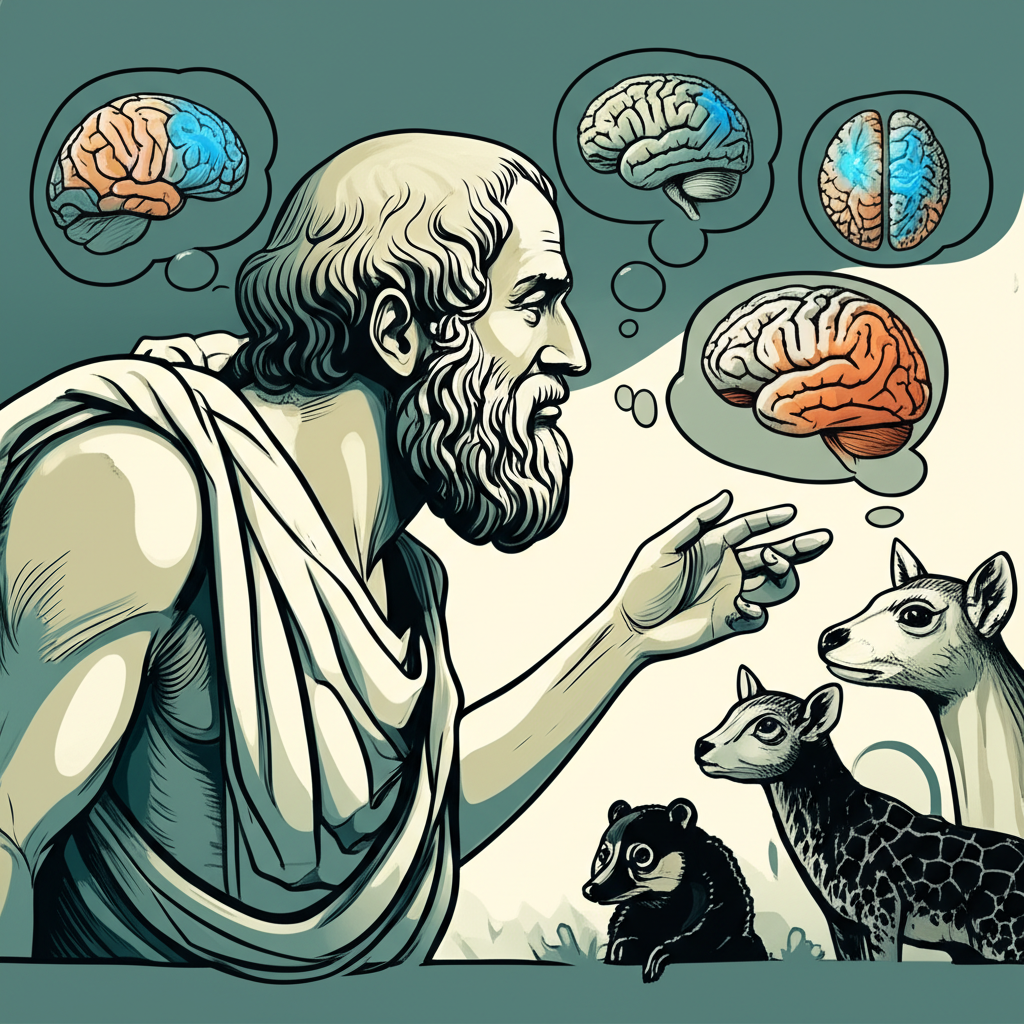
The Spectrum of Animal Consciousness
Is consciousness an all-or-nothing phenomenon, or does it exist on a gradient? Modern philosophy and science lean towards the latter, suggesting a spectrum of awareness across the animal kingdom.
Levels of Awareness
It's helpful to consider different levels of consciousness that animals might possess:
- Sentience: The most basic form, the capacity to feel sensations, particularly pain and pleasure. This is widely accepted for most vertebrates and increasingly for many invertebrates.
- Phenomenal Consciousness: The capacity for subjective experience – "what it's like" to be that animal. This is harder to prove but strongly inferred from complex behaviors and neurological similarities in many species.
- Self-Awareness: The ability to recognize oneself as a distinct entity. This is often tested using the mirror self-recognition test, passed by great apes, dolphins, elephants, and some birds.
- Meta-Cognition: The ability to think about one's own thoughts, to know what one knows or doesn't know. Evidence for this is emerging in some highly intelligent animals.
Diverse Expressions of Mind
The nature of the animal mind is incredibly diverse. A dog's consciousness might be dominated by scent, a bat's by sound, and a bird's by vision. Their subjective worlds, or Umwelten, are shaped by their unique sensory apparatus and ecological niches.
For example:
- Octopuses: Possess a highly decentralized nervous system, with "mini-brains" in their arms, exhibiting remarkable problem-solving abilities, camouflage, and even play. Their consciousness may be profoundly different from ours, yet undeniably present.
- Birds: Once thought to be less intelligent due to smaller brains, birds like corvids and parrots demonstrate incredible cognitive feats, including tool manufacture, complex communication, and self-control, suggesting highly developed forms of consciousness.
- Fish: Recent research indicates fish feel pain, exhibit learning, and even show signs of personality, challenging the long-held assumption of their insentience.
The journey to understand animal consciousness is one of continuous discovery, pushing the boundaries of our empathy and challenging our anthropocentric assumptions.
Ethical Implications of Animal Consciousness
The philosophical and scientific understanding of animal consciousness carries profound ethical implications. If animals are not mere machines but beings capable of experiencing pain, pleasure, fear, and joy, then our moral obligations towards them fundamentally shift.
- The Problem of Suffering: If animals are sentient, then causing them unnecessary suffering becomes a grave moral concern. This underpins the arguments for animal welfare and animal rights.
- Moral Status: Do conscious animals have inherent moral status, deserving of rights similar to humans, or at least a high degree of protection?
- Rethinking Our Practices: This question forces us to re-evaluate practices such as factory farming, animal experimentation, hunting, and the use of animals for entertainment.
Philosophers like Jeremy Bentham, a utilitarian, famously stated, "The question is not, Can they reason? nor, Can they talk? but, Can they suffer?" This simple yet powerful statement places sentience, the capacity for subjective experience of pain and pleasure, at the heart of moral consideration. Contemporary philosophers like Peter Singer have built upon this, arguing that speciesism – discrimination based on species membership – is as unjustifiable as racism or sexism, especially when dealing with the capacity to suffer.
Our growing comprehension of the nature of the animal mind compels us to consider a more inclusive ethical framework, one that extends moral consideration beyond our own species and acknowledges the rich, diverse tapestry of conscious life on Earth.
Conclusion
The inquiry into "The Nature of Animal Consciousness" is a profound philosophical journey, one that began with ancient contemplations on the soul and has evolved into a vibrant interdisciplinary field. From Aristotle's sensitive souls to Descartes' beast-machines, and through the empirical insights of Locke and Hume, the historical debate laid the groundwork for our modern scientific explorations. Today, through sophisticated behavioral studies and neuroscientific discoveries, we are increasingly confirming what many have long suspected: animal minds are rich, varied, and often astonishingly complex, capable of sensation, emotion, cognition, and in many cases, a form of subjective awareness.
This evolving understanding of animal consciousness is not merely an academic exercise; it challenges us to confront our anthropocentric biases and re-evaluate our ethical responsibilities towards the non-human world. As we continue to unravel the mysteries of the animal mind, we are not just learning about them; we are learning more about consciousness itself, and ultimately, about our own place within the grand nature of existence. The frontier of animal consciousness remains an open and fertile ground for both philosophical contemplation and scientific discovery, urging us towards greater empathy and a more profound respect for all sentient life.
YouTube Suggestions:
-
📹 Related Video: PLATO ON: The Allegory of the Cave
Video by: The School of Life
💡 Want different videos? Search YouTube for: ""The Cambridge Declaration on Consciousness Explained""
-
📹 Related Video: ARISTOTLE ON: The Nicomachean Ethics
Video by: The School of Life
💡 Want different videos? Search YouTube for: ""Philosophical Debate on Animal Minds and Ethics""