

Unveiling the Animal Mind: A Philosophical Journey into the Nature of Animal Consciousness
Summary
The question of animal consciousness is one of philosophy's most enduring and profound challenges. This pillar page delves into the multifaceted nature of non-human minds, exploring how we define, detect, and interpret awareness, sentience, and cognitive abilities across the animal kingdom. From ancient philosophical inquiries into the soul to modern scientific investigations, we trace the evolution of thought on whether animals possess subjective experiences, self-awareness, and the capacity for complex emotions, ultimately examining the ethical implications of these understandings for humanity's relationship with the natural world.
Introduction: The Enigma of the Animal Mind
For centuries, humanity has grappled with a profound question: do animals think, feel, and experience the world in a way akin to our own? The nature of animal consciousness remains one of the most intriguing and challenging frontiers in philosophy, science, and ethics. It forces us to confront not only the complexity of other species but also the very definition of what it means to be a conscious being. Are the chirping bird, the playful dog, or the majestic whale mere biological automata, or do they possess rich inner lives, subjectivities, and a genuine mind?
This exploration will embark on a philosophical journey, drawing from the wisdom of the Great Books of the Western World and contemporary thought, to illuminate the various facets of animal consciousness. We will navigate the historical perspectives that have shaped our understanding, examine the scientific evidence hinting at sophisticated animal minds, and confront the profound ethical responsibilities that arise from acknowledging their potential for sentience.
I. Defining Consciousness in the Animal Kingdom: A Philosophical Quandary
Before we can ask if animals are conscious, we must first ask what consciousness truly is. This foundational question has plagued philosophers for millennia. Is it simply the ability to react to stimuli, or does it require self-awareness, reflective thought, and the capacity for subjective experience?
- Phenomenal Consciousness: The "what it's like" aspect – the raw, subjective experience of sensations, feelings, and perceptions. This is often referred to as sentience.
- Access Consciousness: The ability to represent and manipulate information in the mind for reasoning, planning, and verbal reporting. This is often associated with higher-order cognitive functions.
When discussing animal consciousness, we are often primarily concerned with phenomenal consciousness – the capacity for an animal to feel something, be it pain, pleasure, fear, or joy. However, evidence for access consciousness in certain species is also growing, complicating the traditional human-centric view of intelligence and awareness.
Ancient Insights from the Great Books:
Aristotle, in his seminal work De Anima (On the Soul), posits a hierarchy of souls. He attributes a nutritive soul (growth, reproduction) to plants, a sensitive soul (sensation, desire, movement) to animals, and a rational soul (thought, reason) uniquely to humans. While he acknowledged animals possess perception and desire, he distinguished their mind from the human capacity for abstract reason, laying groundwork for centuries of debate regarding the qualitative difference in consciousness.
II. Historical Perspectives: From Automatons to Sentient Beings
The philosophical discourse surrounding animal consciousness has undergone significant transformations, often mirroring advancements in scientific understanding and shifts in ethical sensibilities.
A. The Mechanistic View: Descartes and the Animal-Machine
Perhaps no philosopher cast a longer shadow over the question of animal consciousness than René Descartes. In works like Discourse on Method and Meditations on First Philosophy, Descartes famously distinguished between res cogitans (thinking substance, the mind) and res extensa (extended substance, matter). For Descartes, animals were complex machines, lacking a rational soul, language, and thus, true consciousness. Their cries of pain were merely mechanical reactions, akin to a clock striking an hour. This perspective, while influential, reduced animals to mere objects, devoid of subjective experience.
B. The Rise of Empiricism and Evolutionary Thought
Later philosophers, particularly British empiricists like John Locke and David Hume, began to challenge the strict Cartesian dualism. While still primarily focused on human mind, their emphasis on experience and sensation provided a framework for considering the sensory world of animals.
The most significant shift, however, came with Charles Darwin. His revolutionary works, On the Origin of Species and The Descent of Man, proposed a continuity of life, suggesting that human faculties, including mental ones, evolved from simpler forms. This implied a gradation of mind and consciousness across species, rather than an absolute divide. Darwin observed complex behaviors and emotional expressions in animals, arguing that the difference between human and animal minds was one of degree, not kind. This paradigm shift opened the door for a scientific and philosophical re-evaluation of animal consciousness.
III. The Spectrum of Animal Minds: Evidence and Interpretation
Modern ethology, cognitive science, and neuroscience have provided a wealth of evidence suggesting that many animals possess sophisticated cognitive and emotional lives, challenging historical assumptions about their lack of a true mind.
A. Cognitive Abilities
Research has revealed remarkable problem-solving skills, memory, and even cultural transmission in various species.
- Tool Use: Chimpanzees using sticks to fish for termites, crows bending wire to retrieve food, otters using rocks to crack shells.
- Problem Solving: Elephants collaborating to solve tasks, dolphins learning complex commands, parrots demonstrating numerical understanding.
- Memory: Pinyon jays remembering thousands of seed cache locations, elephants recalling individuals and routes over decades.
B. Emotional Expressions and Social Complexity
The capacity for emotions, often considered a hallmark of consciousness, is increasingly recognized in animals.
- Joy and Play: Observed in species from puppies to primates, indicating positive affective states.
- Grief and Mourning: Elephants visiting the bones of deceased relatives, chimpanzees grieving their dead young.
- Fear and Stress: Universal survival responses, demonstrating a subjective experience of threat.
- Empathy and Altruism: Instances of animals aiding injured conspecifics or even members of other species.
C. Self-Awareness and Theory of Mind
These higher-order cognitive functions are crucial indicators of a complex mind.
- Self-Awareness (Mirror Test): The ability to recognize oneself in a mirror, indicating a sense of self distinct from others. Species that have passed include chimpanzees, orangutans, dolphins, elephants, and some birds (e.g., magpies).
- Theory of Mind: The ability to attribute mental states (beliefs, intentions, desires) to oneself and others. While difficult to prove definitively in animals, evidence in primates suggests they can understand others' perspectives and intentions.
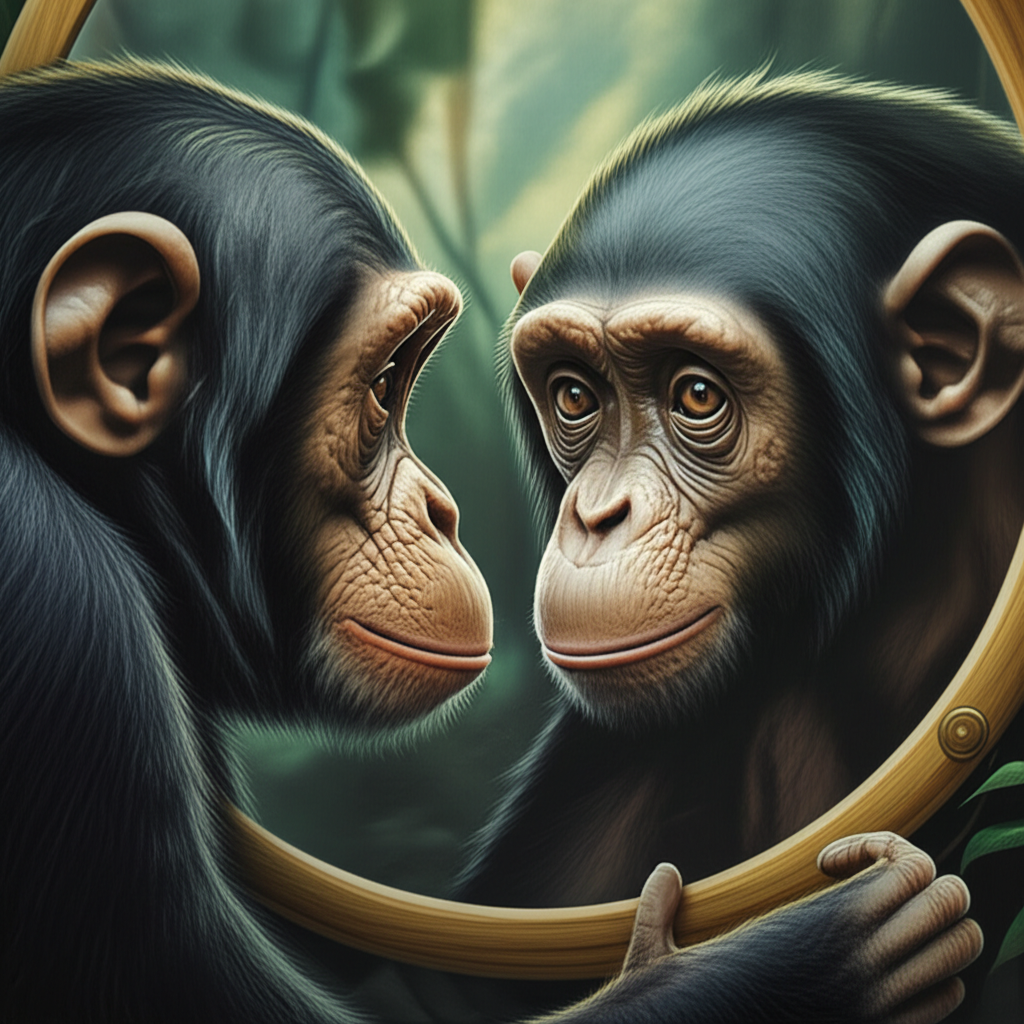
D. Examples of Complex Animal Cognition
| Animal Species | Demonstrated Cognitive Abilities | Implications for Consciousness |
|---|---|---|
| Dolphins | Self-recognition, complex communication, social learning, problem-solving | Suggests high level of self-awareness and social intelligence. |
| Elephants | Long-term memory, empathy, grief, cooperation, tool use (modified branches) | Indicates rich emotional life and advanced social cognition. |
| Crows/Ravens | Tool manufacture and use, causal reasoning, planning, episodic memory | Highlights complex problem-solving and foresight in avian minds. |
| Primates | Self-recognition, theory of mind (limited), cultural transmission, complex social hierarchies, deception | Strong evidence for sophisticated social and cognitive consciousness. |
| Octopuses | Problem-solving, camouflage mastery, individual personalities, escape artistry | Demonstrates complex intelligence in an evolutionarily distant lineage. |
IV. Philosophical Challenges and Ethical Implications
Acknowledging the possibility of animal consciousness brings forth a cascade of profound philosophical and ethical questions.
A. The "Hard Problem" Extended
If consciousness is a "hard problem" for humans (how physical processes give rise to subjective experience), it is arguably even harder for animals. We cannot directly ask them what it's like to be a bat, as Thomas Nagel famously explored. We rely on observational data, behavioral cues, and physiological markers, which are always open to interpretation. The "problem of other minds" is amplified when those minds are non-human.
B. The Moral Status of Animals
Perhaps the most significant implication of animal consciousness is its bearing on their moral status. If animals can suffer, feel pain, experience joy, and possess a form of mind, what duties do we owe them?
- Utilitarianism: Philosophers like Jeremy Bentham famously argued that the question is not "Can they reason?" nor "Can they talk?" but "Can they suffer?" If animals can suffer, then their pain should be considered in our moral calculations.
- Rights-based Ethics: Some argue that if animals are subjects-of-a-life, possessing inherent value and consciousness, they may have certain rights, such as the right not to be harmed or exploited.
- Kant's Perspective (and its limitations): Immanuel Kant, in Groundwork of the Metaphysics of Morals, emphasized rationality as the basis for moral worth, viewing animals as means to an end. However, even Kant acknowledged indirect duties to animals, arguing that cruelty to animals could habituate one to cruelty towards humans. Modern ethical thought often challenges this anthropocentric view, seeking to extend moral consideration directly to animals based on their capacity for consciousness and suffering.
The debate over animal consciousness is therefore not merely academic; it has profound implications for our food systems, scientific research, conservation efforts, and our very definition of what it means to be a moral agent in the natural world.
V. The Future of Understanding Animal Consciousness
The journey into the nature of animal consciousness is far from over. It is an ongoing, interdisciplinary quest that merges philosophy with cutting-edge science.
- Neuroscience: Advances in brain imaging, genetic research, and comparative neuroanatomy are providing new insights into the neural correlates of consciousness in diverse species.
- Ethology: Detailed behavioral studies continue to uncover astonishing cognitive and emotional complexities in the animal kingdom, from octopuses to birds.
- Philosophy of Mind: Philosophers continue to refine definitions of consciousness, explore the implications of various theories (e.g., Integrated Information Theory), and grapple with the ethical challenges posed by our evolving understanding.
As our tools for observation and analysis become more sophisticated, so too does our appreciation for the vast and varied tapestry of minds that share our planet. The ultimate goal is not just to understand them, but to understand us better, and our place within the grand nature of existence.
Conclusion: A Shared World of Mind
The exploration of "The Nature of Animal Consciousness" reveals a profound truth: the world around us is likely far richer in subjective experience than previously imagined. From the ancient philosophical inquiries into the soul to the latest scientific discoveries, the evidence increasingly points to a spectrum of minds across the animal kingdom, each with its unique way of experiencing the world.
This journey challenges our anthropocentric biases and compels us to reconsider our relationship with other species. Recognizing the potential for consciousness in animals is not just an intellectual exercise; it is a moral imperative that reshapes our ethical landscape, urging us towards greater empathy, responsibility, and respect for the intricate web of life. The question of animal consciousness remains a vibrant and essential area of inquiry, continually pushing the boundaries of our understanding of mind, nature, and what it means to be alive.
YouTube Suggestions:
- YouTube: "The Science of Animal Consciousness"
- YouTube: "Philosophical Arguments for Animal Rights Peter Singer"
📹 Related Video: What is Philosophy?
Video by: The School of Life
💡 Want different videos? Search YouTube for: "The Nature of Animal Consciousness philosophy"