

The Enduring Enigma: The Mind-Body Problem in Modern Science
The relationship between our subjective experience – our thoughts, feelings, consciousness – and the physical stuff of our brains and bodies has perplexed thinkers for millennia. This is the Mind-Body Problem, a foundational question in Metaphysics that continues to challenge Science in the 21st century. Despite astounding advancements in neuroscience and physics, the chasm between the objective, measurable world and our subjective inner life remains, pushing the boundaries of our understanding of existence itself. This article explores the historical lineage of this profound inquiry, its manifestations in contemporary scientific discourse, and the philosophical implications that continue to resonate.
A Timeless Conundrum: From Ancient Philosophy to Modern Inquiry
At its core, the Mind-Body Problem asks: What is the relationship between the mind and the body? Are they distinct entities, or merely different aspects of the same thing? This is not merely an academic curiosity; it underpins our understanding of consciousness, free will, morality, and even the nature of reality.
Summary: The Mind-Body Problem, a central tenet of metaphysics, investigates the intricate relationship between consciousness and the physical brain. From ancient philosophical debates to contemporary neuroscience, this article explores how science grapples with the subjective "mind" arising from the objective "body," highlighting key historical perspectives and modern scientific approaches, while acknowledging the enduring philosophical challenges.
The Philosophical Foundations: Echoes from the Great Books
Long before fMRI machines and quantum physics, the sages of antiquity wrestled with this very question. The Great Books of the Western World offer a rich tapestry of early attempts to reconcile the inner and outer worlds:
- Plato's Dualism: In works like Phaedo, Plato posited a clear distinction between the immortal soul (mind) and the mortal body. The soul, for Plato, belonged to a realm of perfect Forms, merely inhabiting the imperfect physical body during life.
- Aristotle's Hylomorphism: Aristotle, while acknowledging distinct aspects, saw the soul (mind) as the form of the body, inseparable from its matter. The soul was the animating principle, giving life and function to the physical organism, much like the shape of a statue is inseparable from its bronze.
- Early Christian Thought: Figures like St. Augustine integrated Platonic dualism with Christian theology, emphasizing the spiritual soul's primacy over the earthly body, a perspective that profoundly shaped Western thought for centuries.
These early inquiries laid the groundwork, framing the problem in terms of distinct substances or integrated properties.
Descartes and the Dawn of Modern Dualism
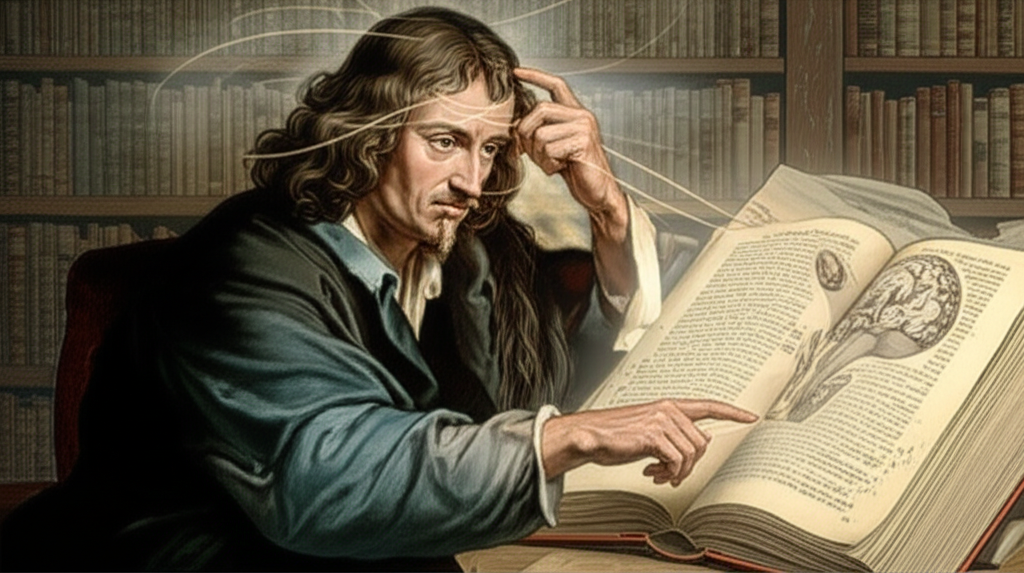
The 17th century saw a pivotal shift with René Descartes, whose radical dualism profoundly shaped subsequent philosophical and scientific inquiry. Descartes, seeking certainty in a world of doubt, concluded: "I think, therefore I am." He argued for two distinct substances:
- Res Cogitans (Thinking Substance): The mind, characterized by thought, consciousness, and indivisibility.
- Res Extensa (Extended Substance): The body, characterized by extension in space, materiality, and divisibility.
Descartes proposed that these two radically different substances interacted in the pineal gland, a theory that immediately presented the formidable "interaction problem": How can a non-physical mind cause changes in a physical body, and vice versa? This question continues to echo in modern scientific debates.
The Mind-Body Problem in the Age of Science
With the rise of empirical science, the focus shifted from metaphysical speculation to observable phenomena. Neuroscience, cognitive science, and even quantum physics now offer new lenses through which to examine the mind-body connection.
Neuroscience: Bridging the Gap, or Deepening the Mystery?
Modern neuroscience has made extraordinary strides in mapping the brain and understanding its functions. We can correlate specific brain activities with thoughts, emotions, and perceptions.
Key Scientific Approaches:
- Localization of Function: Identifying specific brain regions responsible for tasks (e.g., Broca's area for speech production).
- Neural Correlates of Consciousness (NCCs): Searching for the minimal set of neuronal events sufficient for a specific conscious experience.
- Brain Imaging Technologies: fMRI, EEG, PET scans allow us to observe brain activity in real-time, showing how physical processes relate to mental states.
However, even with these advancements, the "hard problem of consciousness" (coined by David Chalmers) persists: Why and how do physical processes give rise to subjective experience? Knowing where consciousness happens or what brain activity accompanies it doesn't explain why it feels like something to be conscious. This is where the metaphysical aspect of the problem resurfaces.
Physicalism and its Challenges
The dominant view in modern Science is physicalism (or materialism), which posits that everything, including the mind, is ultimately physical.
Varieties of Physicalism:
| Type of Physicalism | Description | Challenge |
|---|---|---|
| Identity Theory | Mental states are identical to brain states (e.g., pain is C-fiber firing). | Multiple realizability (can different brain states cause the same mental state?) |
| Functionalism | Mental states are defined by their causal roles, not their physical composition (e.g., software on hardware). | Explaining qualitative subjective experience (qualia). |
| Eliminative Materialism | "Folk psychology" (beliefs, desires) will eventually be replaced by neuroscientific explanations. | Intuitive resistance; difficulty explaining current subjective reality. |
| Emergentism | Mental properties emerge from complex physical systems (the brain), but are not reducible to them. | How do properties "emerge"? Are they truly non-physical? |
The Quantum Conundrum and AI
Some theories flirt with quantum mechanics, suggesting that consciousness might involve quantum phenomena, though this remains highly speculative and lacks strong empirical support. Similarly, advancements in Artificial Intelligence (AI) and machine learning raise questions about whether complex computational processes could eventually lead to genuine consciousness, blurring the lines between computation and subjective experience. These fields push us to redefine our understanding of the mind beyond biological confines.
The Enduring Metaphysical Quagmire
Despite scientific progress, the fundamental Metaphysical questions of the Mind-Body Problem remain. Is consciousness an epiphenomenon, a mere side effect of brain activity with no causal power? Or does it have its own independent existence, perhaps even influencing the physical world?
Persistent Questions:
- Qualia: How do objective brain states give rise to the subjective, qualitative feel of experiences (e.g., the redness of red, the taste of chocolate)?
- Intentionality: How can physical states be about something (e.g., a thought about Paris)?
- Free Will: If the mind is merely a product of physical processes, is our sense of agency an illusion?
- Personal Identity: What constitutes our enduring self if our physical body and brain are constantly changing?
These are not questions that can be answered solely by observing neurons. They demand a deeper philosophical inquiry into the nature of reality itself.
Moving Forward: A Holistic Perspective
The journey through the Mind-Body Problem illustrates the continuous interplay between Science and Metaphysics. While science provides empirical data and models, philosophy grapples with the conceptual frameworks and implications. Perhaps a complete understanding will require a new paradigm, one that transcends the traditional dualistic and materialistic assumptions. As we continue to unravel the mysteries of the brain, the mind remains the most profound frontier of human exploration, a testament to the enduring power of inquiry that began with the earliest thinkers preserved in the Great Books.
Further Exploration
📹 Related Video: ARISTOTLE ON: The Nicomachean Ethics
Video by: The School of Life
💡 Want different videos? Search YouTube for: ""The Hard Problem of Consciousness Explained""
📹 Related Video: What is Philosophy?
Video by: The School of Life
💡 Want different videos? Search YouTube for: ""Mind Body Problem Philosophy Crash Course""