

The Enduring Enigma: The Mind-Body Problem in Modern Science
Summary: The ancient philosophical conundrum of how the non-physical mind relates to the physical body remains one of humanity's most profound intellectual challenges. Far from being relegated to dusty tomes, this fundamental metaphysical question has been vigorously re-engaged by modern science, particularly in fields like neuroscience, cognitive psychology, and even theoretical physics. This article explores how contemporary scientific inquiry, while offering unprecedented insights into brain function, simultaneously deepens the mystery of subjective experience, pushing the boundaries of our understanding of consciousness and existence itself.
A Legacy of Inquiry: From Ancient Greece to Cartesian Doubt
For millennia, thinkers have wrestled with the nature of existence, specifically the relationship between our inner, subjective world of thoughts, feelings, and consciousness, and the tangible, observable world of matter and energy. The Great Books of the Western World are replete with attempts to grasp this elusive connection. Plato's theory of Forms posited a non-physical realm of perfect ideas, with the soul (mind) being distinct from the corruptible body. Aristotle, while emphasizing the soul as the form of the body, still acknowledged its unique functions.
However, it was René Descartes in the 17th century who articulated the problem in its most influential dualistic form. He proposed that the mind (res cogitans – thinking substance) and the body (res extensa – extended substance) were fundamentally distinct entities, interacting, he speculated, in the pineal gland. This Cartesian dualism, though often critiqued, laid the groundwork for much subsequent philosophical and scientific debate, forcing us to confront the seemingly unbridgeable gap between subjective experience and objective physical reality.
Modern Science's Illumination: Probing the Physical Substrate
With the advent of advanced technologies, modern science has made astonishing strides in understanding the body, particularly the brain. Neuroimaging techniques, electrophysiology, and sophisticated psychological experiments now allow us to observe, measure, and even manipulate brain activity with unprecedented precision.
Key Scientific Approaches:
- Neuroscience: This field meticulously maps brain regions to specific functions, identifying neural correlates of consciousness (NCCs). We can see which parts of the brain light up when someone feels joy, solves a problem, or perceives a color. Yet, while we can correlate brain activity with mental states, the leap from a cascade of electrochemical signals to the subjective experience of "redness" or "joy" remains a profound puzzle.
- Cognitive Science: Focusing on mental processes like perception, memory, and language, cognitive science often employs computational models. These models aim to replicate cognitive functions, raising questions about whether a sufficiently complex algorithm could, in principle, possess a mind.
- Physics and Quantum Mechanics: While less directly focused on the mind-body problem, certain interpretations of quantum mechanics, particularly those involving the observer's role in collapsing wave functions, have led some to speculate on a deeper connection between consciousness and the fabric of reality itself.
Despite these remarkable advancements, the core metaphysical question persists: How does the physical brain give rise to the non-physical phenomenon of consciousness? This is often referred to as the "hard problem" of consciousness, distinguishing it from the "easy problems" of correlating brain activity with mental functions.
The Enduring Divide: Dualism, Monism, and Emerging Perspectives
The mind-body problem continues to generate a diverse array of philosophical positions within the scientific and philosophical communities:
- Substance Dualism: The traditional Cartesian view that mind and body are distinct substances. While less popular in modern science, variations still exist.
- Property Dualism: Argues that while there is only one substance (the physical brain), it possesses two fundamentally different kinds of properties: physical properties and non-physical mental properties (like qualia – the subjective qualities of experience).
- Physicalism/Materialism: The dominant view in science, asserting that everything, including the mind, is ultimately physical. Mental states are brain states, or emergent properties entirely reducible to physical processes. Challenges include explaining subjective experience and free will within a purely physical framework.
- Idealism: Less common in scientific discourse, this view posits that reality is fundamentally mental or conscious, with the physical world being a manifestation of mind.
- Panpsychism: A growing contemporary perspective suggesting that consciousness (or proto-consciousness) is a fundamental, ubiquitous property of the universe, present even at the most basic levels of matter. This approach attempts to bridge the gap by positing consciousness as an intrinsic property of the physical, rather than an emergent one.
| Perspective | Core Claim | Challenge |
|---|---|---|
| Substance Dualism | Mind and Body are two distinct, interacting substances. | Explaining how non-physical interacts with physical. |
| Property Dualism | One physical substance (brain), but with distinct physical and mental properties. | Explaining the emergence and nature of non-physical mental properties. |
| Physicalism | Mind is entirely reducible to physical brain processes. | Explaining subjective experience (qualia) and the feeling of "being" conscious. |
| Panpsychism | Consciousness is a fundamental property of matter, not just the brain. | Defining and measuring basic consciousness in non-neural systems. |
The Challenge of Subjectivity: Why the Problem Persists
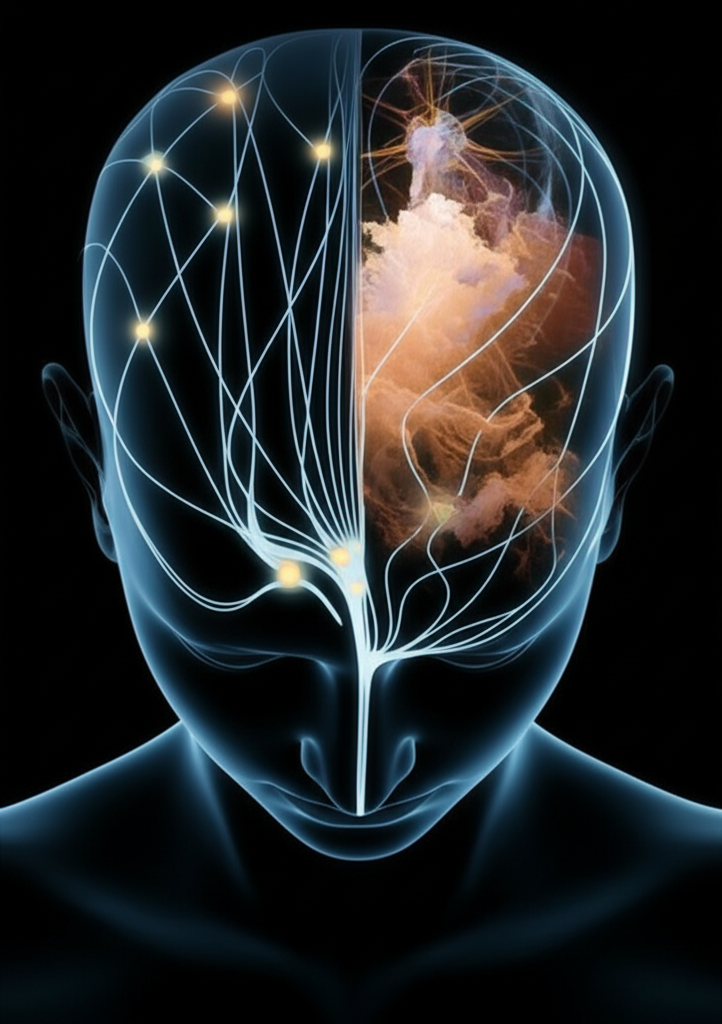
The heart of the mind-body problem lies in the irreducible nature of subjective experience. Science excels at objective measurement and analysis, breaking down phenomena into their constituent parts. However, the experience of "what it is like" to be a conscious being – the first-person perspective – resists such objective dissection. We can measure brain waves, neurotransmitter levels, and neural firing patterns, but none of these directly capture the feeling of pain, the sight of blue, or the thought of a loved one.
This qualitative gap between the objective third-person data of science and the subjective first-person reality of the mind is what makes the problem so recalcitrant. It forces us to confront the limitations of our current scientific paradigms and perhaps even the very language we use to describe reality.
Conclusion: An Ever-Evolving Quest for Self-Understanding
The mind-body problem is not merely an academic exercise; it underpins our understanding of free will, morality, identity, and the very nature of reality. While modern science has provided an astonishing wealth of data regarding the body's most complex organ, the brain, it has simultaneously clarified the profound depth of the mind's mystery. The quest to understand how a lump of biological matter gives rise to consciousness remains one of humanity's most ambitious intellectual endeavors, bridging the rigorous empiricism of science with the profound inquiries of metaphysics. As we continue to unravel the brain's intricacies, we are constantly reminded that the ultimate answer may require not just more data, but a fundamental re-evaluation of our philosophical assumptions about the mind, the body, and the universe we inhabit.
YouTube Video Suggestions:
-
📹 Related Video: ARISTOTLE ON: The Nicomachean Ethics
Video by: The School of Life
💡 Want different videos? Search YouTube for: ""The Hard Problem of Consciousness Explained""
2. ## 📹 Related Video: What is Philosophy?
Video by: The School of Life
💡 Want different videos? Search YouTube for: ""Mind Body Problem Neuroscience Philosophy""