

The Inner Sanctum: Exploring the Mind as the Seat of Memory and Imagination
The human Mind, in its most profound sense, is far more than a mere biological organ; it is the very crucible of our experience, the architect of our understanding, and the canvas upon which our inner world unfolds. This article delves into the philosophical journey of understanding the Mind as the quintessential seat of Memory and Imagination, exploring how these two indispensable faculties not only define our individual realities but also shape our collective human story. From the echoes of past experiences to the vivid construction of possible futures, memory and imagination, powered by the deeper currents of Consciousness and often linked to the enigmatic concept of the Soul, reveal the extraordinary depth of our inner lives.
Unveiling the Mind: A Philosophical Odyssey
For millennia, philosophers have grappled with the nature of the Mind. Is it synonymous with the brain? Is it an emergent property? Or is it something more ethereal, perhaps connected to the ancient notion of the Soul? From Plato's tripartite soul to Descartes' dualism, and from Locke's tabula rasa to Kant's transcendental idealism, the Great Books of the Western World offer a rich tapestry of inquiry into this most intimate yet elusive aspect of our being. What remains constant across these diverse perspectives is the recognition that the Mind is the locus of our cognitive and affective functions, fundamentally housing our capacity for remembering and creating.
Memory: The Echoes of Experience
Memory is the bedrock of identity, anchoring us to our past and providing the framework for our present. It's not merely a passive archive but an active, often reconstructive, process.
- Philosophical Perspectives on Memory:
- Plato's "Wax Tablet": In Theaetetus, Plato famously likens memory to impressions made on a wax tablet, suggesting a physical inscription of experience.
- Aristotle's Impressions: Aristotle, in On the Soul, views memory as a retention of "impressions" of sensations, yet he also acknowledges its active role in recall.
- Augustine's Vast Palace: St. Augustine, in his Confessions, describes memory as a vast, magnificent palace, containing countless images, ideas, and even the very faculty of remembering itself. For him, it is almost limitless and deeply spiritual.
- Locke's Association of Ideas: John Locke, a key figure in empiricism, posits that memory is the power to revive ideas that have been previously perceived, often through the association of these ideas.
Memory allows us to learn, to grow, and to maintain a coherent sense of self across time. Without it, each moment would be utterly new, and the concept of personal identity would dissolve. It is the repository of our knowledge, our skills, and our emotional history, constantly shaping our conscious experience.
Imagination: The Architect of Possibility
If memory looks backward, Imagination gazes forward and sideways, constructing new realities, envisioning alternatives, and fueling creativity. It is the faculty that allows us to transcend the immediate and the actual.
- The Diverse Roles of Imagination:
- Creative Power: From the artist's brush to the scientist's hypothesis, imagination is the engine of creation, allowing us to conceive of things that do not yet exist.
- Empathy and Understanding: It enables us to step into another's shoes, to understand perspectives different from our own, fostering connection and insight.
- Problem-Solving: By picturing various scenarios and outcomes, imagination is crucial for planning, decision-making, and navigating complex challenges.
- Philosophical Speculation: Philosophers themselves rely heavily on imagination to construct thought experiments, explore ethical dilemmas, and conceive of ideal societies or fundamental truths. Kant, for instance, spoke of the transcendental imagination's role in synthesizing sensory data into coherent experience.
Imagination is not mere fantasy; it is a fundamental cognitive tool that allows us to manipulate mental images, concepts, and ideas, leading to innovation, empathy, and a richer understanding of the world's potential.
The Interplay: Memory, Imagination, and Consciousness
The true power of the Mind emerges from the dynamic interplay between Memory and Imagination. Our Consciousness is not a static state but a flowing stream, constantly informed by what we remember and what we can imagine.
Consider the following connections:
| Faculty | Primary Function | Relationship to Other Faculties |
|---|---|---|
| Memory | Recalling past experiences, knowledge, and skills | Provides the raw material (past experiences, learned concepts) for imagination to manipulate and reconfigure. |
| Imagination | Constructing new images, ideas, and scenarios | Utilizes elements from memory to build novel combinations. It can also reshape or reinterpret memories, influencing their meaning. |
| Consciousness | The state of being aware of one's existence and surroundings | The overarching framework within which memory and imagination operate, allowing us to experience, reflect, and create our inner world. |
This intricate dance allows us to learn from our past, adapt to our present, and innovate for our future. Our sense of self, our personal narrative, is continuously woven from the threads of what we remember and what we project, all within the living fabric of Consciousness.
The Enigmatic Soul and Consciousness
While modern neuroscience often grounds the Mind in brain activity, the enduring philosophical questions around Consciousness and the Soul persist. Is Consciousness merely an emergent property of complex neural networks, or does it hint at a deeper, perhaps non-physical, substrate?
From ancient Greek philosophy to medieval theology, the Soul was often considered the very essence of a person, the animating principle that housed the intellect, will, Memory, and Imagination. Even in more secular philosophical traditions, the subjective, first-person experience of Consciousness remains a profound mystery, distinct from objective physical processes. Whether we speak of the Mind, the Soul, or Consciousness, we are pointing to that internal arena where our memories reside and our imaginations soar, making us uniquely human.
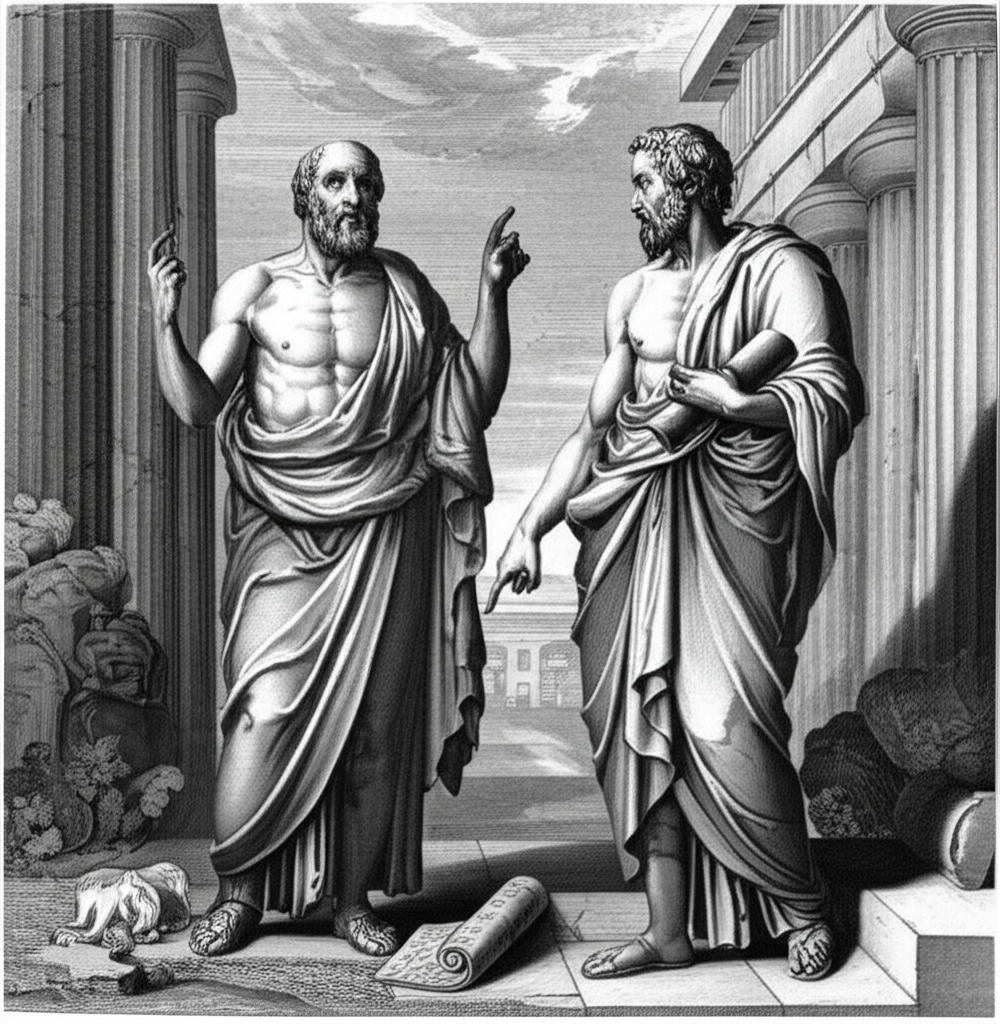 and imagination (a faint, swirling mist forming abstract shapes or distant, imagined landscapes) are interwoven into the background, signifying their foundational roles in philosophical thought.)
A Journey Through the Great Books of the Western World
The intellectual lineage concerning the Mind, Memory and Imagination is beautifully traced through the Great Books:
- Ancient Greece: Plato's Republic and Phaedrus explore the Soul's tripartite nature and its capacity for grasping eternal truths (memory of forms). Aristotle's De Anima (On the Soul) provides a systematic analysis of the soul's faculties, including sensation, imagination (phantasia), and intellect.
- Medieval Thought: St. Augustine's Confessions offers an unparalleled introspective dive into the vastness of memory and its connection to God and self.
- The Enlightenment: René Descartes' Meditations on First Philosophy famously establishes mind-body dualism, placing thought, memory, and imagination squarely within the non-extended thinking substance (the mind). John Locke's An Essay Concerning Human Understanding details the empirical origins of ideas and their storage and retrieval through memory. David Hume, in A Treatise of Human Nature, distinguishes between vivid "impressions" and fainter "ideas" (memories and imaginings), highlighting their role in shaping our understanding of reality.
- Modern Philosophy: Immanuel Kant's Critique of Pure Reason elevates the role of imagination, seeing it as crucial for synthesizing sensory experience and forming coherent perceptions.
This continuous philosophical engagement underscores the enduring significance of these faculties to our understanding of ourselves and the world.
Conclusion: The Unfolding Canvas of the Mind
The Mind, as the cherished seat of Memory and Imagination, stands as the most extraordinary frontier of human inquiry. It is here that our past is preserved, our present is interpreted, and our future is conceived. Through the intricate dance of recalling what was and envisioning what could be, fueled by the ever-present spark of Consciousness, we construct our realities, forge our identities, and propel human civilization forward. To explore the Mind's depths is to embark on a journey into the very essence of what it means to be alive, aware, and endlessly capable of creation.
📹 Related Video: PLATO ON: The Allegory of the Cave
Video by: The School of Life
💡 Want different videos? Search YouTube for: ""Plato Aristotle Mind Memory Imagination Philosophy""
📹 Related Video: PLATO ON: The Allegory of the Cave
Video by: The School of Life
💡 Want different videos? Search YouTube for: ""Consciousness and the Soul Philosophical Debates""