

The Inner Landscape: Unveiling the Mind as the Seat of Memory and Imagination
The human Mind, that enigmatic core of our being, has long captivated philosophers, poets, and scientists alike. Far from being a mere biological organ, it stands as the profound seat of our most intimate faculties: Memory and Imagination. This article delves into the rich philosophical tradition, particularly as illuminated by the Great Books of the Western World, to explore how the mind serves as both the meticulous archivist of our past and the boundless architect of our future, intrinsically linked to our very Soul and the unfolding tapestry of Consciousness.
The Mind's Dual Dominion: Memory and Imagination
At the heart of human experience lies the intricate interplay between what we remember and what we can conceive. The Mind, in its most profound sense, is where these two fundamental powers reside, shaping our understanding of reality, our sense of self, and our capacity for innovation. From the ancient Greeks pondering the nature of the Soul to Enlightenment thinkers dissecting Consciousness, the mind's role in memory and imagination has been a persistent theme, revealing its essential function in crafting our individual and collective narratives.
Ancient Echoes: The Soul's Faculties
For many classical thinkers, the Mind was inseparable from the Soul. Plato, for instance, in dialogues like the Phaedo and Republic, suggests that the soul (and thus the mind) has an innate capacity to recall perfect Forms, hinting at a deep, pre-existent memory. Aristotle, in De Anima, meticulously dissects the soul's faculties, attributing to it the powers of sensation, thought, and, crucially, both memory (mnēmē) and imagination (phantasia). For Aristotle:
- Memory is the retention of past perceptions or thoughts. It is not merely a record but an active process of recalling.
- Imagination is the faculty by which we form images, even in the absence of sensory input. It acts as a bridge between sensation and pure thought, allowing us to mentally manipulate perceived objects and create new ones.
These foundational ideas established the mind as the central processing unit, not just for immediate experience, but for the entire temporal spectrum of our existence.
The Archive of Self: Memory's Profound Depths
Augustine, in his monumental Confessions, offers one of the most poignant and extensive explorations of Memory. He marvels at its vastness, comparing it to "a great cavern, full of countless chambers," where not only images of things are stored, but also "the feelings of my mind." His introspection reveals memory as:
- A repository of sensory experiences: sights, sounds, smells, tastes, and textures.
- A storehouse of intellectual concepts: abstract ideas, mathematical truths, and philosophical principles.
- The seat of emotions and affections: where love, joy, sorrow, and fear are remembered and re-experienced.
Augustine grapples with the paradox of memory – how we can search for something within it, implying a prior knowledge of what we're looking for, yet still discover it anew. This profound inquiry highlights memory not just as a passive storage, but an active, searching faculty crucial for self-identity and the understanding of one's own Consciousness.
The Canvas of Creation: Imagination's Boundless Reach
While memory anchors us to the past, Imagination propels us into possibilities. Descartes, in his Meditations on First Philosophy, distinguishes between pure intellect and imagination, noting that imagination involves a certain "effort of the mind" to form images. While he views it as less perfect than pure understanding, he acknowledges its practical utility in dealing with the physical world.
Later empiricists like John Locke, in his Essay Concerning Human Understanding, explain how the mind, through imagination, combines "simple ideas" derived from sensory experience into "complex ideas." This process is fundamental to creativity and problem-solving:
| Faculty | Primary Function | Philosophical Significance |
|---|---|---|
| Memory | Retaining and recalling past experiences/knowledge | Foundation of personal identity, learning, and wisdom |
| Imagination | Forming mental images, creating new concepts | Source of creativity, planning, empathy, and abstract thought |
Imagination allows us to mentally rehearse actions, envision future scenarios, empathize with others by placing ourselves in their shoes, and even construct entirely new worlds, as seen in literature, art, and scientific hypotheses. It is the engine of human innovation and the wellspring of our capacity for empathy.
Consciousness: The Unifying Thread
The faculties of Memory and Imagination are not isolated functions but deeply interwoven within the broader fabric of Consciousness. Our conscious experience is a continuous stream, where past recollections inform present perceptions, and future imaginings guide our actions. The Mind orchestrates this symphony, allowing us to construct a coherent sense of self and reality.
The ongoing philosophical debate regarding the nature of Consciousness often circles back to these two faculties. How does the mind create a subjective experience from raw data? How do we know we are the same person who experienced something yesterday? Memory provides the continuity, while imagination allows for the anticipation of tomorrow, both crucial elements in the unfolding narrative of our conscious lives. The very concept of the Soul as an enduring essence often relies on the continuity of memory and the unique imaginative capacity that defines individual consciousness.
Conclusion: The Enduring Mystery of the Mind
The journey through the Great Books of the Western World reveals a consistent fascination with the Mind as the unparalleled seat of Memory and Imagination. From Plato's ideal Forms to Augustine's labyrinthine memory, and from Aristotle's functional analysis to Descartes' introspective distinctions, philosophers have grappled with the profound implications of these faculties. They underscore the mind's pivotal role not just in Consciousness but in shaping our very humanity, connecting us to our past, empowering us in the present, and inspiring us towards an imagined future. The mind remains our most precious inner landscape, a testament to the enduring mystery and power of human thought.
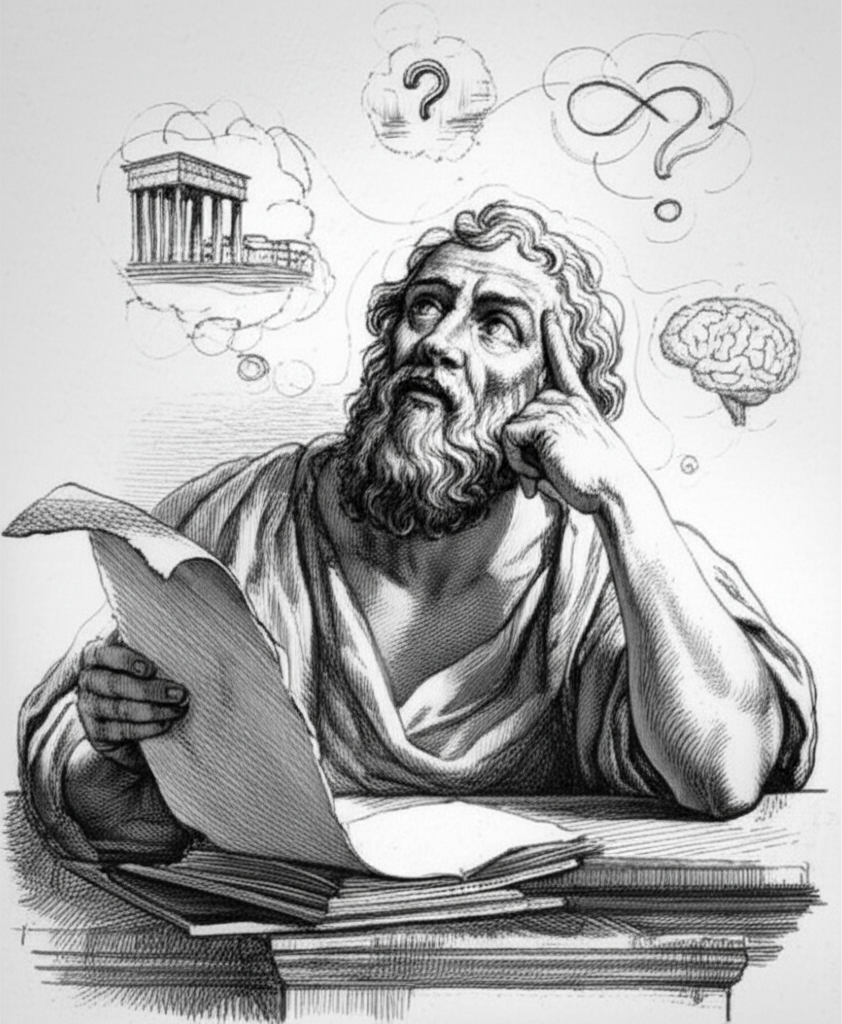 , a vivid imaginative scene (e.g., a winged creature or a new architectural design), and perhaps a glowing light representing consciousness, all emanating from the figure's mind.)
📹 Related Video: PLATO ON: The Allegory of the Cave
Video by: The School of Life
💡 Want different videos? Search YouTube for: ""Plato Aristotle Memory Imagination Philosophy""
📹 Related Video: KANT ON: What is Enlightenment?
Video by: The School of Life
💡 Want different videos? Search YouTube for: ""Augustine Confessions Memory Consciousness""