

Beyond the Particular: Unpacking the Metaphysical Status of Universal Ideas
The metaphysical status of universal ideas is a cornerstone debate in philosophy, challenging us to consider the fundamental nature of reality and how we understand the world. At its heart, this discussion grapples with whether general concepts like "redness," "humanity," or "justice" exist independently of our minds and the specific instances of them we encounter, or if they are merely mental constructs or linguistic conveniences. This article delves into the historical perspectives and ongoing relevance of this profound philosophical puzzle.
The Enduring Question of Universals and Particulars
From ancient Greece to modern analytic philosophy, thinkers have wrestled with the relationship between the universal and the particular. When we see a red apple, a red car, and a red rose, we recognize them all as sharing the quality of "redness." But what is this "redness"? Is it an independent entity, a Form existing in some transcendent realm? Is it a property inherent in the objects themselves? Or is it simply a word we use to group similar experiences? This question about the metaphysical reality of shared qualities – or universal ideas – forms the bedrock of the "problem of universals."
Ancient Roots: Plato's Forms and Aristotle's Immanent Universals
The earliest and arguably most influential discussions on the metaphysical status of universals trace back to the ancient Greek philosophers, whose works are foundational to the Great Books of the Western World.
Plato and the Realm of Forms
Plato, as presented in dialogues like The Republic and Phaedo, proposed a radical solution: universal ideas exist as perfect, unchanging, and eternal Forms (or Ideas) in a non-physical, transcendent realm.
- For Plato, the "redness" we perceive in objects is merely an imperfect copy or participation in the perfect, eternal Form of Redness.
- Similarly, the Form of Justice or the Form of Beauty exists independently of any just act or beautiful object in the sensible world.
- These Forms are more real than the fleeting particulars we experience through our senses; they are the true objects of knowledge.
Aristotle's Grounded Approach
Aristotle, Plato's most famous student, offered a significant counter-argument. While acknowledging the reality of universals, he rejected Plato's separate realm of Forms. For Aristotle, universal ideas do not exist apart from the particular things in which they are instantiated.
- The "redness" of an apple is in the apple itself; it is an immanent quality.
- We abstract the universal idea of "redness" from observing many red particulars.
- Aristotle's view is often called "moderate realism" or "immanent realism," where universals exist, but only in the particulars they qualify. The Form of a thing is inseparable from its matter.
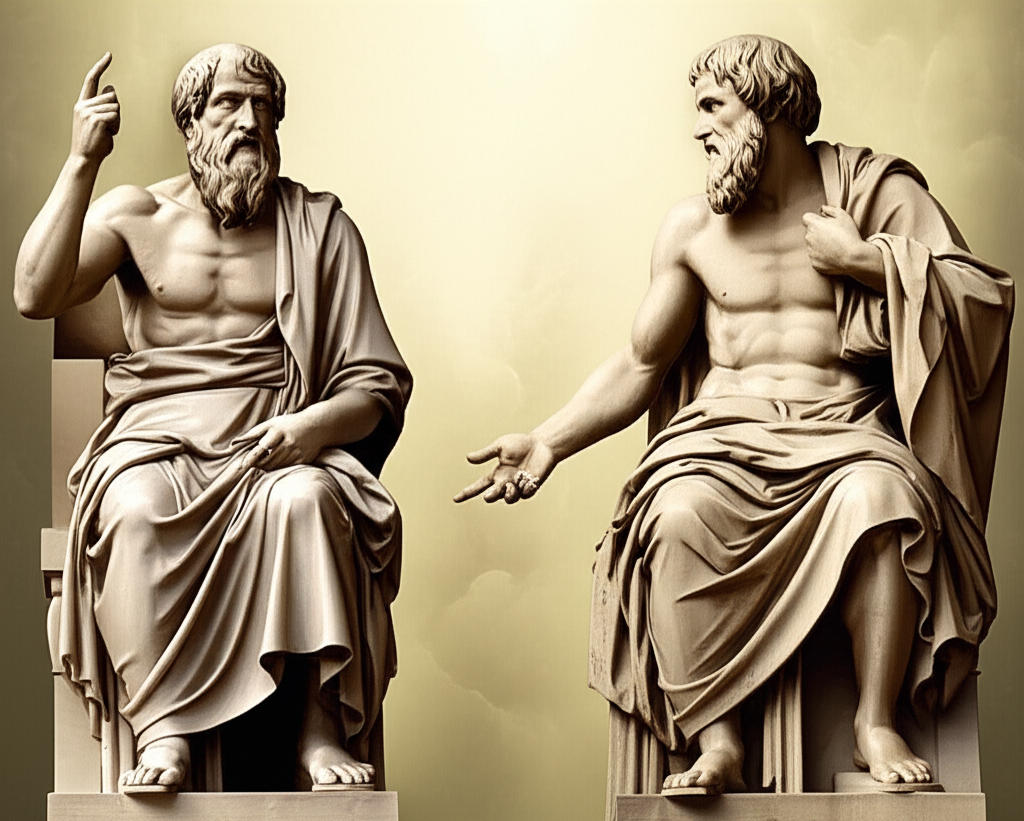
Medieval Debates: Realism, Nominalism, and Conceptualism
The problem of universals continued to animate philosophical discourse throughout the Middle Ages, with scholastic thinkers developing sophisticated arguments building upon or reacting to Plato and Aristotle. This period saw the crystallisation of three main positions regarding the metaphysical status of universal ideas:
1. Realism (Platonic and Aristotelian)
- Platonic Realism (Extreme Realism): Universals exist as separate, transcendent entities (e.g., St. Augustine, who saw Platonic Forms as ideas in the mind of God).
- Aristotelian Realism (Moderate Realism): Universals exist within particulars, not separately, and are abstracted by the mind (e.g., Thomas Aquinas).
2. Nominalism
- Core Idea: Universals are merely names, words, or labels that we apply to collections of similar particulars. They have no independent existence, either in a separate realm or within the particulars themselves.
- Key Proponent: William of Ockham, famous for "Ockham's Razor," argued that positing the existence of universal entities was an unnecessary multiplication of entities. For Ockham, only particulars truly exist. The idea of "humanity" is just a sound or a mental concept without a corresponding external universal reality.
3. Conceptualism
- Core Idea: Universals exist only as concepts in the mind. They are not external realities (like realists claim) but are more than mere names (like nominalists claim).
- Relationship to Nominalism: Often seen as a milder form of nominalism, conceptualism acknowledges the mental reality of general ideas, but denies their external, independent existence.
Modern Perspectives: Empiricism and the Challenge to Innate Ideas
The Enlightenment brought new perspectives, particularly from British empiricists who questioned the source and nature of our ideas.
- John Locke, in his Essay Concerning Human Understanding, argued that all our ideas originate from experience. He suggested that complex ideas, including general ones, are formed by the mind through abstraction from sensory input. While he believed in "abstract general ideas," their existence was mental, not external.
- George Berkeley, taking empiricism further, famously argued "to be is to be perceived." For Berkeley, there are no abstract general ideas existing independently. We only perceive particular instances. The "universal" is a mental operation, not a separate entity.
- David Hume pushed this to its logical conclusion, suggesting that we have no genuine idea of a universal beyond a particular image to which we attach a general term.
These empiricist views largely leaned towards forms of nominalism or conceptualism, challenging the notion of mind-independent universal ideas.
Why Does the Metaphysical Status of Universals Still Matter?
The debate over universals isn't just an arcane philosophical exercise; it has profound implications for:
- Epistemology (Theory of Knowledge): How can we have knowledge of general truths (e.g., scientific laws, mathematical principles) if only particulars exist?
- Philosophy of Language: How do general terms ("tree," "virtue") acquire meaning if there's no corresponding universal?
- Ethics: If there's no universal Form of Justice or Goodness, are moral values merely subjective or culturally relative?
- Science: Do scientific laws describe universal properties of the world, or are they just useful predictions about particulars?
Understanding the metaphysical status of universal ideas forces us to confront fundamental questions about the nature of reality, our minds, and the very language we use to describe the world. Whether universals are transcendent Forms, immanent properties, mental constructs, or mere names, the conversation continues to shape our philosophical landscape.
📹 Related Video: What is Philosophy?
Video by: The School of Life
💡 Want different videos? Search YouTube for: ""Problem of Universals Explained Philosophy" for an overview of the main positions."
📹 Related Video: PLATO ON: The Allegory of the Cave
Video by: The School of Life
💡 Want different videos? Search YouTube for: ""Plato's Theory of Forms vs Aristotle's Metaphysics" for a comparison of the ancient giants."