

The Elusive Essence: Unpacking the Metaphysical Status of Universal Ideas
The metaphysical status of universal ideas is a foundational philosophical inquiry that asks whether general concepts, such as "redness," "justice," or "humanness," exist independently of the particular instances we observe, or if they are merely mental constructs or names we apply. This ancient problem, central to metaphysics, profoundly influences our understanding of reality, knowledge, language, and even the very fabric of existence. It challenges us to confront the nature of Universal and Particular, prompting a deep dive into what constitutes an Idea and the role of Form in our perception of the world.
The Enduring Problem of Universals: A Primal Inquiry
Let's be honest, we all use universal terms daily. We speak of "trees" or "courage" as if these concepts have a shared meaning that transcends any single oak or brave act. But what is that shared meaning? Does "tree-ness" exist as a separate entity somewhere, or is it just a convenient label we've invented to group similar particulars? This is the heart of the problem of universals, a philosophical Gordian knot that has puzzled thinkers for millennia. It's not just an academic exercise; our answer to this question shapes everything from scientific classification to ethical reasoning.
Plato's Realm of Forms: Ideas as Archetypes
Perhaps the most famous and influential answer comes from Plato, who, as explored in the Great Books of the Western World (e.g., Phaedo, Republic), posited the existence of Forms (or Ideas). For Plato, universals are not mere mental constructs but independently existing, perfect, and unchanging entities dwelling in a non-physical realm.
- Key Tenets of Platonic Forms:
- Transcendent: They exist apart from the physical world.
- Perfect and Unchanging: Unlike their imperfect, transient earthly manifestations.
- Archetypal: Particular objects "participate" in or "imitate" these perfect Forms. A beautiful flower is beautiful because it partakes in the Form of Beauty.
- Knowable through Reason: Access to these Forms is through intellect, not sensory experience.
For Plato, the Idea of Justice or the Form of a Circle is more real than any specific just act or drawn circle. This radical metaphysics suggests that the true reality lies beyond our immediate perception, providing a stable ground for knowledge and morality.
Aristotle's Immanent Universals: Form in the Particular
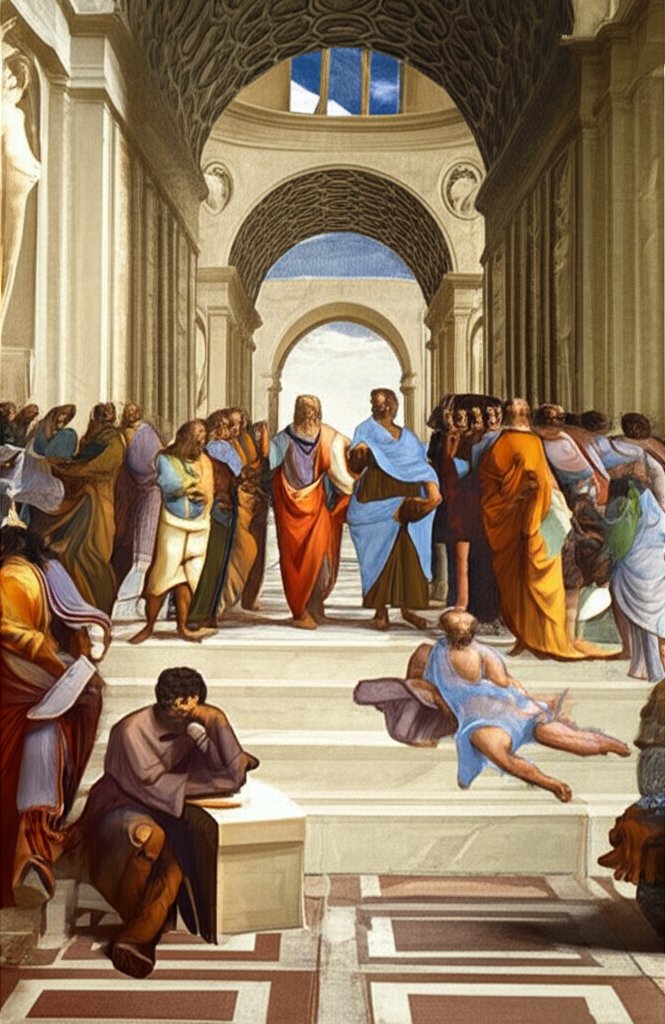
Aristotle, Plato's most famous student, offered a significant counter-perspective, detailed in works like Categories and Metaphysics from the Great Books of the Western World. While he agreed that universals are real, he disagreed with their separate existence. For Aristotle, the Form of a thing is not separate from the thing itself; it is immanent within the particular.
Consider a human being. For Aristotle, "humanness" (the universal) doesn't exist in a separate realm but is intrinsic to every individual human (the particular). It's the essence that makes a human a human.
- Key Tenets of Aristotelian Universals:
- Immanent: Universals exist in the particulars they characterize.
- Empirically Derived: We come to know universals by observing and abstracting from many particulars.
- Essential Properties: They represent the essential properties of things, defining what something is.
- No Separate Realm: There is no separate "World of Forms."
Aristotle's approach grounds universals in the observable world, making them accessible through empirical investigation and logical analysis. The metaphysics shifts from a transcendent reality to one firmly rooted in our shared experience.
The Medieval Crossroads: Nominalism vs. Realism
The debate over universals continued fiercely throughout the Middle Ages, shaping much of scholastic philosophy. This period saw the development of distinct positions:
| Philosophical Position | Core Belief Regarding Universals | Key Proponents (Examples) |
|---|---|---|
| Extreme Realism | Universals exist independently of particulars and the mind (Platonic view). | Anselm of Canterbury |
| Moderate Realism | Universals exist within particulars, but can be abstracted by the mind (Aristotelian view). | Thomas Aquinas |
| Conceptualism | Universals exist only as concepts in the mind, formed by abstraction from particulars. | Peter Abelard |
| Nominalism | Universals are mere names or labels, linguistic conventions with no objective reality. | William of Ockham |
Nominalism, in particular, challenged the very notion of universals having any independent reality, arguing that only particulars exist. The Idea of "cat" is simply a word we use to group individual cats; there is no abstract "cat-ness." This perspective, famously associated with William of Ockham (Ockham's Razor), had profound implications for theology, logic, and the nascent sciences.
Why Does It Matter? The Enduring Impact of Universal Ideas
You might be thinking, "This is all very interesting, but why should I care about whether 'redness' exists independently?" The truth is, the metaphysical status of universal ideas impacts far more than just abstract philosophical discussions:
- Science and Classification: How do we classify species, elements, or diseases? Are these classifications merely human constructs, or do they reflect real, underlying universals in nature?
- Language and Meaning: How do words acquire meaning? If universals don't exist, how do we communicate effectively using general terms? Does language create universals, or merely describe them?
- Ethics and Morality: Are concepts like "justice," "goodness," or "human rights" universal truths, or are they culturally relative constructs? The answer often hinges on one's stance on universals.
- Artificial Intelligence: When AI learns to identify a "chair," is it recognizing a universal Form, abstracting an Idea, or simply processing patterns in particular images?
The problem of Universal and Particular continues to resonate in modern thought, challenging us to define the boundaries between mind, language, and reality.
Navigating the Labyrinth of Existence
The metaphysical status of universal ideas remains one of philosophy's most persistent and fascinating challenges. From Plato's transcendent Forms to Aristotle's immanent essences, and through the medieval debates to contemporary analyses, thinkers have grappled with whether our shared concepts point to an independent reality or are merely tools of the mind. There is no easy answer, no universally accepted solution. Instead, we find ourselves grappling with the profound implications of each perspective, recognizing that our understanding of Idea, Form, and the very nature of Metaphysics is inextricably linked to how we choose to define the existence of universals. It is a journey into the very structure of being, a testament to humanity's relentless quest to understand the world and our place within it.
📹 Related Video: What is Philosophy?
Video by: The School of Life
💡 Want different videos? Search YouTube for: ""The Problem of Universals Explained - Crash Course Philosophy""
📹 Related Video: PLATO ON: The Allegory of the Cave
Video by: The School of Life
💡 Want different videos? Search YouTube for: ""Plato's Theory of Forms vs. Aristotle's Metaphysics - A Deep Dive""