

The Enduring Enigma of Universal Forms: A Metaphysical Inquiry
The question of universal forms stands as one of the most persistent and profound challenges in metaphysics. At its heart lies the puzzle of how seemingly disparate particular things can share common qualities. How can countless individual red objects all possess "redness"? What is the metaphysical status of this shared quality? Is "redness" merely a word we use, or does it exist in some deeper, more fundamental sense? This inquiry, stretching back to ancient Greece and resonating through every epoch of philosophical thought, compels us to confront the very nature of reality, knowledge, and language. Understanding the relationship between the universal and particular is not merely an academic exercise; it dictates how we perceive, categorize, and ultimately comprehend the world around us.
Unpacking the Problem: What Are Universals?
Imagine a vast collection of objects: a specific apple, a fire truck, a stop sign, a ruby. Each is a particular entity, unique in its spatial and temporal coordinates. Yet, we readily identify a shared attribute among them: redness. Similarly, we speak of "humanity," "justice," "beauty," or "triangularity." These are universals – properties, qualities, relations, or kinds that can be instantiated by multiple particular things.
The core problem, often termed the "Problem of Universals," asks:
- Do these shared qualities (universals) exist independently of the particular things that exemplify them?
- If so, where and how do they exist?
- If not, how do we account for our ability to recognize and name commonalities?
This seemingly abstract debate has profound implications for our theories of knowledge (epistemology), language, and even the very fabric of existence.
The Ancient Foundations: Plato and Aristotle
The most foundational responses to the problem of universals emerge from the towering intellects of Plato and Aristotle, both extensively explored within the Great Books of the Western World. Their differing views established a dichotomy that continues to shape philosophical discourse.
Plato's Realm of Eternal Forms (Ideas)
For Plato, the universal was more real than the particular. Influenced by Socrates' search for stable definitions, Plato posited a transcendent realm of perfect, immutable Forms (or Ideas). These Forms are not mental constructs but independently existing entities, serving as the blueprints or archetypes for everything we perceive in the sensory world.
- Metaphysical Status: Forms exist independently of human minds and the physical world. They are eternal, unchanging, non-spatial, and non-temporal.
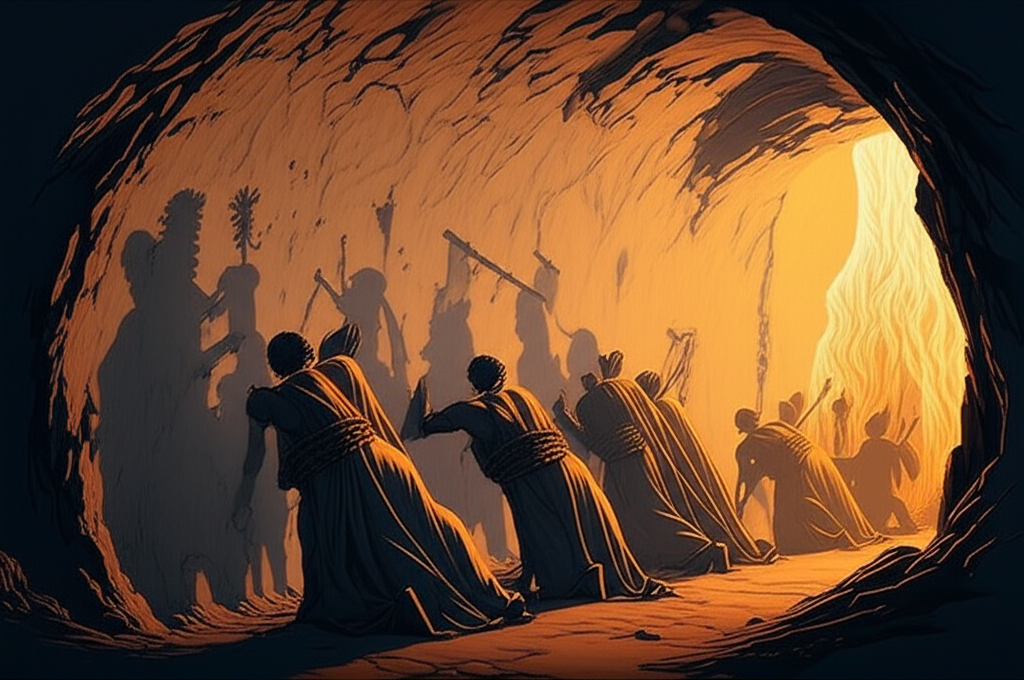
- Nature of Reality: The true reality resides in the intelligible realm of Forms. The physical world is merely a shadow or imperfect copy of this higher reality.
- Relationship to Particulars: Particular objects "participate in" (μετέχειν) or "imitate" (μιμεῖσθαι) their corresponding Forms. A beautiful person is beautiful because they participate in the Form of Beauty.
- Knowledge: True knowledge (episteme) is of the Forms, accessed through intellect and reason, not sensory experience.
- Key Concept: The Idea of a thing (e.g., the Idea of a perfect circle) is more real and perfect than any particular circle we can draw.
Aristotle's Immanent Forms
Aristotle, Plato's most famous student, offered a radical departure. While acknowledging the reality of shared qualities, he rejected the notion of a separate realm of Forms. For Aristotle, the Form of a thing is not transcendent but immanent – it exists within the particular object itself.
- Metaphysical Status: Forms do not exist separately from particulars. They are the essence or "whatness" of a thing, inseparable from its matter.
- Nature of Reality: Reality is found in the concrete, individual substances we perceive. The Form gives structure and definition to matter, making a thing what it is.
- Relationship to Particulars: The Form and matter are co-principles of a substance. We abstract the universal Form from observing many particulars. For example, by observing many individual humans (particulars), we discern the Form of "humanity" (universal) inherent in each.
- Knowledge: Knowledge begins with sensory experience. Through observation and abstraction, our intellect apprehends the Forms embedded in particulars.
- Key Concept: The Form of "humanness" exists only in individual humans, not in some separate heavenly realm.
Comparing Plato and Aristotle on Forms
| Feature | Plato's View | Aristotle's View |
|---|---|---|
| Location of Forms | Transcendent (separate, intelligible realm) | Immanent (within particular objects) |
| Existence | Independent of particulars and minds | Dependent on particulars for existence |
| Nature | Perfect, eternal, unchanging, non-physical | The essence or "whatness" of a thing, inseparable from matter |
| Relationship to World | Archetypes/Blueprints; particulars "participate" | Co-principle with matter; actualizes potential |
| Path to Knowledge | Reason, intellect, recollection | Sensory experience, observation, abstraction |
The Enduring Debate: From Medieval Scholasticism to Modern Thought
The differing approaches of Plato and Aristotle laid the groundwork for centuries of philosophical debate, particularly during the medieval period.
- Realism: Broadly aligns with Plato's view, asserting that universals exist independently of particulars and minds. Extreme Realism (Platonic) holds they exist in a separate realm. Moderate Realism (Aristotelian) holds they exist in particulars but are abstractable by the mind.
- Nominalism: Argues that universals are merely names or linguistic conventions, not real entities. There are only particulars. "Redness" is just a label we apply to certain objects, not a thing in itself.
- Conceptualism: A middle ground, suggesting that universals are mental concepts or ideas formed by the human mind based on similarities observed among particulars. They exist in the mind, but are not arbitrary.
This historical trajectory demonstrates the profound grip the problem of universals has had on philosophical inquiry. It touches upon:
- Philosophy of Language: How do general terms refer to things?
- Philosophy of Mind: How do we form general concepts?
- Science: What is the metaphysical status of scientific laws or species classifications?
The Enduring Significance of the Metaphysical Status of Universal Forms
Why does this ancient debate continue to captivate us? Because the answer to the metaphysical status of universal forms fundamentally shapes our understanding of reality, knowledge, and our place within the cosmos.
If universals exist independently, it suggests a more ordered, perhaps even divinely structured, universe where objective truths and essences are foundational. If they are merely names or mental constructs, it shifts the focus to human cognition and language as the architects of our perceived order, potentially leading to forms of relativism.
The journey through the problem of universals, from the Great Books' insights of Plato and Aristotle to the nuanced positions of later philosophers, is a testament to philosophy's persistent quest to understand the most fundamental aspects of existence. It compels us to ask: What truly exists? And how do we know it? These are questions that will forever stir the minds of those who dare to delve into the depths of metaphysics.
📹 Related Video: PLATO ON: The Allegory of the Cave
Video by: The School of Life
💡 Want different videos? Search YouTube for: ""Plato's Theory of Forms Explained""
📹 Related Video: ARISTOTLE ON: The Nicomachean Ethics
Video by: The School of Life
💡 Want different videos? Search YouTube for: ""Aristotle's Metaphysics: Substance and Form""