
The Enduring Question of Universals: What Are They, Really?
The metaphysical status of universal forms stands as one of philosophy's most enduring and perplexing questions. At its heart, this debate grapples with the fundamental nature of reality: whether general concepts, properties, or kinds—such as "redness," "humanity," or "triangularity"—exist independently of the particular instances that embody them. From the ancient Greeks to contemporary thought, philosophers have wrestled with the relationship between the Universal and Particular, seeking to understand if these abstract Forms or Ideas possess a genuine existence beyond the individual objects we perceive. This article will explore the core arguments within Metaphysics concerning universals, tracing their lineage from classical thought and highlighting why this intellectual pursuit remains profoundly significant.
Unpacking the Problem: Universal vs. Particular
Before diving into the historical responses, it's crucial to clarify the distinction that underpins the entire discussion.
- Particulars: These are individual, specific things that exist in space and time. Examples include this specific red apple, that particular human being named Socrates, or the triangle drawn on this piece of paper. Particulars are unique and concrete.
- Universals: These are general properties, qualities, or relations that can be instantiated by multiple particulars. "Redness" is a universal because many different objects (apples, cars, shirts) can be red. "Humanity" is a universal shared by all human beings. "Triangularity" is a universal shared by all triangles.
The "problem of universals" asks: What is the nature of these universals? Do they exist? If so, where and how? Are they mind-independent realities, or merely concepts in our minds, or even just names we apply?
Plato's Transcendent Forms: The Realm of Ideas
One of the earliest and most influential answers to the problem of universals comes from Plato, whose theory of Forms (often translated as Ideas) postulates a realm of perfect, eternal, and unchanging essences existing independently of the physical world.
Plato argued that the objects we perceive in the sensory world are mere imperfect copies or shadows of these true Forms. For instance, any beautiful object we see is beautiful only insofar as it "participates" in the singular, perfect Form of Beauty.
Key Characteristics of Platonic Forms:
- Transcendent: They exist outside of space and time, in a separate, non-physical realm.
- Perfect and Unchanging: Unlike the mutable particulars of our world, Forms are immutable and ideal.
- Archetypal: They serve as the perfect blueprints or paradigms for all particulars.
- Graspable by Intellect: Forms are not perceived through the senses but apprehended through reason and philosophical contemplation.
For Plato, these Forms are the ultimate reality, and understanding them is the highest aim of philosophy. The metaphysical status of "humanity" for Plato is not found in individual humans, but in the perfect Form of Man, which all humans imperfectly embody. This foundational concept, extensively discussed in works like The Republic and Phaedo within the Great Books of the Western World, established a powerful realist position regarding universals.
Aristotle's Immanent Forms: Universals Within Particulars
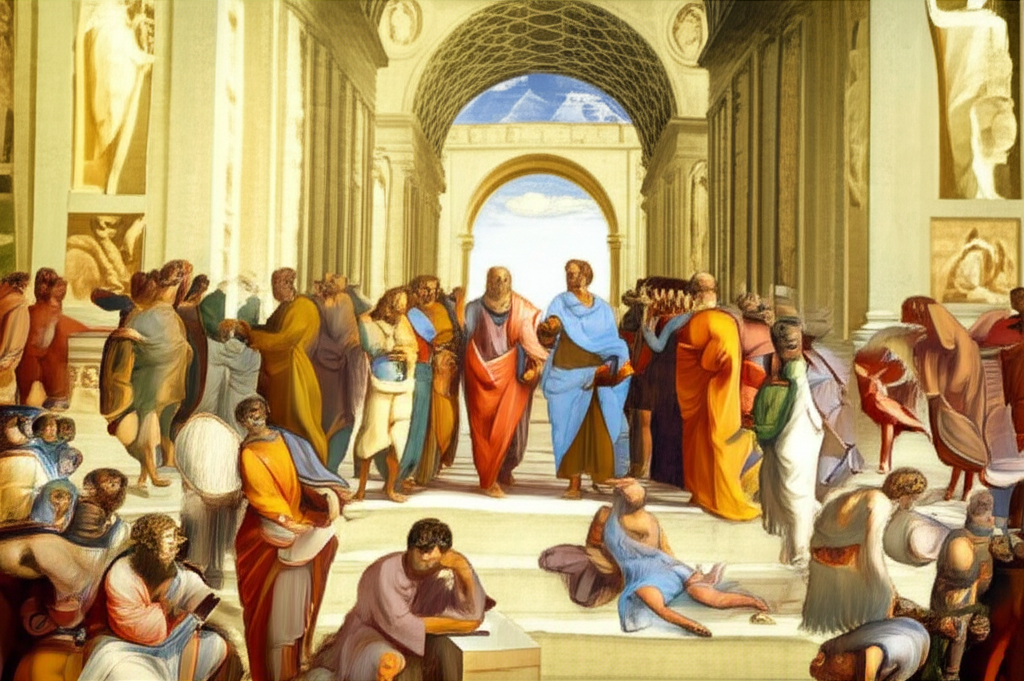
Plato's most famous student, Aristotle, offered a profound critique of his teacher's theory, proposing an alternative account of Form that dramatically shifted the discussion. While Aristotle agreed that Forms (or essences) are crucial for understanding reality, he rejected the notion of their separate, transcendent existence.
For Aristotle, the Form of a thing is not separate from it but is immanent within the particular object itself. The Form of "humanity" is not in some ethereal realm; it is inherent in every individual human being, making them the kind of thing they are.
Key Differences from Plato:
- Immanent: Forms exist in particulars, not separate from them. They are the essential structure or nature of a thing.
- Inseparable from Matter: Aristotle argued that substances are a composite of Form and matter. The Form gives matter its specific structure and purpose, while matter provides the potential for that Form to be realized.
- Discovered through Observation: We come to understand universals by abstracting them from our experience of many particulars, not by accessing a separate realm.
Aristotle's approach, detailed in his Metaphysics and Categories (also central to the Great Books canon), represents a moderate realism, where universals are real but are found in the world of experience, not apart from it. The Idea of a species, for instance, is the shared essence found in all members of that species.
The Medieval Debate: Realism, Nominalism, and Conceptualism
The problem of universals continued to dominate philosophical discourse through the Middle Ages, with scholars refining and debating the Platonic and Aristotelian legacies.
| Philosophical Position | View on Universals | Proponents (Examples) |
|---|---|---|
| Extreme Realism | Universals exist independently of particulars and the mind. | Plato, Anselm |
| Moderate Realism | Universals exist in particulars, not separately. | Aristotle, Thomas Aquinas |
| Nominalism | Universals are mere names or words; only particulars exist. | William of Ockham, Roscelin of Compiègne |
| Conceptualism | Universals exist as concepts in the mind, abstracted from particulars. | Peter Abelard (often seen as a bridge) |
This period saw the rise of Nominalism, a radical challenge to both Platonic and Aristotelian realism. Nominalists argued that universals are nothing more than mental constructs or linguistic labels. There is no actual "redness" existing out there; there are just many red things, and we apply the word "red" to them. This position significantly impacts Metaphysics by denying the objective existence of Forms or Ideas beyond individual entities.
The Enduring Significance of Universal Forms
The debate over the metaphysical status of universal forms is far from an academic exercise confined to ancient texts. Its implications ripple through various branches of philosophy and even science:
- Epistemology: How do we acquire knowledge of general truths if only particulars exist? How can we know that all triangles have three sides if we've only ever seen individual triangles?
- Logic: What do universal propositions ("All humans are mortal") refer to? Do they describe relationships between abstract universals or merely summarize observations about particulars?
- Ethics: Do universal moral principles (e.g., "Justice is good") exist independently, or are they culturally constructed?
- Science: When scientists classify species or identify laws of nature, are they discovering objective universals, or are these classifications merely human constructs for organizing particulars?
- Language: How does language, which relies heavily on general terms, relate to the structure of reality? Does the existence of the word "tree" imply the existence of "treeness"?
Understanding the Universal and Particular distinction and the various theories concerning the Form or Idea of universals is fundamental to grasping the deepest questions of Metaphysics. Whether we lean towards a world populated by transcendent Forms, immanent essences, or merely a collection of unique particulars grouped by human convention, our choice profoundly shapes our understanding of reality itself.
This centuries-old conversation, deeply embedded in the Great Books of the Western World, continues to challenge and inspire, prompting us to critically examine the very fabric of existence and the tools we use to comprehend it.
📹 Related Video: PLATO ON: The Allegory of the Cave
Video by: The School of Life
💡 Want different videos? Search YouTube for: "Plato's Theory of Forms Explained"
📹 Related Video: PLATO ON: The Allegory of the Cave
Video by: The School of Life
💡 Want different videos? Search YouTube for: "The Problem of Universals: Nominalism vs. Realism"