

The Enduring Enigma: Unpacking the Metaphysical Status of Universal Forms
The question of "universal forms" strikes at the very heart of metaphysics, probing the fundamental nature of reality itself. Are the shared qualities we observe in the world—such as "redness," "justice," or "cat-ness"—mere mental constructs, or do they possess an independent existence beyond our minds and the particular objects that exemplify them? This article delves into the historical and philosophical debate surrounding the metaphysical status of these universal concepts, exploring the monumental contributions of Plato and Aristotle, and tracing the profound implications of their divergent views on our understanding of Form and Idea.
The Problem of Universals: A Core Metaphysical Challenge
At its core, the problem of universals asks: what is the nature of properties, kinds, and relations that can be exemplified by multiple particular things? When we say "Socrates is a man" and "Plato is a man," what is this "man-ness" that they share? Is it a distinct entity, a shared Form, or merely a label we apply? This fundamental inquiry has been a cornerstone of philosophical thought since antiquity, shaping our understanding of knowledge, language, and existence.
Plato's Transcendent Forms: A Realm of Perfect Ideas
For Plato, the answer lay in a radical and influential theory of Forms (or Ideas). As explored in the Great Books of the Western World, particularly in dialogues like Phaedo, Republic, and Parmenides, Plato posited that universals exist as perfect, unchanging, and eternal archetypes in a separate, non-physical realm.
- Independent Existence: These Forms are not dependent on human thought or the existence of particular objects. The Form of Beauty exists whether or not beautiful things exist in our sensory world.
- Perfection and Unchangeability: Unlike the imperfect, transient things we perceive, Forms are perfect and immutable. A beautiful flower withers, but the Form of Beauty is eternal.
- Causal and Explanatory Power: Particular objects derive their nature and intelligibility by participating in or imitating these Forms. A specific cat is a cat because it partakes in the Form of Cat.
- Epistemological Significance: True knowledge (episteme) for Plato is knowledge of these eternal Forms, accessible not through the senses, but through reason and philosophical contemplation.
For Plato, the metaphysical status of universal Forms is one of ultimate reality. They are the true objects of knowledge, more real than the fleeting sensory world we inhabit.
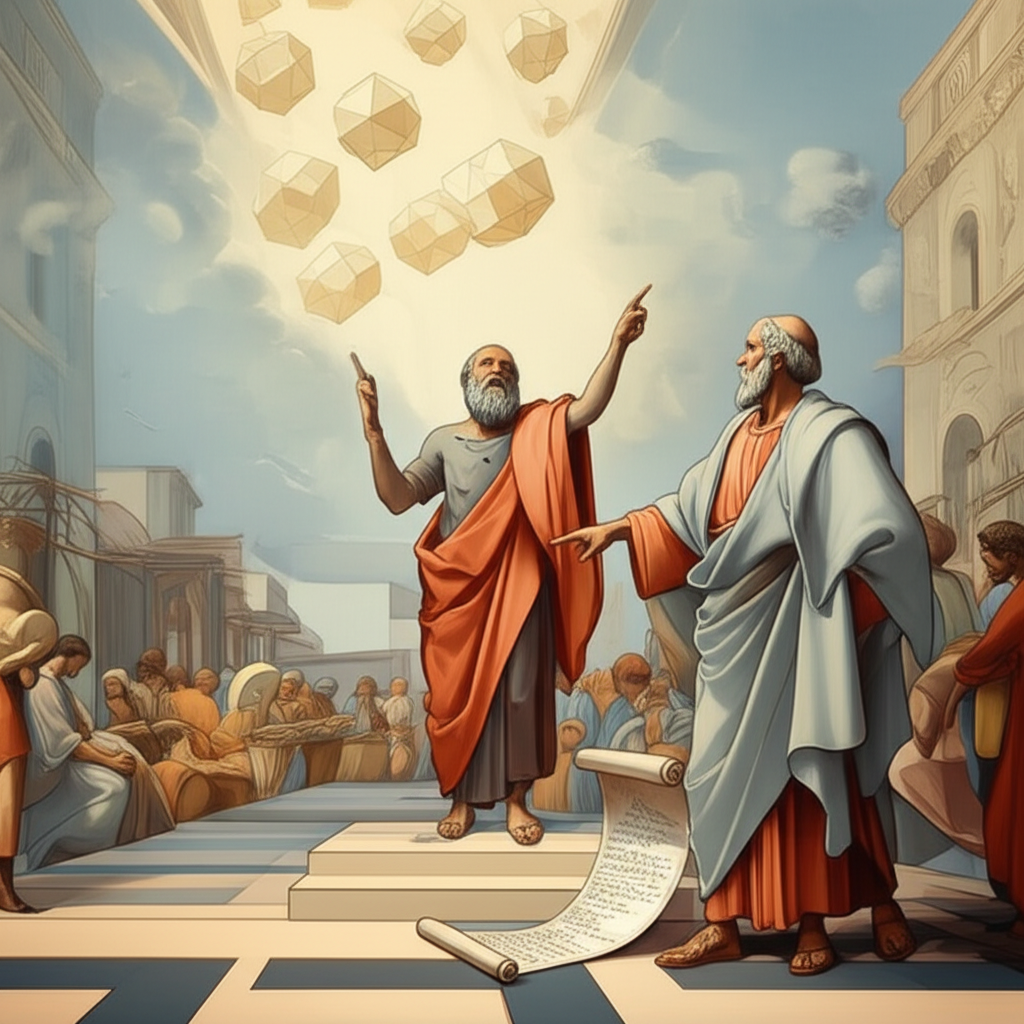
Aristotle's Immanent Forms: Universals In Particulars
Aristotle, Plato's most famous student, offered a profound critique and alternative to his teacher's theory. While accepting the reality of universals, Aristotle rejected the notion of a separate realm of Forms. For Aristotle, as detailed in texts like Metaphysics and Categories from the Great Books of the Western World, universals exist within the particular objects themselves.
Aristotle's key points include:
- Immanence, Not Transcendence: The Form of "man-ness" is not separate from individual men; it is an intrinsic part of their being. The Form of "cat" exists only in cats.
- Substance as Primary: Aristotle emphasized the individual substance (the particular thing) as primary. Universals, while real, are secondary; they are the properties and characteristics of substances.
- Empirical Discovery: We come to understand universals through abstraction from our experience of particular objects. By observing many individual cats, we can abstract the common Form of cat.
- Form and Matter: Every physical object is a composite of Form and matter. The matter is what makes it a particular thing, while the Form is what gives it its specific nature and structure.
For Aristotle, the metaphysical status of universal Forms is tied directly to their instantiation in particular things. They are real, but their reality is concrete and empirical, not transcendent.
The Enduring Debate: Realism, Nominalism, and Conceptualism
The fundamental divergence between Plato and Aristotle sparked a debate that has echoed through centuries of philosophy, manifesting in various forms:
- Platonic Realism (Extreme Realism): Universals exist independently of particulars and human minds (Plato).
- Aristotelian Realism (Moderate Realism): Universals exist within particulars and are discoverable through abstraction (Aristotle).
- Nominalism: Universals are merely names or linguistic labels we apply to collections of similar particulars. There are no actual shared properties, only similar things. The concept of "redness" is just the word "red."
- Conceptualism: Universals exist as concepts or ideas in the human mind, formed by abstracting similarities from particulars. They are not independent of the mind, nor are they mere words.
This spectrum of views highlights the complexity of determining the metaphysical status of universal Forms or Ideas. Each position grapples with how we account for the order, structure, and intelligibility of the world, as well as our ability to categorize and understand it.
Why Does the Metaphysical Status of Forms Matter?
The debate over universals is not a mere academic exercise. Its implications stretch across numerous philosophical domains:
- Epistemology: How do we acquire knowledge? If universals exist transcendentally, knowledge might be innate or recollectable. If they are immanent, knowledge comes from experience and abstraction. If they are only names, then objective knowledge of shared properties might be elusive.
- Philosophy of Language: How do general terms ("tree," "justice") refer? Do they point to a shared Form, a mental concept, or just a collection of individuals?
- Ethics: Are there universal moral principles (e.g., the Form of Justice) that transcend cultures and individuals, or are ethical norms purely conventional or subjective?
- Science: Do scientific laws describe real, universal patterns in nature, or are they convenient human constructs for predicting phenomena?
Understanding the metaphysical status of universal Forms is thus crucial for constructing a coherent philosophical worldview. It forces us to confront fundamental questions about what is real, how we know it, and how we articulate our understanding of the world.
Conclusion
From Plato's transcendent Ideas to Aristotle's immanent Forms, the journey to understand the metaphysical status of universals has been one of philosophy's most enduring quests. The tension between the universal and particular continues to fuel rigorous inquiry, reminding us that the deepest questions about reality often lie hidden in plain sight, waiting for us to unravel their profound complexities. The way we answer this question fundamentally shapes our understanding of ourselves, our knowledge, and the very fabric of existence.
📹 Related Video: PLATO ON: The Allegory of the Cave
Video by: The School of Life
💡 Want different videos? Search YouTube for: ""Plato's Theory of Forms Explained""
📹 Related Video: ARISTOTLE ON: The Nicomachean Ethics
Video by: The School of Life
💡 Want different videos? Search YouTube for: ""Aristotle Metaphysics: Form and Matter""