

The Enduring Riddle: Unpacking The Metaphysical Problem of the One and Many
Summary: The Metaphysical Problem of the One and Many stands as one of philosophy's most fundamental and persistent questions. At its core, it asks how a seemingly singular reality can manifest as diverse, individual entities, or conversely, how a multitude of distinct things can ultimately constitute a unified whole. This ancient dilemma explores the nature of Being itself, grappling with how unity and plurality coexist, and how relations bind or separate them within the grand tapestry of Metaphysics.
Introduction: A Fundamental Conundrum
From the earliest stirrings of philosophical thought, humanity has grappled with the perplexing nature of reality. We perceive a world teeming with distinct objects, unique individuals, and countless phenomena – a vibrant "many." Yet, our intellect often seeks underlying patterns, unifying principles, or even a singular, ultimate source – a fundamental "one." This tension, the profound philosophical puzzle of how the One relates to the Many, and vice versa, forms the bedrock of Metaphysics. It's a question that permeates every branch of philosophy, from cosmology to ethics, and continues to challenge our understanding of existence itself.
This article delves into the historical evolution and enduring significance of this problem, drawing insights from the venerable texts within the Great Books of the Western World that have shaped our intellectual heritage.
The Ancient Roots of the Dilemma: From Elea to Athens
The problem of the One and Many is not a modern invention; its genesis lies in the pre-Socratic inquiries into the fundamental stuff of the cosmos.
Parmenides and the Immutable One
One of the most radical early proponents of the One was Parmenides of Elea. In his seminal poem, On Nature, Parmenides argued for the absolute unity and immutability of Being. For him, what is must be singular, eternal, unchanging, indivisible, and perfect. Change, motion, and multiplicity were mere illusions of the senses, illogical and impossible in the face of pure, unadulterated Being. To say something "is not" or "becomes" implies a transition from non-being to being, which Parmenides deemed unthinkable. This profound insistence on a singular, undifferentiated reality presented the ultimate challenge to reconciling our experience of the "many."
Heraclitus and the Eternal Flux of Many
In stark contrast stood Heraclitus of Ephesus, whose famous dictum, "You cannot step into the same river twice," epitomized his philosophy of constant change and flux. For Heraclitus, reality was characterized by an eternal becoming, a ceaseless interplay of opposing forces. The Many were not an illusion but the very essence of existence, a dynamic process of strife and harmony. While he posited a unifying Logos or reason governing this change, his emphasis was firmly on the transient, multiform nature of reality.
Plato's Forms: A Synthesis and a New Problem
Plato, seeking to bridge the chasm between Parmenides' static One and Heraclitus's fluid Many, proposed his theory of Forms. For Plato, the changing, sensible world of particulars (the Many) was merely an imperfect reflection of an eternal, immutable realm of perfect Forms (the One). A particular beautiful object is beautiful because it participates in the Form of Beauty.
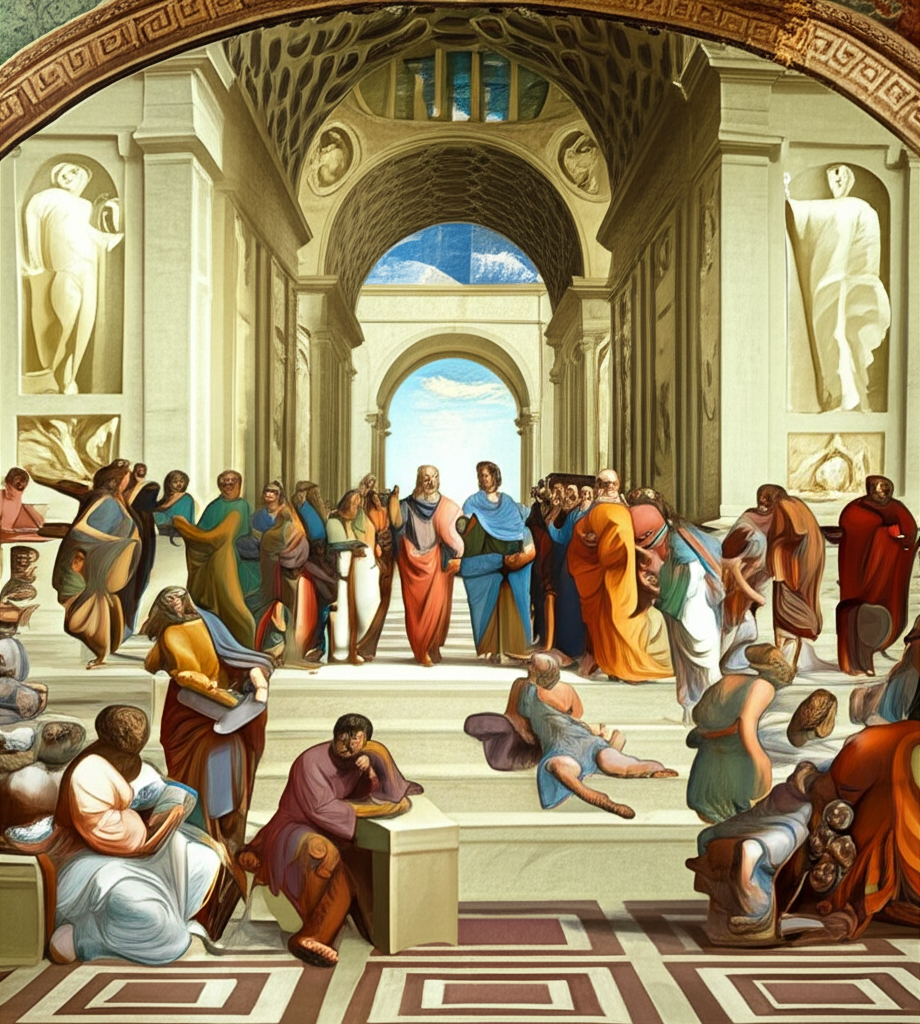
This offered a powerful framework:
- The One: The transcendent, perfect, unchanging Forms (e.g., the Form of Justice, the Form of the Good).
- The Many: The imperfect, changing particulars in the sensible world (e.g., individual just acts, individual good things).
However, Plato's solution introduced its own set of problems, notably the "Third Man Argument," which questioned the relation between a Form and its particulars – if particulars resemble a Form, must there not be another Form that explains the resemblance between the Form and its particulars, leading to an infinite regress?
Aristotle's Approach: Substance, Categories, and Relation
Aristotle, Plato's most famous student, offered a different path. While acknowledging the need for stable principles, he brought philosophy back down to earth, focusing on the individual, concrete entities we encounter.
Substance as the Primary Being
For Aristotle, the primary sense of Being resided in individual substances – a specific human, a particular tree, a unique horse. Each substance is a unified one composed of matter and form, yet it also possesses numerous attributes or properties (the many). A human is one being, but also many in terms of their height, weight, intelligence, virtues, etc. The substance itself is the fundamental unity that grounds these multiple attributes.
Categories and the Web of Relation
Aristotle's Categories provided a systematic way to understand the various ways things can be said to be. Beyond substance, he identified nine other categories (quantity, quality, relation, place, time, position, state, action, affection). The category of relation became crucial for understanding how distinct entities interact and form a coherent world. For instance, a father is defined by his relation to a child; knowledge is a relation between a knower and the known. These relations are not arbitrary but are integral to how the many are interconnected and form a larger, intelligible reality.
The Enduring Significance: From Medieval Theology to Modern Science
The problem of the One and Many continued to resonate throughout Western thought:
- Medieval Philosophy: The debate manifested in the problem of universals, asking whether universals (like "humanity" or "redness") exist independently of individual things (realism) or are merely concepts in the mind (conceptualism/nominalism). This was directly tied to understanding the unity of God and the diversity of creation.
- Early Modern Philosophy: Thinkers like Spinoza sought a singular, infinite substance (God or Nature) from which all finite modes and attributes emanate, echoing Parmenides' monism. Leibniz, conversely, proposed a universe of countless individual "monads," each a self-contained one, yet harmoniously pre-established.
- Contemporary Philosophy: The problem persists in discussions of identity, mereology (the study of parts and wholes), the nature of consciousness (how a unified self arises from diverse neural activity), and even in physics (the search for a unified field theory that explains all fundamental forces).
Key Concepts Revisited: Metaphysics, Being, Relation
The journey through the problem of the One and Many is fundamentally a journey into Metaphysics – the study of the fundamental nature of reality. It forces us to confront:
- Being: What does it mean for something to exist? Is existence singular and undifferentiated, or plural and diverse? How do we reconcile the Being of a whole with the Being of its parts?
- Relation: How do entities, whether singular or multiple, connect to one another? Are relations fundamental to reality, or are they merely mental constructs? Understanding the nature of relation is key to bridging the gap between the One and the Many.
The table below summarizes some key approaches:
| Philosopher/School | Primary Emphasis | View of "One" | View of "Many" | How they relate |
|---|---|---|---|---|
| Parmenides | Monism | Ultimate Reality | Illusionary | Many is not real, only One is |
| Heraclitus | Flux/Change | Underlying Logos | Fundamental Reality | Governed by Logos, in constant change |
| Plato | Idealism | Forms (Transcendent) | Particulars (Imperfect) | Participation of Many in One |
| Aristotle | Empiricism/Substance | Individual Substance | Attributes of Substance | Substance grounds its attributes |
Conclusion: An Unending Inquiry
The Metaphysical Problem of the One and Many is more than an academic exercise; it's an invitation to confront the deepest structures of reality and our perception of it. From the ancient Greeks seeking the arche to modern physicists searching for a grand unified theory, the human mind yearns to understand how the incredible diversity of existence can arise from, or coalesce into, a coherent whole. It is a testament to the enduring power of philosophical inquiry that this fundamental question continues to illuminate the complex interplay between unity and plurality, reminding us that the quest to understand Being and its relations is an unending and profoundly human endeavor.
YouTube Video Suggestions:
-
📹 Related Video: ARISTOTLE ON: The Nicomachean Ethics
Video by: The School of Life
💡 Want different videos? Search YouTube for: ""Parmenides Heraclitus One and Many""
-
📹 Related Video: PLATO ON: The Allegory of the Cave
Video by: The School of Life
💡 Want different videos? Search YouTube for: ""Plato Aristotle Metaphysics Universals""