

Bridging the Divide: The Metaphysical Problem of the One and Many
The Metaphysical Problem of the One and Many stands as one of philosophy's most enduring and fundamental inquiries. At its core, it asks: how can the world, which appears to us as a collection of diverse, ever-changing particulars (the Many), ultimately be understood as a coherent, unified reality (the One)? Or, conversely, if reality is fundamentally one, how does it give rise to the multiplicity we perceive? This isn't merely an academic puzzle; it delves into the very nature of Being, challenging our assumptions about existence, identity, and the intricate relation between the universal and the particular.
Unpacking the Core Dilemma
From the earliest philosophical investigations, thinkers have grappled with the tension between unity and diversity. Is reality a singular, unchanging substratum, or is it a dynamic, fragmented collection of distinct entities? The way we answer this question profoundly shapes our understanding of everything from the cosmos to consciousness.
- The "One": Represents unity, underlying substance, universal principles, unchanging essence, or a singular ultimate reality.
- The "Many": Represents multiplicity, particular instances, diverse phenomena, change, individual objects, or the varied experiences of the world.
The challenge is to explain how these two seemingly contradictory aspects can coexist, or how one can emerge from the other, without dissolving either into nothingness.
Ancient Voices from the Great Books: Parmenides vs. Heraclitus
The "Great Books of the Western World" illuminate this problem through the foundational debates of pre-Socratic philosophers.
Parmenides and the Immutable One
Parmenides of Elea, a towering figure, argued vehemently for the absolute unity and immutability of Being. For Parmenides, what is cannot change, cannot come into existence, and cannot cease to be. Change, motion, and multiplicity are mere illusions of the senses. Reality, the One, is eternal, indivisible, and perfect. His rigorous logical deductions led him to conclude that the Many — the world of distinct objects and experiences — simply cannot exist in any true sense. If something is, it is completely; to speak of "not-being" is illogical.
Heraclitus and the Flux of Many
In stark contrast, Heraclitus of Ephesus famously declared that "everything flows" (panta rhei). For Heraclitus, change is the only constant. Reality is a dynamic interplay of opposing forces, a perpetual flux where nothing truly endures. The Many are not just apparent but fundamental; unity is found not in static sameness but in the underlying pattern of change itself, like the constant flow of a river. He saw the relation between opposites as crucial to existence, where unity emerges from tension.
Plato's Forms: A Grand Synthesis?
Plato, deeply influenced by both Parmenides' demand for unchanging truth and Heraclitus's observation of constant flux, proposed a sophisticated solution: the Theory of Forms.
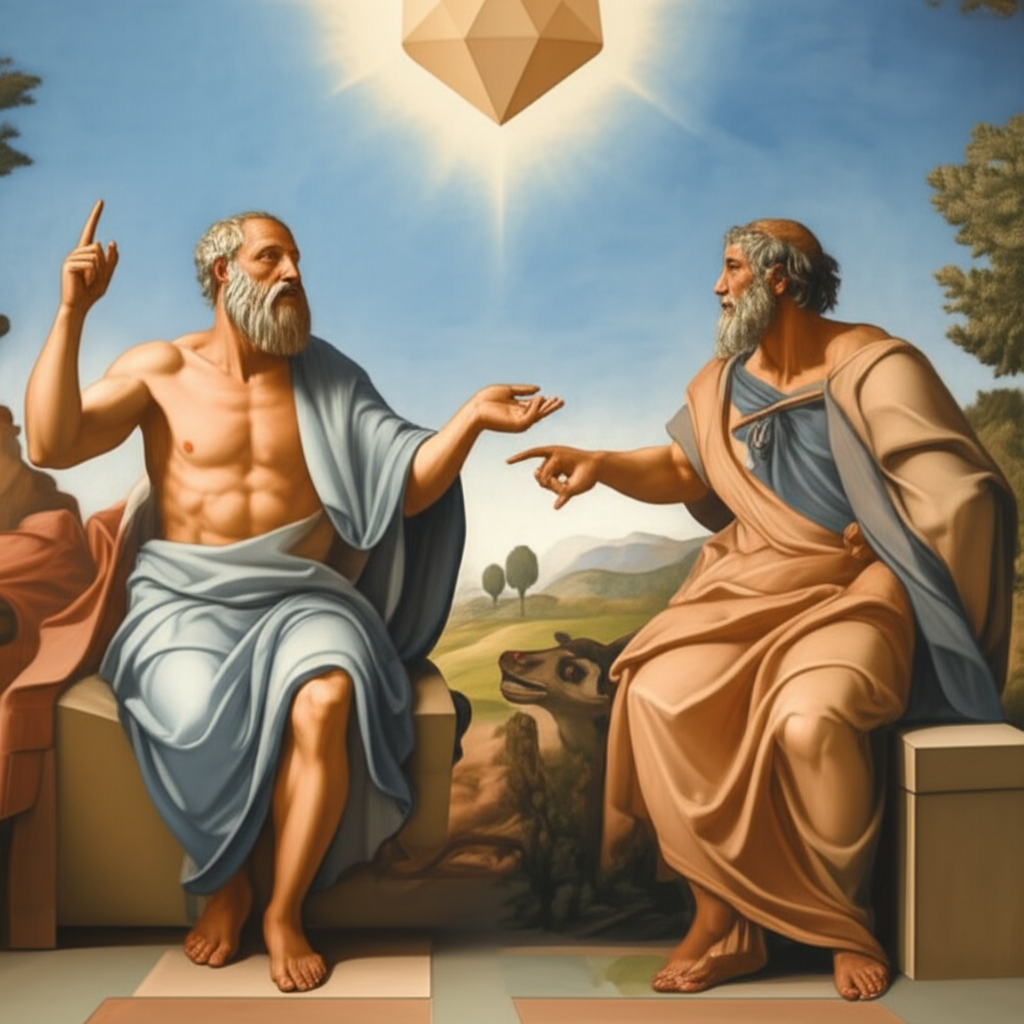
Plato posited a dual reality:
- The World of Forms (The One): This is a transcendent realm of perfect, eternal, and unchanging essences (e.g., the Form of Beauty, the Form of Justice, the Form of the Good). These Forms are the true Being and provide the blueprint and intelligibility for everything in the sensible world. Each Form is a perfect One.
- The World of Particulars (The Many): This is the sensible world we inhabit, characterized by change, imperfection, and multiplicity. Individual beautiful objects, just actions, or good things "participate in" or "imitate" their corresponding Forms.
For Plato, the relation between the One (Forms) and the Many (particulars) is one of participation or imitation. The Forms provide the unity and intelligibility that allow us to group diverse particulars under a single concept. Without the Form of "Humanity," for instance, the multitude of individual humans would lack a shared essence.
Aristotle's Substance and the Immanent One
Aristotle, Plato's most famous student, offered a different approach, seeking to locate the One within the Many rather than in a separate realm. For Aristotle, the primary Being is the individual substance — the concrete, particular thing (e.g., this specific horse, this specific human).
He argued that each substance is a compound of:
- Form (Actuality): The essence or "whatness" of a thing, its defining characteristics. This is the unifying principle that makes a thing what it is.
- Matter (Potentially): The stuff out of which a thing is made, which has the potential to take on various forms.
For Aristotle, the relation between the universal (Form) and the particular (Matter) is immanent; the Form is not separate from the individual substance but is inherent within it. The unity of a particular Being comes from its specific form, which organizes its matter into a coherent whole. The Many are unified by shared forms (species) but remain distinct as individual substances. The problem of the One and Many is thus addressed by understanding how universals exist in particulars.
The Enduring Challenge of Relation
The Metaphysical Problem of the One and Many continues to animate philosophical discourse because the question of how particulars relate to universals, or how diversity relates to unity, remains profoundly challenging.
- Is the One prior to the Many (e.g., a single God creating the universe)?
- Is the Many prior to the One (e.g., unity as an emergent property of complex interactions)?
- Are they co-dependent, each defining the other?
This fundamental inquiry permeates various fields:
- Philosophy of Mind: How does the unified experience of consciousness arise from the diverse activities of billions of neurons?
- Science: How do the fundamental particles (the Many) combine to form stable, identifiable objects (the One)?
- Ethics and Politics: How can individual liberties (the Many) be reconciled with the common good of society (the One)?
The quest to understand the relation between these two poles of existence is not just about abstract thought; it’s about constructing a coherent picture of reality that accounts for both the profound diversity we experience and the underlying order we intuit.
YouTube: "Parmenides Heraclitus One Many"
YouTube: "Plato Aristotle Forms Substance"
📹 Related Video: What is Philosophy?
Video by: The School of Life
💡 Want different videos? Search YouTube for: "The Metaphysical Problem of the One and Many philosophy"